

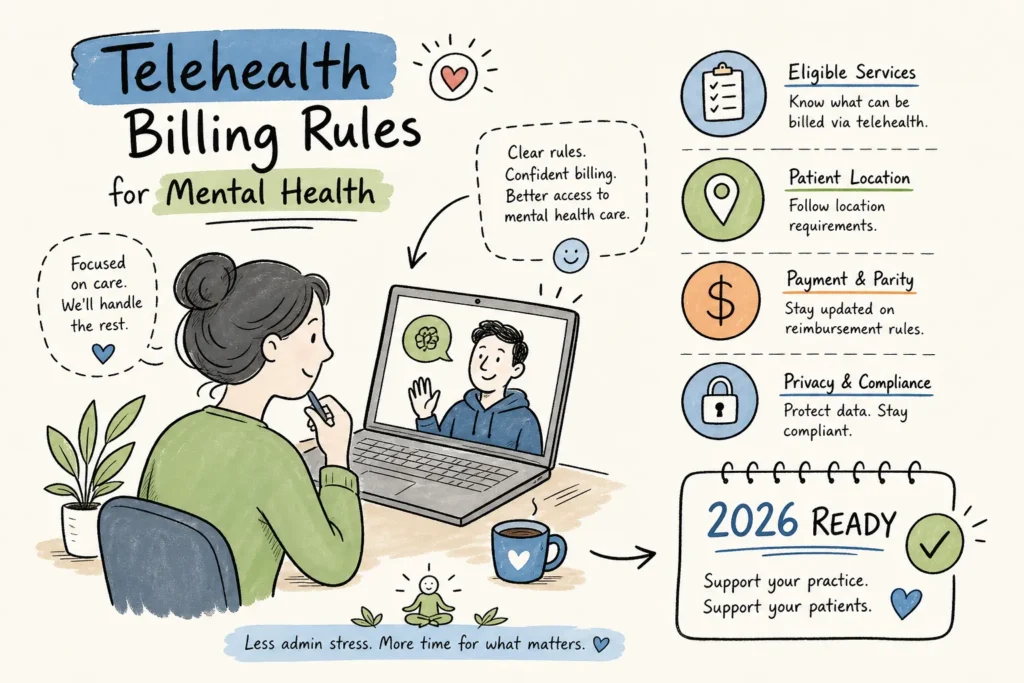
Telehealth coverage for mental health services remains broad in 2026, and that’s genuinely good news for providers and patients alike. The challenge is that the billing rules sitting underneath that coverage have grown more layered with each CMS update cycle, adding new modifier requirements, FQHC/RHC billing instructions, and place-of-service clarifications that weren’t factors even two years ago. A therapist or psychiatrist who billed telehealth without issue in 2024 can easily find themselves staring at a stack of denials today if they haven’t kept pace with the changes now in effect.
This guide is built specifically for mental health providers and their billing teams. At WeBill Health, we work with behavioral health practices across the country, and the rules covered below are the ones generating the most confusion and unnecessary revenue loss in 2026. If you want a quick primer on the most common pitfalls and fixes, see our Top 5 Behavioral Health Billing Challenges & Solutions.
What are the telehealth billing rules for mental health providers in 2026?
The short answer: the 2026 telehealth billing rules for mental health providers require correct modifier selection (95 for audio-video, 93 for audio-only), accurate place-of-service coding (POS 10 or POS 02), documented justification for audio-only sessions, and separate workflows for Medicare, state Medicaid, and commercial payers. The sections below break each of those requirements down in full.
What the 2026 CMS updates mean for mental health telehealth
Medicare has extended telehealth coverage for mental health services through December 31, 2027 (per CMS guidance on telehealth services under the Medicare program). That extension is real and significant, but it comes with conditions that not every provider is tracking closely. For most practices billing in 2026, CMS has clarified that the in-person visit requirement is not enforced during the current extension period, which runs through the end of 2027.
The in-person visit timing rule you still need to understand
When the waiver period eventually ends, the underlying statutory rule requires an in-person, non-telehealth visit within six months before a patient’s first telehealth mental health service and at least once every 12 months after that. CMS has confirmed that any beneficiary who began receiving mental health telehealth services on or before December 31, 2027 is treated as an established patient, meaning the six-month “start-up” visit rule does not apply to them, they fall under the 12-month ongoing visit framework instead. Knowing this now matters because your documentation practices need to be ready for when the rule does activate.
FQHC and RHC billing: behavioral vs. non-behavioral telehealth in 2026
CMS treats these two categories differently, and conflating them is a billing error that many FQHCs and RHCs make. Behavioral health telehealth at FQHCs and RHCs is billed like an in-person visit under the FQHC prospective payment system (PPS) or the RHC all-inclusive rate (AIR). You do not use G2025 for behavioral health telehealth services at FQHCs or RHCs. Non-behavioral telehealth is handled differently: G2025 applies through December 31, 2026, but starting October 1, 2026, CMS has issued updated instructions directing FQHCs and RHCs to bill the individual CPT or HCPCS code for the service plus the applicable telehealth modifier, rather than a single G2025 line item. (See CMS FAQs on FQHC and RHC telehealth billing for the specific guidance on both the G2025 applicability period and the October 2026 instruction.) If your practice spans both categories, you need separate workflows for each.
CPT codes, modifiers, and place of service: getting the basics right
This is where the majority of telehealth billing errors originate. The psychotherapy codes themselves haven’t changed dramatically, but modifier and place-of-service reporting errors remain the fastest route to a denial or a payer audit. Getting these elements aligned on every claim is the difference between payment and a denial.
Core psychotherapy codes for telebehavioral health
The time-based psychotherapy codes most commonly used in Medicare telehealth billing for mental health are 90832 (16 to 37 minutes), 90834 (38 to 52 minutes), and 90837 (53 or more minutes). These are the same codes used for in-person sessions. The difference is entirely in how the claim is reported, which means your documentation of session time needs to be precise, code selection is driven directly by that time documentation. For a deeper look at code selection and documentation expectations, review our Mental Health Billing Codes: 2026 Guide for Providers.
Modifier 95 vs. modifier 93: which one applies to your session
Per CMS billing instructions, modifier 95 applies to real-time, synchronous audio-video sessions. Modifier 93 is used for audio-only sessions, though acceptance of modifier 93 can be payer-dependent, so confirm with each payer before assuming it applies. Using the wrong modifier is a direct denial trigger, and payers cross-reference the modifier against the place-of-service code on the claim. If these two elements don’t align with each other and with your documentation, the claim fails. The modifier must accurately reflect the technology used for that specific session.
Place-of-service codes and why they need to match the claim
For Medicare telehealth mental health claims, use POS 10 (Telehealth Provided in Patient’s Home) when the patient is at home and POS 02 (Telehealth Provided Other Than in Patient’s Home) when the patient is at a non-home location such as a clinic, school, or facility. The place-of-service code must be consistent with the modifier used and with the patient location documented in the clinical note. A claim showing modifier 93 (audio-only) with the patient documented as being at home but coded under POS 02 creates an internal inconsistency that payers flag immediately. If you need technical guidance on how payers interpret POS and modifier combinations for Medicare, this telehealth place-of-service coding guidance for Medicare is a helpful reference.
E/M and psychotherapy on the same day: the bundling rules psychiatrists need to know
Same-day E/M and psychotherapy billing is where some of the most nuanced and frequently misapplied rules live. This is especially relevant for psychiatrists who provide medication management and psychotherapy in a single session. The bundling rules aren’t new, but in our experience working with psychiatric practices, they remain a leading cause of claim denials and audit exposure in psychiatric billing.
When to use MDM vs. time for E/M selection
For standalone medication management visits, psychiatrists can select the E/M level using either medical decision-making (MDM) or total time on the date of the encounter. When a psychotherapy add-on is also being billed on the same day, the E/M code must be selected by MDM only, per CMS guidance and CPT E/M instructions for combined service reporting. Time cannot be used for E/M selection in that combined service scenario because time can’t split cleanly between the E/M component and the psychotherapy component. This is a rule many psychiatric billing teams still get wrong, and it creates bundling denials that are entirely avoidable.
Add-on codes 90833, 90836, and 90838 and how modifier 25 applies
When a psychiatrist provides both medication management and psychotherapy in the same session, the psychotherapy add-on codes are 90833 (16 to 37 minutes of therapy time), 90836 (38 to 52 minutes), and 90838 (53 or more minutes). Modifier 25 goes on the E/M code to signal that a significant, separately identifiable evaluation and management service was provided in addition to the psychotherapy. Without documentation clearly supporting two distinct services, payers will bundle the codes and deny the add-on. The documentation must show that the E/M work and the psychotherapy work were genuinely separate clinical activities during that session.
Audio-only mental health telehealth rules in 2026
Audio-only telehealth for behavioral health remains one of the most misunderstood areas of the 2026 ruleset. CMS does allow it, but under specific conditions that need to be documented clearly, or the claim will not survive a payer review. Treating audio-only as a blanket permission is how practices end up with post-payment audit exposure.
When Medicare covers audio-only for mental health services
Medicare allows audio-only for behavioral health telehealth when two conditions are both true: the patient is at home, and the patient cannot or declines to use video technology. The practitioner must also be technically capable of providing audio-video. The practical implication is that you can’t use audio-only simply because it’s more convenient. The clinical rationale and the patient’s preference must be documented in the visit note using language that reflects the CMS framework. A straightforward documentation statement aligned with CMS guidance would read: “Patient declined video visit; patient does not consent to audio-video communication technology. Audio-only behavioral health telehealth provided; clinician technically capable of audio-video communication. Patient located in home.” For an accessible overview of Medicare telehealth policy and how it applies to behavioral health, see these Medicare telehealth resources.
What a compliant telebehavioral health chart note looks like
CMS and most payers expect the following core elements in a telebehavioral health note: the reason telehealth was used, the modality (video or audio-only), the patient’s location, the provider’s location, confirmation that consent was obtained, who participated in the session, any technical issues that arose, and the clinical documentation that supports the CPT code billed. Informed consent for telehealth can be obtained verbally, but it must appear in the medical record. That entry doesn’t need to be lengthy, it needs to be present and specific enough to demonstrate it actually happened.
State Medicaid and private payer compliance in 2026
Medicare rules establish the federal floor, but state Medicaid programs and commercial payers frequently apply requirements that are stricter or simply different. Providers who assume that Medicare compliance equals full compliance discover this during audits or when MCO denials start stacking up.
Where state Medicaid rules diverge from Medicare for behavioral health
The key areas where states vary from the Medicare framework are worth tracking specifically:
- Whether audio-only is covered and under what clinical conditions
- Whether an in-person visit is required before telehealth treatment begins
- Which CPT codes appear on the state’s approved telehealth list
- Whether Medicaid managed-care plans (MCOs) apply claim edits that are stricter than the state’s fee-for-service policy
That last point catches many practices off guard. A behavioral health telehealth claim can be fully payable under FFS Medicaid and still be denied by an MCO operating in that same state, because the MCO’s internal policies may be narrower. Virginia and Ohio are examples of states that publish explicit behavioral health telehealth billing guidance: Virginia maintains a telehealth supplement listing covered mental health and substance use disorder services, and Ohio publishes 2026 behavioral health telehealth billing instructions specifying POS and modifier requirements by service type. Your starting point for any state should be the state Medicaid provider manual, the behavioral health billing guide, and each MCO’s provider handbook. See the Medicaid telehealth reimbursement guidelines for federal-level reimbursement and provider guidance to use as a baseline.
Private payer parity laws and what they actually mean for your claims
Telehealth parity laws exist in most states but vary significantly in what they actually require. Some states mandate full coverage parity, meaning telehealth must be covered on the same terms as in-person care. Others limit parity to coverage only and still allow payers to apply different utilization management rules, prior authorization requirements, or reimbursement rates. Commercial payers commonly require HIPAA-compliant platforms, documented patient consent, and proof of medical necessity on telebehavioral health claims. Practices billing across multiple states need consistent payer verification processes to stay ahead of these differences. That’s where partnering with a billing team that actively tracks payer-specific telehealth rules prevents compliance gaps before a denial wave hits.
The bottom line on 2026 telehealth billing for mental health
The 2026 telehealth billing rules for mental health providers are manageable, but they require active attention. CMS keeps extending coverage while layering on new conditions. State Medicaid programs and commercial payers add their own requirements on top of that. The cost of getting it wrong compounds quickly, through claim denials, delayed payments, or audit exposure that requires retroactive remediation.
The practices that stay ahead of these rules don’t necessarily have more staff or bigger budgets. They have better systems and better support. If telehealth billing compliance is pulling your focus away from patient care, that’s a problem worth solving now rather than after a payer audit forces your hand.
WeBill Health works with behavioral health practices on telehealth billing compliance across payers and states. If you want to make sure your 2026 telehealth claims are clean before they go out the door, reach out to our team and we’ll show you exactly where your current process has exposure. Learn how our smarter behavioral health billing support helps practices reduce denials and improve cash flow.