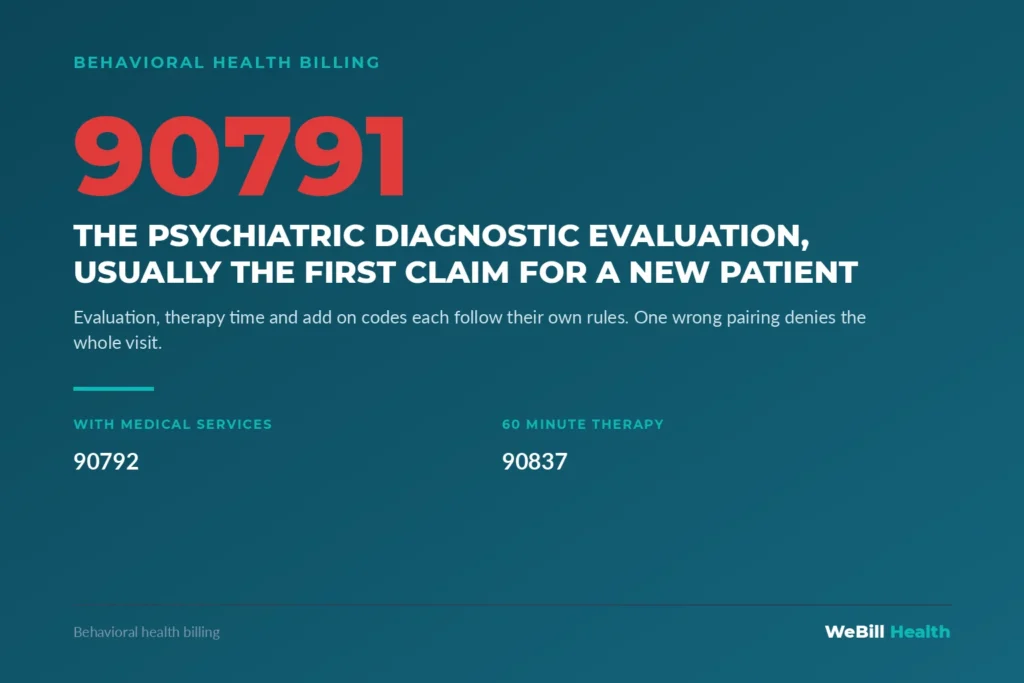
Behavioral health billing runs on a different rulebook than medical or surgical billing, and many general billing guides don’t cover the nuances that actually cause denials for therapists, counselors, and psychiatry practices. A misapplied psychotherapy code, a missing telehealth modifier, or a clinical note that doesn’t document start and stop times can delay payment or trigger a denial that’s difficult to reverse. Those aren’t edge cases. They’re the patterns clinics face every single billing cycle.
This article is the clinic-ready reference for getting it right before the claim goes out. At WeBill Health, we work specifically with behavioral health and telehealth practices navigating these exact challenges, so everything here reflects what actually happens when claims hit payer adjudication systems. Use this as your 2026 playbook.
Behavioral health billing: the core CPT codes your practice uses most
Code selection is the foundation of clean claims in behavioral health billing. Behavioral health uses a mix of CPT codes for professional services and HCPCS H-codes for Medicaid-covered programs. Using the wrong category is one of the top denial triggers, especially for practices that treat across funding sources.
Individual psychotherapy and psychiatry visit codes
For outpatient individual psychotherapy, the primary codes are 90832, 90834, and 90837, selected by the documented session time (more on that in the next section). Psychiatrists billing evaluation and management visits use the 99202 to 99215 code set instead. Therapists and prescribers often bill different code sets for the same clinical encounter because one is providing psychotherapy while the other is managing medication. Knowing which code set applies to which clinician avoids bundling problems from the start.
One code pair that clinics consistently underuse is 90839/90840 for crisis psychotherapy. Code 90839 covers the first 30 to 74 minutes of a crisis intervention, and 90840 is the add-on for each additional 30 minutes. When a clinician provides genuine crisis services and bills a routine psychotherapy code instead, the practice leaves reimbursement in denied or underbilled claims.
Group therapy, SUD treatment, and community-based service codes
For group psychotherapy, use 90853. Multiple-family group therapy bills under 90849, which CMS added to the permanent Medicare telehealth list for 2026, so it can now be delivered virtually to Medicare beneficiaries without the temporary extension rules. For SUD and community behavioral health, the primary HCPCS H-codes are H0004 (individual counseling), H0005 (group counseling), and H0015 (intensive outpatient treatment).
Codes 99408 and 99409 cover brief substance misuse screening and intervention and are broadly accepted by commercial payers. Note that Medicare more commonly processes SBIRT services under G0396 and G0397 instead of 99408/99409, so verify payer-specific acceptance before submitting.
Medicaid-funded programs often require H-codes even when a CPT code exists for the same service type. If your practice serves Medicaid beneficiaries in a community behavioral health or SUD treatment context, verify with the specific state plan or managed care plan which code set is accepted before submitting.
Key modifiers that change how payers process your claim
Modifier 25 is not required by CPT when a prescriber bills an E/M visit with the psychotherapy add on codes 90833, 90836 or 90838, and Medicare does not require it either; some commercial plans, such as Blue Shield of California, still do, so check each contract. For Medicare telehealth, modifier 95 marks an audio and video visit and modifier 93 marks an audio only visit; GT is no longer a Medicare professional telehealth modifier. Medicaid plans set their own modifier rules. Modifier 59 separates distinct procedural services billed on the same claim when payer bundling rules would otherwise combine them.
The wrong modifier, or a missing one, generates a bundling denial or a telehealth reimbursement rejection. Neither of those is a clinical dispute. Both are fixable before the claim goes out.
How Medicare, Medicaid, and commercial payers handle behavioral health claims differently
The same CPT code can be covered, denied, or paid at a different rate depending on which payer is adjudicating the claim. Behavioral health reimbursement is especially fragmented because payers apply different medical necessity standards, credentialing requirements, and authorization thresholds. Verifying the applicable rules before submission is the only way to catch mismatches before they become denials.
Medicare coverage updates and telehealth rules for 2026
CMS expanded the permanent telehealth list for behavioral health in 2026, including the addition of 90849 for multiple-family group psychotherapy. Audio-only mental health services remain available under specific Medicare conditions, primarily for patients who lack access to video technology.
Opioid Treatment Programs operate under a bundled weekly payment model per CMS reimbursement guidelines, which means separate billing for services inside that bundle triggers automatic denials. Provider type also determines payment: psychologists, clinical social workers, MFTs, and MHCs are each covered under different Medicare enrollment categories, and billing under the wrong provider type causes credentialing-related denials.
For detailed operational guidance on telehealth and remote monitoring rules, review the CMS guidance on telehealth and remote monitoring, which clarifies modality, consent, and documentation expectations for Medicare.
Medicaid state variations and managed care complications
Medicaid billing rules vary by state and by managed care plan within the same state. Licensed provider eligibility, covered CPT codes, and telehealth reimbursement rules are all state-dependent. Some states let counselors and family therapists bill Medicaid directly, while others restrict direct billing to specific credential types or program settings. Managed care Medicaid plans often layer additional prior authorization and outcomes-reporting requirements on top of the state fee-for-service plan. Billers must verify the applicable benefit design before assuming coverage transfers from one plan to another.
For an in-depth review of state-level prior authorization trends and policy implications, see the MACPAC report on prior authorization in Medicaid, which highlights common authorization drivers and variation across programs.
Commercial payer requirements and prior authorization triggers
Commercial payers use proprietary medical necessity criteria, including tools like MCG and InterQual, and apply them unevenly across service types. Intensive outpatient programs, partial hospitalization, residential treatment, and neuropsychological testing are the service types most likely to require prior authorization. A significant share of those denials involves NQTLs, nonquantitative treatment limitations applied more strictly to behavioral health than to equivalent medical benefits.
MHPAEA, as amended by the Consolidated Appropriations Act of 2021, requires health plans to complete and document a comparative analysis for every NQTL they apply to behavioral health benefits. The federal departments are not enforcing the newer parts of the 2024 final rule and said on March 30, 2026 that they would issue a new proposed rule by December 31, 2026, but the statutory comparative analysis duty still applies. When a commercial payer denies an authorization or a claim using criteria that would not apply to a comparable medical service, that denial can be appealed on parity grounds. Many small practices underutilize MHPAEA parity appeals, and building that step into your denial workflow can meaningfully shift outcomes.
For practical compliance guidance on MHPAEA implementation and steps payers and providers should consider, review these practical pointers for MHPAEA compliance from a specialty legal perspective.
Behavioral health billing: time-based coding and telehealth modifiers explained
Wrong time-threshold selections and misapplied telehealth modifiers are the two most fixable coding errors in behavioral health billing, and both show up in the same predictable ways. Neither requires a clinical review to resolve. Both can be caught before the claim goes out.
Selecting the right psychotherapy code by documented session time
Codes 90832, 90834, and 90837 are not interchangeable. The correct code is determined by the documented psychotherapy minutes in the clinical note, not by the scheduled appointment length. Sixteen to 37 minutes maps to 90832, 38 to 52 minutes to 90834, and 53 minutes or more to 90837. Billers must pull the documented start and stop times from the note itself before selecting the code. Using the calendar appointment duration instead of the documented time is a reliable path to a denial.
Add-on codes and same-day E/M with psychotherapy
When a prescriber provides both medication management and psychotherapy in the same session, the add on codes 90833, 90836 and 90838 pair with the E/M visit. The E/M level is chosen by medical decision making, and the psychotherapy minutes are documented separately in the note. CPT does not require modifier 25 on the E/M in this pairing, though some commercial plans ask for it. The add on codes cannot stand alone; the E/M code must be on the same claim.
Telehealth modifiers: when to use 95 or 93 and which POS to apply
For Medicare, modifier 95 marks a synchronous audio and video visit and modifier 93 marks an audio only visit. Place of service 10 applies when the patient is at home and 02 when the patient is somewhere else. GT is no longer a Medicare professional telehealth modifier, and Medicaid and commercial plans set their own rules, so confirm each payer’s requirement before submitting. Mismatching the place of service and modifier generates telehealth rejections that need a corrected claim.
Does modifier 25 go on an E/M billed with psychotherapy?
No, CPT does not require modifier 25 when an E/M visit is billed with the psychotherapy add on codes 90833, 90836 or 90838, because the add on codes are built to pair with the E/M. The American Psychiatric Association wrote to Blue Shield of California on July 14, 2026 objecting to a policy that requires it, so check each commercial contract before you change your billing.
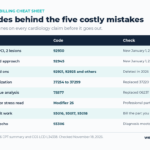
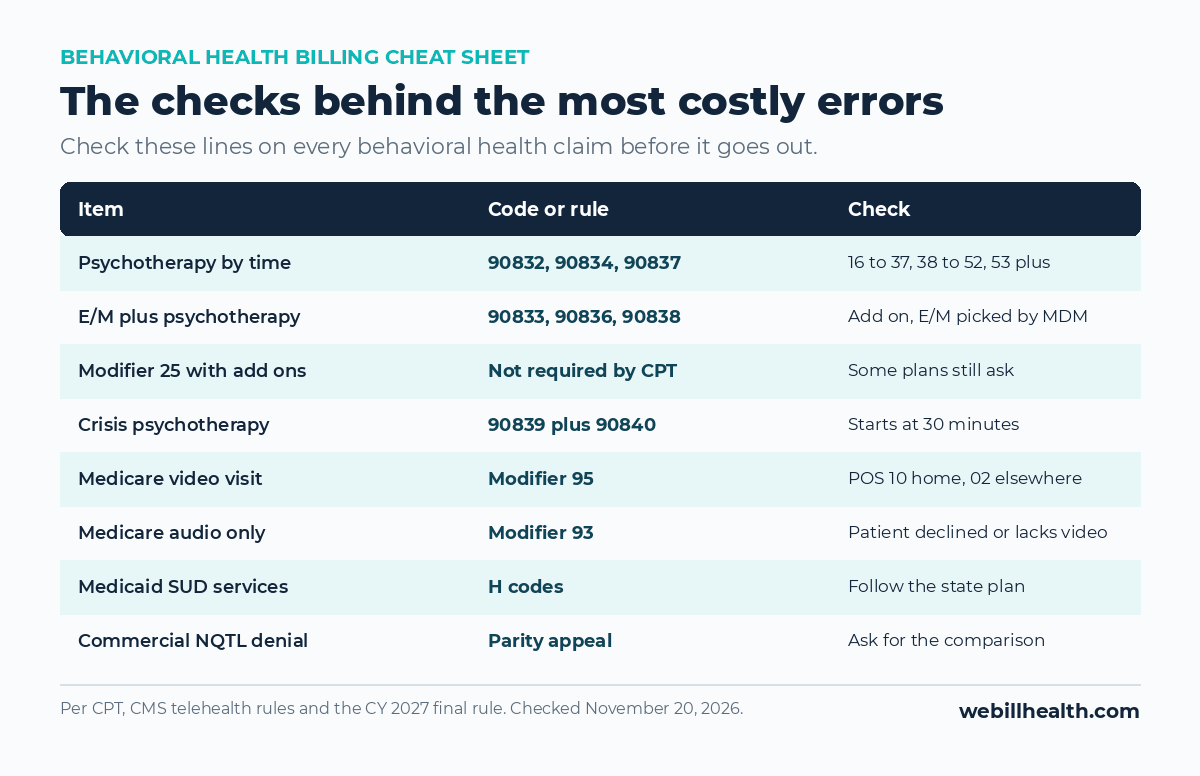
Behavioral health billing cheat sheet: what to check on every claim
These are the lines to check on every behavioral health claim, because each one sits behind a common denial.
| Item | Code or rule | What to check |
|---|---|---|
| Psychotherapy by time | 90832, 90834, 90837 | 16 to 37, 38 to 52, 53 minutes or more |
| E/M plus psychotherapy | 90833, 90836, 90838 | Add on codes; E/M level picked by medical decision making |
| Modifier 25 with add on codes | Not required by CPT | Some commercial plans still ask for it |
| Crisis psychotherapy | 90839 plus 90840 | First 30 to 74 minutes, then each added 30 |
| Medicare video visit | Modifier 95 | POS 10 at home, POS 02 elsewhere |
| Medicare audio only visit | Modifier 93 | Patient lacks or declines video |
| Medicaid SUD services | H codes such as H0004 | Follow the state plan |
| Commercial NQTL denial | Parity appeal | Ask for the medical and surgical comparison |
What changes for behavioral health billing in 2027?
For 2027, the Medicare in person visit requirement for mental health telehealth stays delayed until January 1, 2028, and audio only telehealth stays covered through 2027. CMS finalized both in the CY 2027 physician fee schedule final rule released November 4, 2026, along with a lower conversion factor. See the 2027 physician fee schedule final rule.
What your documentation must show to survive payer review
Payers and auditors aren’t only checking that a session occurred. They’re reviewing the note for evidence that the service was medically necessary, that the clinician was qualified to render it, and that the service type matches what was billed. Documentation gaps are the single most preventable source of behavioral health claim denials.
The clinical record elements payers audit most often
Every note supporting a behavioral health claim should include all of the following:
- Date of service with documented start and stop times
- Rendering provider identity and licensure
- Diagnosis with functional impairment documented
- A clear description of the service type and interventions delivered
- The patient’s response to treatment
- An ongoing treatment plan with measurable goals
For medical necessity to hold up on appeal, the note must show symptom severity, risk level, and why a lower level of care was not sufficient for this patient at this point in treatment.
Telehealth credentialing and consent documentation requirements
In most cases, the rendering clinician must be licensed in the state where the patient is physically located at the time of service, and that may differ from where the practice is based. This is the standard operational requirement across Medicare, Medicaid, and most commercial payers, though specific telehealth allowances vary by payer policy and state law, verify current requirements before assuming coverage. Most payers also require documented patient consent for telehealth delivery, and the modality used, audio-video versus audio-only, must be reflected in the clinical note.
Behavioral health billing denials: common causes and the appeal steps that reverse them
Most behavioral health billing denials trace back to a short list of fixable problems. Practices that categorize their denials by root cause and build upstream fixes stop fighting the same denials month after month instead of treating each one as a standalone event.
The denial causes you can prevent before the claim goes out
The most common preventable denial triggers fall into five categories: missing or expired prior authorization, eligibility or benefit coverage mismatches, behavioral health coding errors (wrong CPT, modifier, or ICD-10 code), timely filing failures, and provider credentialing or taxonomy mismatches. Reading the CARC and RARC codes on the remittance advice is the fastest way to classify a denial as administrative (correctable with a corrected claim) or clinical (requires an appeal with supporting documentation). Skipping that classification step and jumping straight to a generic appeal letter adds weeks to the resolution cycle.
Appeal frameworks for medical necessity, prior auth, and parity denials
Behavioral health practices use three appeal types most often. The first is corrected claim submission for administrative errors: wrong code, missing modifier, or taxonomy mismatch. The second is a medical necessity appeal, which needs clinical language that ties symptoms to functional impairment and demonstrates why the requested level of care was the least intensive appropriate option. The third is a MHPAEA parity appeal, used when a commercial payer applied stricter criteria to a behavioral health service than it would to a comparable medical or surgical benefit. Parity appeals are most effective when they specifically ask the payer to disclose the comparable medical/surgical standard it used and to re-adjudicate the claim under a parity-compliant review.
Appeals succeed most consistently when they’re submitted promptly, include the exact documentation the denial letter cited as missing, and reference the payer’s own clinical criteria in the appeal letter. Practices with high denial volumes benefit from systematic appeal workflows instead of handling each case in isolation. Building that kind of infrastructure takes time, which is where a specialized billing partner adds the most value. WeBill Health supports behavioral health practices with denial pattern analysis, specialty-specific appeal templates, and a team that understands how payer-side utilization management works for BH claims.
For a practical reference that covers common denial codes, documentation requirements, and appeal strategies, consult this comprehensive guide to behavioral health billing, which highlights denial drivers and remediation tactics specific to behavioral health practices.
Build clean claims before you fight bad denials
Behavioral health billing is manageable when clinicians and billers understand the specific rules that apply to their service types and payers. The issues that drive most behavioral health billing denials, wrong codes, missing modifiers, underdocumented notes, and failed prior authorizations, are all preventable with the right processes in place.
Start by auditing your most denied codes and verifying your telehealth modifier usage against each payer’s current requirements. Check that your clinical notes document start and stop times consistently and that every E/M and psychotherapy combination uses modifier 25 correctly. Those two steps alone will reduce your denial volume.
For practices where the administrative burden outweighs internal capacity, working with a billing partner that specializes in behavioral health revenue cycle management means recovering revenue that’s sitting in denied or underbilled claims. WeBill Health works with behavioral health, mental health, and telehealth practices across the U.S. to reduce denials, manage appeals, and keep cash flow moving. Reach out to WeBill Health to talk through what’s driving your denials and what a specialized behavioral health billing partnership looks like for your practice.
Sources
- American Psychiatric Association, letter to Blue Shield of California on psychotherapy add on codes and modifier 25, July 14, 2026
- Holland & Knight, CMS issues CY 2027 Medicare physician fee schedule final rule, November 13, 2026
- Baldwin Group, Mental health parity update on the March 30, 2026 joint status report
- First Coast Service Options, Telehealth services and modifiers 93 and 95, accessed November 20, 2026
Want to know where your practice is losing revenue? Request your Revenue Defense Audit and we will review your denials, A/R and payer mix by payer, code and reason. For a quick read first, get your Revenue Defense Score in 60 seconds.
Frequently Asked Questions
Which codes do behavioral health practices bill most?
Psychotherapy codes 90832, 90834 and 90837 by session length, diagnostic evaluations 90791 and 90792, and HCPCS H codes for many Medicaid programs. Billing a CPT code where Medicaid expects an H code is a common denial trigger.
How are psychotherapy session times coded?
CPT uses time ranges: 90832 for 16 to 37 minutes, 90834 for 38 to 52 minutes, and 90837 for 53 minutes or more. Notes must show start and stop times or total time to support the code billed.
Which modifier goes on telehealth therapy claims?
Modifier 95 for synchronous audio and video sessions and modifier 93 for audio only, along with the place of service code the payer requires, usually 02 or 10 for Medicare. Commercial rules vary, so confirm them plan by plan.