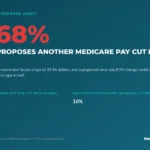
The final 2027 Medicare Physician Fee Schedule lowers the main conversion factor to $32.63, down 2.31% from $33.40, according to the CMS fact sheet released November 4, 2026. It also cuts payment by 20% for the lower valued service when an office visit and a zero day global procedure happen on the same day. Both changes start January 1, 2027.
How much will Medicare pay per RVU in 2027?
Most practices will get $32.63 per RVU in 2027. Clinicians who qualify as Advanced APM participants get $32.95, down 1.83% from $33.57.
The drop comes from a few pieces. The statutory update is only 0.25% for most clinicians and 0.75% for qualifying APM participants. CMS also took 0.12% off to offset work RVU changes for some codes. The biggest piece is the end of the one year 2.50% bump Congress passed for 2026. CMS says that loss works out to a 2.50% pay cut next to 2026.
The final rule does not add a new efficiency adjustment for 2027. CMS applied a 2.5% efficiency adjustment to many work RVUs at the start of 2026 and plans to revisit it every three years, so the next round is expected in CY 2029 rulemaking.
What happens when an office visit and a minor procedure happen on the same day?
Medicare will pay the highest valued service in full and pay every other service that day at 80%. This applies when an office or outpatient E/M visit is billed on the same day as a procedure with a zero day global period, by the same practitioner or a practitioner of the same specialty in the same group.
CMS first proposed a 50% cut and wanted it to cover 10 day and 90 day global procedures too. Then it got what the rule calls an “overwhelming response” from commenters. CMS dropped the 10 day and 90 day globals and cut the reduction to 20%. The CMS press release groups the change with its push to curb duplicate billing for work that overlaps between the two services.
For a dermatology, orthopedic, podiatry or pain practice, this matters every clinic day. A typical case is a visit plus a joint injection, a skin biopsy or a lesion destruction. Under the new rule, one of those lines will pay 20% less than it does today, even with modifier 25 billed correctly.
What replaces the G2211 add on code?
G2211 becomes modifier B1, which adds 16% to the payment for the associated E/M visit at every level. You bill it in the same situations where you bill G2211 today, but it now sits on the E/M claim line instead of a separate line.
CMS also created modifier B2, which adds 32% to the E/M payment. It is voluntary and only open to practitioners in a Medicare Shared Savings Program ACO or a LEAD Model ACO. A practitioner in one of those ACOs can bill B2 for every beneficiary they serve, and those claims count toward ACO assignment and spending calculations.
Check that your billing system takes B1 on E/M lines before January 1. Ask your MACs and payers how they will treat claims that still carry G2211 as a separate line after that date.
What else changes for remote monitoring, advance care planning and group visits?
Several smaller coding changes also start in 2027. The ones that touch most outpatient practices are below.
- Remote therapeutic monitoring is limited to established patients, and both RPM and RTM now require a separately reportable initiating visit when monitoring starts.
- The rule that only practice employed clinical staff can furnish RPM and RTM is delayed to January 1, 2029.
- New codes G0572 and G0573 pay for advance care planning time by clinical staff under direct supervision. CPT 99497 and 99498 are now limited to the billing practitioner’s own time.
- Shared medical appointments get their own codes and payment, with an add on code for extra time.
- Collaborative Care work RVUs go up. Smoking cessation and SBIRT codes join the last year of the timed behavioral health code shift.
- New add on codes pay for work on vaccine adverse effects that goes beyond the E/M visit.
Does telehealth still work the same way in 2027?
Mostly yes. The Consolidated Appropriations Act, 2026 keeps the Medicare telehealth flexibilities in place through December 31, 2027, and the final rule reflects that.
Patients can still be seen at home with no geographic limits, and the wider list of eligible practitioners stays. The in person visit requirement for telehealth mental health services is delayed to January 1, 2028, and audio only telehealth is extended to the same date. The rule also notes that the law requires CMS to set up new telehealth modifiers effective January 1, 2027, so watch for MAC guidance on when to append them.
What changes for MIPS and quality reporting?
Traditional MIPS reporting ends beginning with the CY 2031 performance period. That gives clinicians until CY 2030 to move to MIPS Value Pathways, two years more than CMS first proposed.
CMS finalized three new MVPs for diabetes, hypertension and hospitalists. Starting in CY 2027, clinicians must also report at least one specialty specific Core Measure. If you still report traditional MIPS, pick an MVP in 2027 and test it early.
What this means for practices with 1 to 15 providers
For a small practice, the 2027 rule hits revenue in two places. The rate per RVU falls 2.31%, and same day procedure visits lose 20% on one line. A family medicine group that bills G2211 often may see part of the loss offset by B1. A procedure heavy specialty group will feel the full weight of both cuts.
Here is a practical list to work through before January 1:
- Pull your top 20 Medicare codes by volume and reprice them at $32.63 per RVU using the CY 2027 addenda CMS posted on November 5.
- Count how many 2026 encounters had an E/M visit with modifier 25 plus a zero day global procedure. Multiply the lower valued line by 20% to estimate your yearly exposure.
- Update your charge master and claim templates so G2211 is replaced by modifier B1 on January 1.
- If you are in an MSSP or LEAD ACO, decide whether your clinicians will bill B2 and confirm the ACO’s rules.
- Review RPM and RTM workflows so every new monitoring episode starts with an initiating visit.
- Train providers to document the separate E/M work on procedure days. A 20% reduction is a lot less painful than a full denial on audit.
- Check commercial contracts that pay as a percentage of Medicare. Many of them will follow these cuts automatically.
Payers often lag on new modifiers in January. Expect some B1 claims to reject in the first weeks of 2027 and plan to track them daily.
Frequently asked questions
When does the 2027 Physician Fee Schedule take effect?
The rule takes effect January 1, 2027. CMS put it on public display November 4, 2026, and it is set to appear in the Federal Register on November 9, 2026.
What is the 2027 Medicare conversion factor?
It is $32.63 for most clinicians and $32.95 for qualifying APM participants, according to CMS.
Did CMS finalize the 50% cut for same day E/M visits?
No. CMS finalized a 20% cut to the lower valued service, and only for procedures with a zero day global period.
Is G2211 going away?
The code is replaced by modifier B1, which pays 16% on top of the associated E/M visit. You bill it in the same situations as G2211.
Will telehealth visits still be paid at home in 2027?
Yes. Federal law extends the home and geographic flexibilities through December 31, 2027.
Can commercial payers follow these Medicare cuts?
Yes, if your contract pays as a percentage of the Medicare fee schedule. Check each contract’s update language now.
What should my practice do next?
The 2027 rule changes how much each claim is worth and how some claims must be built. WeBill Health checks every claim against internal payer rule libraries by specialty and carrier, with human review by coding experts before submission, and holds a 98% clean claim rate. ENT practices carry some of the heaviest same day overlap exposure under this rule. See the ENT billing defense page for how modifier 25 documentation applies to a scope procedure and office visit billed the same day, or the full practice level breakdown for the dollar impact on a 3 to 5 provider group. If you want to know how the new rates and the same day cut will hit your own numbers, start with a Revenue Defense Audit, or get your Revenue Defense Score in 60 seconds. We will show you where revenue is at risk in 2027 and how to defend it.
Sources
- CMS, Calendar Year (CY) 2027 Medicare Physician Fee Schedule Final Rule fact sheet, November 4, 2026
- CMS press release, CMS Finalizes CY 2027 Physician Fee Schedule, November 4, 2026
- CMS 1848 F final rule, Federal Register public inspection document 2026 22743
- CMS, CMS 1848 F rule page with addenda and telehealth list