
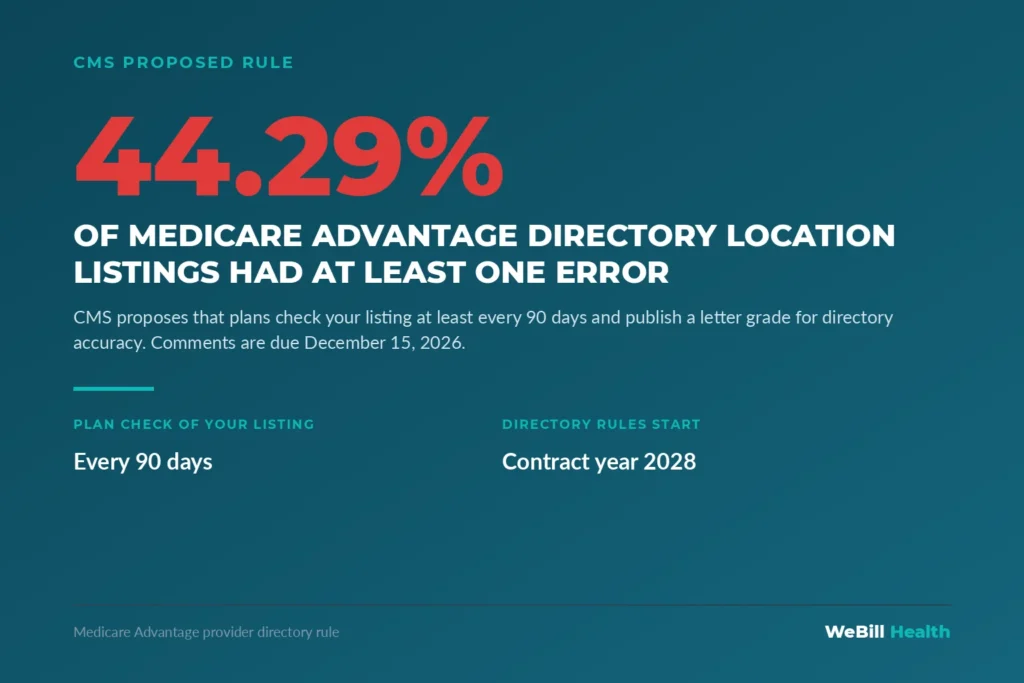
Medicare Advantage (MA) plans will have to check your directory listing at least every 90 days and post a letter grade for directory accuracy, under a CMS proposed rule published in the Federal Register on October 20, 2026. CMS reviews cited in the rule found that 44.29 percent of location listings had at least one error. Comments are due December 15, 2026.
What is the new MA provider directory rule?
It is a CMS plan to put the REAL Health Providers Act into force. Congress passed that law as section 6220 of the Consolidated Appropriations Act, 2026. The President signed it on February 3, 2026.
The rule goes after what many call ghost networks. These are plan lists that still show doctors who left the network, moved, retired or stopped taking new patients. CMS released the proposal on October 16, 2026. The same rule also covers pharmacy benefit manager pay and a $0 generic copay for some low income enrollees. The directory part is the piece that hits doctor offices.
The directory rules would start in contract year 2028. Public scores follow in 2029.
How often will plans have to verify my listing?
At least once every 90 days for most providers. CMS proposes a longer cycle of once every 12 months for acute inpatient hospitals, critical care services and surgical services such as ambulatory surgery centers.
Plans could check your data in a few ways. CMS lists plan records, phone or email, provider attestations, CMS data such as NPPES, and claims data. For a typical office, that means more calls, emails and portal attestations from every MA plan you work with.
CMS is also weighing a minimum time to reply. One example in the rule is 7 business days, with at least one reminder, before the plan tries another way to check.
What happens if my practice does not respond?
Your listing would carry a warning. If a plan cannot check your data in a cycle, it must show this note by your name: “The provider’s information may not be up to date.”
The draft text does not say plans must drop providers who fail to reply. Still, a warning by your name can steer new patients to another office. Plans must take the flag down once they confirm or update your data.
The rule also sets clocks for plans. They must fix a listing within 30 days of getting new data. They must remove a provider within 5 business days of finding that the provider has left the network.
What information will my listing have to show?
CMS proposes nine basic data points. They include:
- Provider name and specialty
- Contact information
- Whether you are accepting new patients
- Access features for patients with disabilities
- Languages and cultural skills
- Whether you offer telehealth
- A disclosure when the provider is under common ownership or control with the plan or its parent company
Each of these can go stale fast in a small office. A new phone line, a closed second site or a doctor who stops taking new patients all count.
How will CMS grade directory accuracy?
Each plan must test a random sample of its providers each year. The result becomes a score shown as a letter grade.
Under the proposal, 65 percent of the sample would come from providers in general. The other 35 percent would come from fields with high error rates. For now, CMS names mental health and substance use care for that group, with Medicare specialty codes such as Psychiatry (26), Psychologist (62), Licensed Clinical Social Worker (80) and Addiction Medicine (79).
CMS says it weighed a 45 percent error line for naming a high error field. Primary care doctors, heart doctors and cancer doctors would meet that bar. CMS did not add them yet, but says they are still in play.
Plans must show their grade in plain view in their directories. CMS will also post the scores as data files.
Why is CMS doing this now?
Its own reviews found errors everywhere. CMS checked 142 MA plans, 11,360 providers and 18,852 locations. It found that 44.29 percent of location listings had at least one error.
The rule also cites 2025 work by the HHS Office of Inspector General (OIG). OIG found that, on average, 55 percent of listed behavioral health providers did not see a single plan enrollee in 2023.
The problem goes past Medicare. A secret shopper study in JAMA Health Forum, out October 2, 2026, made 5,822 calls to mental health clinicians listed by the largest private insurer in five states. Directory errors showed up in 55.6 percent of calls that reached a clear result.
Will patients still pay in network rates if a listing is wrong?
Yes, under the proposal. CMS says enrollees who trust a wrong listing and then see an out of network provider would pay no more than their in network share.
This matters for your front desk. A patient may show up sure you are in network because the plan said so. Confirm network status for every MA plan when you book, and save a record of what the plan listing showed.
What this means for practices with 1 to 15 providers
Expect more check requests and less room for error. Small offices often have one person on payer enrollment, so a simple system pays off. Start these steps now, before contract year 2028.
- List every MA contract. Note each plan, the NPIs and sites it lists, and how it wants updates.
- Assign one owner. Give one staff member the job of answering plan requests within a set number of days.
- Use a role mailbox. Send plan requests to an address such as enrollment@ that more than one person can read.
- Keep NPPES current. CMS names NPPES as a source plans can use, so fix your address, phone and taxonomy there first.
- Track every change. Log new hires, exits, new sites, phone changes and closed panels. Send updates to each plan the same week.
- Check your listings. Search each plan’s online directory for your providers every quarter and screenshot what you find.
- Read your contracts. Plans must add a term that tells you to keep your data current, so watch for changes in your next contract.
- Comment by December 15. Practices can tell CMS how these requests affect office work before the rule is final.
Behavioral health groups should act first. Their specialty codes sit in the high error sample, so their listings will get the closest look.
Directory upkeep is part of credentialing upkeep. Practices that track CAQH attestations, PECOS revalidation and plan rosters on one calendar will find these requests far easier.
Frequently asked questions
When does the MA directory rule take effect?
The directory requirements would start in contract year 2028. Public display of accuracy scores would follow in contract year 2029. The rule is still a proposal and could change.
When are comments due on the proposed rule?
The Federal Register lists a comment deadline of December 15, 2026, at 5 p.m. Eastern time.
Do physicians have new legal duties under this rule?
The rule puts the duty on plans. Plans must add a contract term that tells their providers to keep directory data current and correct.
Will a plan remove me if I miss a verification request?
The draft text does not require removal. It requires a note that your data may not be up to date until the plan confirms it.
Which specialties face the closest review?
Mental health and substance use providers, such as psychiatrists, psychologists, clinical social workers and addiction doctors. CMS says primary care, heart and cancer care are still in play.
Does this rule apply to commercial plans?
No. It applies to MA plans. Private plan directories fall under other federal and state rules.
Where should my practice start?
Start with a clear view of every payer enrollment record your practice relies on. WeBill Health works as a revenue defense partner for independent practices, with 24/7 CAQH and PECOS lifecycle monitoring and 40% faster credentialing enrollment. If you want to see where enrollment gaps or directory errors may cost you visits and payments, request a Revenue Health Audit and we will show you what to fix first.
Sources
- Federal Register, October 20, 2026: Medicare Program; Implementation of Sections 6219, 6220, and 6224 of the Consolidated Appropriations Act, 2026
- CMS press release, October 16, 2026: CMS Proposes Reforms to Strengthen Transparency and Affordability in Medicare Advantage and Part D
- CMS fact sheet, October 16, 2026: Implementation of Sections 6219, 6220, and 6224 of the Consolidated Appropriations Act, 2026
- Haeder S, Lou Y, Xu W, Miller BF. Mental Health Ghost Networks in Commercial Insurance Plans. JAMA Health Forum. October 2, 2026.