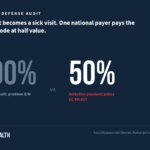


Seventy two of the hundred sacroiliac joint injection claims federal auditors reviewed did not survive the review. A failure rate that high on a routine interventional procedure is not a coding problem. It is what happens when a national billing pattern outruns the documentation trail it depends on.
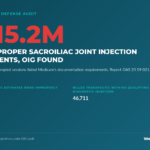
The Office of Inspector General audited a national sample of Medicare claims for sacroiliac joint injections and found that 72 of 100 sampled sessions failed to meet documentation requirements. Extrapolated across the audit period, OIG estimates 134,526 improperly paid sessions and $15.2 million in improper payments, with close to a quarter of the failures traced to diagnostic injections billed as therapeutic.
The finding comes from report OAS 25 09 021, issued August 3, 2026, and covers claims paid between October 1, 2023 and September 30, 2024 under CPT 27096, the direct injection into the sacroiliac joint, and CPT 64451, the block of the nerves that supply it. Those two codes cover a sampling frame of 186,842 sessions nationwide. Auditors pulled 100 for review. Seventy two failed.
Pain management billing is not new to this kind of scrutiny. OIG’s broader audit series on spinal pain management services has already found $30 million in improper payments for facet joint interventions and separately flagged facet joint denervation sessions and epidural steroid injections in prior years. Sacroiliac joint injections are simply the newest procedure in that series to fail at scale, and the 72 percent failure rate here is higher than most of what came before it.
Where the Documentation Actually Broke Down
Indication requirements accounted for the largest share of failures. Auditors expect three positive provocative maneuvers on the affected side, a diagnosis of low back pain without radiculopathy, and at least four weeks of documented conservative therapy before an interventional injection counts as medically necessary. Sessions failed on each of those elements separately, not only as a group, so a chart with two of the three maneuvers documented failed the same way one with none of them did.
A second, nearly as large group of failures sat in imaging and pain assessment. More than a third of the sampled sessions were missing a post procedure pain score, the single most common gap auditors reported in the entire review. Missing baseline pain levels and thin documentation of fluoroscopic or ultrasound guidance made up most of the rest of this category.
A third category is sequencing. Medicare’s rule for these injections treats the diagnostic and the therapeutic injection as two separate decisions, not one continuous procedure, and a therapeutic session is only payable once a qualifying diagnostic injection has confirmed the joint as the actual pain source. Auditors found sessions billed as therapeutic where that qualifying diagnostic step was never documented at all.
The Diagnostic to Therapeutic Trap
This sequencing failure matters more than it looks. Medicare Administrative Contractors that cover sacroiliac joint injections generally cap therapeutic sessions on a rolling twelve month basis. A therapeutic injection billed without a documented qualifying diagnostic injection does not just risk a payment recoupment. It also consumes one of the patient’s limited therapeutic allowances on a session that was never actually eligible to use it.
OIG’s extrapolation puts the number of sessions coded as therapeutic without a documented qualifying diagnostic injection at roughly 46,711 nationwide, close to a quarter of the entire sampling frame. A pain management practice billing this code combination at any real volume should assume this pattern is present somewhere in its own claims until it has actually checked.
CMS Agreed to Educate Providers. It Did Not Agree to Fix the Coverage Gap.
OIG issued three recommendations. CMS agreed to build targeted provider education on the documentation requirements above, and agreed to develop a way to stop diagnostic injections from being billed as therapeutic in the first place. Both carry an expected update in February 2027.
The third recommendation asked CMS to develop a national coverage determination, or at minimum encourage local coverage determinations, so sacroiliac joint injections are judged against one documentation standard regardless of which Medicare Administrative Contractor processes the claim. CMS declined it. The patchwork already exists today: contractors including Wellpoint Federal, CGS Administrators, Noridian Healthcare Solutions, and WPS Insurance Corporation each maintain their own separate local coverage determination for sacroiliac joint injections, with different effective dates and, in places, different documentation thresholds. A session compliant under one contractor’s policy can fail under another’s.
What This Means for a Pain Management Practice
None of this requires a practice to stop performing sacroiliac joint injections. OIG’s recommendations do not call for that. What they require is proof, on every claim, that the provocative maneuvers were performed and documented, that conservative therapy was tried and recorded, that pain scores were captured before and after the procedure, and that a diagnostic injection was actually completed and confirmed before a therapeutic session was billed against it.
Most practices billing CPT 27096 and 64451 are not tracking these elements as a defined checklist. They are relying on a treating physician’s general documentation habits and hoping a payer’s post payment review, if one ever happens, lines up with what was actually written in the chart. A 72 percent failure rate on national audit says that gamble carries real financial exposure for a specialty already under this much scrutiny.
WeBill Health’s Pain Management billing work is built around exactly this kind of documentation to coding match. WeBill Health maintains internal payer rule libraries organized by specialty and by carrier, built and updated by people who work claims in pain management every day, and every claim receives human pre submission review against those libraries before it goes out. That review checks for the same elements OIG audits for, provocative maneuvers, conservative therapy, pain scores, and diagnostic to therapeutic sequencing, before the claim ever reaches a payer, not after a post payment audit finds it two years later.
Practices working with WeBill Health operate on a 98% clean claim rate and a 48 hour submission guarantee, and see an average 25% increase in collections within six months, driven by specialty specific coding and reduced days in accounts receivable. None of that comes from software guessing at what a payer wants. It comes from an expert who knows the sacroiliac joint injection rules reading the chart before the claim goes out.
Find Out Where Your Own Claims Stand
A Revenue Defense Audit reviews your existing sacroiliac joint injection claims against the same indication, imaging, and sequencing requirements OIG just audited nationally, before a Medicare contractor does it for you on a post payment review. You get a concrete answer about where your documentation actually stands, not a guess.
Get your Revenue Defense Score to see how your pain management billing compares across denial risk, documentation gaps, and credentialing exposure, specialty by specialty, before the next OIG report picks your procedure code.
Frequently Asked Questions
What report found the $15.2 million in improper payments for sacroiliac joint injections?
OIG report OAS 25 09 021, issued August 3, 2026, covering Medicare claims paid between October 1, 2023 and September 30, 2024 for CPT 27096 and CPT 64451.
How many sacroiliac joint injection claims did OIG actually review?
Auditors pulled 100 sessions from a national sampling frame of 186,842 and found that 72 failed to meet Medicare’s documentation requirements. The dollar and session totals in the report are extrapolated from that sample across the full frame.
Why were some sessions billed as therapeutic when they should have been diagnostic?
Medicare requires a qualifying diagnostic injection to confirm the sacroiliac joint as the pain source before a therapeutic session is payable. OIG found sessions billed as therapeutic without that diagnostic step documented, extrapolated to roughly 46,711 sessions nationally.
Did CMS agree to fix the underlying coverage problem?
Partially. CMS concurred with provider education and with building a way to prevent diagnostic injections from being billed as therapeutic. CMS did not concur with creating a national coverage determination, so documentation standards for these injections continue to vary by Medicare Administrative Contractor.
What should a pain management practice do about this now?
Every sacroiliac joint injection claim should document three positive provocative maneuvers, at least four weeks of conservative therapy, pre and post procedure pain scores, and a completed qualifying diagnostic injection before any therapeutic session is billed against it.
Sources
- Medicare Improperly Paid Physicians an Estimated $15.2 Million for Sacroiliac Joint Injections, report OAS 25 09 021, HHS Office of Inspector General
- Audits of Medicare Payments for Spinal Pain Management Services, HHS Office of Inspector General Work Plan
- Medicare Improperly Paid Physicians an Estimated $30 Million for Spinal Facet Joint Interventions, HHS Office of Inspector General
- Local Coverage Determination L39455, Sacroiliac Joint Injections and Procedures, Wellpoint Federal, CMS Medicare Coverage Database