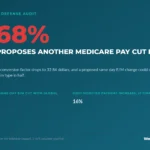


CMS has proposed cutting your evaluation and management payment by 50 percent whenever Modifier 25 is billed with a same day procedure that carries a 0, 10, or 90 day global period. The comment period on that proposal closes September 14, 2026. On September 4, the American Medical Association confirmed that more than 150 national medical specialty societies, state medical associations, and other healthcare organizations have formally asked CMS to withdraw it. Nothing is decided yet. Family medicine practices that bill an office visit alongside a minor procedure on the same day should document the encounter as if the cut were already in effect, because the standard CMS is testing will matter no matter which way the rule lands.
What CMS actually proposed
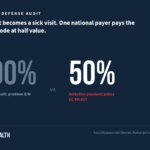
The Calendar Year 2027 Medicare Physician Fee Schedule proposed rule, released July 14, 2026, targets a specific billing pattern: an office or outpatient E/M service, reported with Modifier 25, furnished on the same day as a procedure with a 0, 10, or 90 day global period. Under the proposal, CMS would pay only half of what that E/M service would otherwise be worth. The stated rationale is resource overlap. CMS believes the E/M work and the procedure work duplicate each other often enough to justify an across the board reduction, applied to the physician work, the practice expense, and the professional liability insurance components alike.
That reaches deep into everyday family medicine billing. It touches any family medicine visit where a patient comes in for one problem, the physician finds and treats a second, separately identifiable issue the same day, and bills both. A wart removal during a wellness exam. A joint injection during a follow up visit. An incision and drainage during an urgent same day appointment. Every one of those encounters would be paid at half the E/M rate if the proposal finalizes as written.
The Federation’s case against it
The AMA’s September 4, 2026 National Advocacy Update laid out the coalition’s argument in detail, and it is worth understanding because it previews exactly what CMS will have to answer before finalizing anything. The letter, addressed to CMS Administrator Mehmet Oz and dated August 27, argues four things. CMS has not substantiated the policy: the agency calls the resource overlap “likely” without quantifying it, without naming which specific resources duplicate, and without explaining what has changed since it declined to finalize a narrower version of the same idea for 2019. The RUC and CMS already remove duplicative work and practice expense through the standard misvalued code process, so an across the board cut takes a second reduction for overlap the valuation system is built to catch code by code. The 50 percent figure breaks from how every other multiple procedure payment reduction works, which applies only to the specific component where an efficiency actually occurs, not the entirety of physician work, practice expense, and liability insurance at once. And the reduction would land hardest on independent, office based practices, because they cannot offset it with facility revenue the way a hospital owned clinic can, and for some common procedures the reduced payment would fall below what it costs to furnish the service at all.
The Federation is not asking CMS to extend the review. It is asking CMS to withdraw the proposal entirely and route any genuine overlap through the existing RUC process, code by code, rather than a blanket cut.
The same cut was already tried once, in Michigan
Blue Cross Blue Shield of Michigan proposed the same idea on a smaller scale in early 2026: a 50 percent E/M reduction when Modifier 25 is billed with a same day, 0 or 10 day global minor procedure. It was set to take effect April 15, 2026. It has been paused since that date, with no new effective date announced, after pushback from the Michigan State Medical Society, the American Osteopathic Association, and more than 25 specialty societies. The commercial payer version and the Medicare version are separate proposals moving on separate tracks, and neither one is confirmed final as of this writing. But the pattern is the same policy, tested twice, opposed both times by organized medicine on the same grounds.
The documentation standard is already an audit target, rule or no rule
Whatever happens to the CY2027 proposal on September 14 or afterward, the underlying documentation question predates the proposal and does not wait on CMS to resolve it. An August 27 CMS education article in MLN Connects, aimed at dermatology billing, cited an OIG finding that roughly 61.5 percent of Medicare dermatology E/M claims from 2019 through 2020 included a same day minor procedure by the same provider. The article restated the existing Medicare global surgery rule: the E/M is already bundled into the minor procedure’s payment unless Modifier 25 is supported by a significant, separately identifiable, medically necessary service, documented apart from the procedure note, not folded into it. That is the rule already in force today, not a future proposal, and the same pattern, an E/M billed alongside a minor procedure, sits at the center of family medicine, internal medicine, pediatrics, urgent care, and every other specialty that mixes office visits with in office procedures.
A practice with clean Modifier 25 documentation today is protected whether the 50 percent cut finalizes or not. A practice with a note that just restates the procedure and calls the visit “significant” is exposed today, under the current rule, regardless of what CMS decides about September 14.
What to document at the point of care now
The visit note has to answer a question the procedure note never will: why did this patient need a separate evaluation on top of the procedure. Three elements carry that weight. The chief complaint for the E/M portion has to be distinct from the reason for the procedure, stated in the patient’s own words where possible, not inferred from the diagnosis code. The history, exam, and medical decision making for the E/M service have to stand on their own, meaning a reviewer could read that section alone and see a complete, medically necessary encounter with no reference to the procedure at all. And the two services need separate documentation blocks inside the same note, not one narrative that blends assessment and procedure into a single paragraph, because that blending reads to an auditor as the E/M being incidental to the procedure, not a service in its own right.
None of that is new advice. It is the same standard OIG has been auditing against for years, restated by CMS itself three weeks before the AMA’s coalition asked the agency to withdraw a rule built on the assumption that most Modifier 25 claims fail it. Root cause work on a denial pattern like this, rather than resubmitting the same documentation gap on repeat, is what Denial Defense 2.0 is built for.
Find out where your Modifier 25 documentation actually stands
A Revenue Defense Audit is a forensic review of your practice’s existing accounts receivable and documentation patterns. It shows whether your Modifier 25 claims would survive the audit standard CMS already applies, before a payer or CMS finds the gap for you. WeBill Health maintains internal payer rule libraries organized by specialty and by carrier, spanning more than 500 payer rulesets, built and updated by people who work family medicine claims every day. Every claim receives human pre submission review against those libraries before it goes out. There is no black box and no algorithm we ask you to take on faith. When a payer changes a policy, an expert updates the library and applies it to your claims.
What to watch after September 14
The comment period closes before CMS typically finalizes anything in this rulemaking cycle; a final rule usually follows in early November, with any adopted changes effective January 1, 2027. Between now and then, expect more specialty societies to file individual comment letters on top of the AMA coalition letter, and watch for whether CMS responds to the coalition’s core objection, that it never quantified the overlap it is trying to correct, or finalizes the cut largely as proposed. Either outcome leaves the documentation standard covered above unchanged. It was already the standard before CMS proposed anything, and it will still be the standard after CMS decides.
See how exposed your practice is before the final rule drops
Get your Revenue Defense Score. See exactly how exposed your family medicine practice is to Modifier 25 denials, documentation gaps, and audit risk, specialty by specialty, in about a minute.
Sources
- Calendar Year (CY) 2027 Medicare Physician Fee Schedule Proposed Rule, CMS
- Sept. 4, 2026: National Advocacy Update, “Federation urges CMS to withdraw modifier 25 payment cut,” American Medical Association
- AMA Federation sign on letter to CMS Administrator Mehmet Oz re Modifier 25, August 27, 2026
- Update: BCBSM Clarifies Modifier 25 Policy Reduction Remains, Michigan State Medical Society
- MLN Connects, August 27, 2026 edition, “Dermatologists: Bill Correctly for Evaluation and Management Services and Minor Surgical Procedures”