
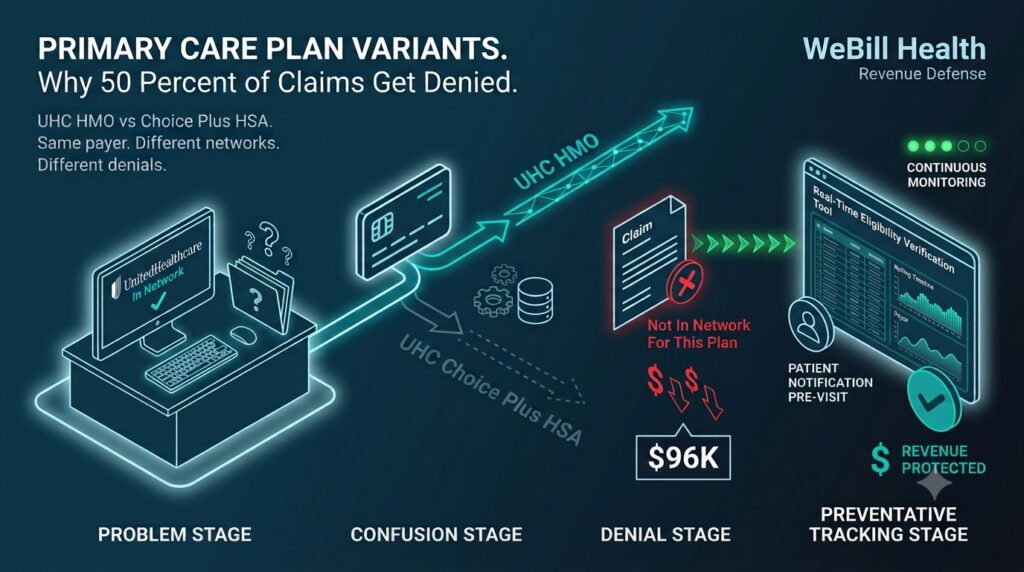
A family medicine practice in Houston submitted a claim for a patient with UnitedHealthcare. The visit was straightforward. But the claim came back denied due to UHC plan variants. The practice is in-network with UHC HMO. The patient was on UHC Choice Plus HSA a different variant entirely. This is the UHC plan variants problem that hits primary care practices hardest.
The claim came back denied: “Not an in-network provider.”
The office called UHC. Three times. Each time, they got the same answer: “You’re not contracted with this plan.”
The practice looked at their UHC enrollment paperwork. It said they were in-network. They were confused.
Here’s what actually happened: The practice is in-network with UHC HMO and UHC EPO. The patient was on UHC Choice Plus HSA. Separate product line. Separate network. Separate contract.
Same payer name. Completely different enrollment status.
That single claim should have been a red flag. It wasn’t. Because the practice didn’t know UHC had eight different plan variants, and they weren’t in-network with all of them.
Over the next six months, this practice submitted 150 UHC Choice Plus HSA claims as in-network. All of them denied. Total revenue lost: $27,000.
This is the UHC problem that hits primary care practices hardest.
This is one piece of a larger pattern. Primary care practices lose $120,000 to $600,000 annually to plan variant denials across every major payer, not just UHC. See the full breakdown in our primary care plan variant denial guide.
The Eight UnitedHealthcare Plan Variants (And Which Ones You’re Actually Enrolled In)
UnitedHealthcare doesn’t operate as one network. It operates as eight separate product lines. Each one is a distinct enrollment. Each one has its own network. Each one has its own fee schedule.
Your practice probably enrolled with UHC once. You think you’re in-network with all of them. You’re wrong.
Here’s what the eight variants are, how they work, and why practices get caught.
UHC HMO (Health Maintenance Organization)
What it is: Restrictive network. Patients need referrals to see specialists. Lower copays.
Who’s typically in-network: Primary care practices almost always. Specialists: only those in the HMO network.
Fee schedule: Standard UHC rates, often lower than PPO.
Common in: Group practices, integrated health systems, large primary care networks.
Denial pattern: If a patient says “I have UHC” and they’re on HMO, claims process fine. If they’re on HMO and see a non-HMO specialist, that specialist’s claims deny (but that’s not your problem as a PCP).
Why practices think they’re in-network with all UHC variants: Because HMO is the most common variant. If you’re in HMO, you assume you’re in other variants too. You’re not.
UHC EPO (Exclusive Provider Organization)
What it is: Broader than HMO. No referrals required. Patients can see any in-network provider directly. Higher copays than HMO.
Who’s typically in-network: Primary care practices almost always, if they’re also in HMO.
Fee schedule: Slightly higher than HMO, lower than PPO.
Common in: Mid-size and large practices.
Why this matters: EPO patients have the same access to you as HMO patients, but slightly different copays. Enrollment is usually bundled with HMO (you get both or neither). This variant rarely causes denials because practices and patients both understand it.
UHC Choice Plus (PPO Variant)
What it is: Flexible PPO. Patients can see any provider in or out of network. Higher out-of-pocket for out-of-network. No referrals.
Who’s typically in-network: Primary care practices in most cases, but NOT always. Enrollment is separate from HMO/EPO.
Fee schedule: Higher than HMO/EPO, but only if you’re enrolled.
Why this causes denials: Choice Plus sounds like it’s part of the HMO/EPO family. It’s not. It’s a separate enrollment. Many practices don’t realize they need to enroll separately. They assume if they’re in HMO, they’re in Choice Plus. Claims get submitted as in-network. Payer denies them. “Not contracted with this plan.”
Real impact: A practice loses 5-15 Choice Plus claims per month before realizing they’re not enrolled.
UHC Choice Plus HSA (High Deductible Health Plan)
What it is: PPO variant tied to Health Savings Accounts. High deductible (usually $2,000-5,000). Low monthly premium. Patients use HSA funds to pay first.
Who’s typically in-network: Fewer practices than other variants. HSA plans have more restrictive networks.
Fee schedule: Varies. Often lower than Choice Plus PPO.
Why this is the worst offender: HSA plans are growing (low premiums appeal to cost-conscious patients). But practices don’t enroll in them at the same rate as HMO/EPO. A practice thinks they’re in-network because they’re in Choice Plus. They’re not in Choice Plus HSA. Patient shows up on HSA, gets denied, office has no idea why.
Real impact: This single variant causes 30-50% of primary care UHC plan variant denials.
UHC Medicare Advantage
What it is: Medicare-only product. Part of Medicare’s private plan ecosystem. Separate network, separate fee schedule, separate authorization requirements.
Who’s typically in-network: Varies widely. Some practices are in MA. Many are not, even if they’re in commercial HMO/EPO.
Fee schedule: Usually lower than commercial. Often bundled differently (includes copays for certain services).
Why denials happen: A Medicare patient calls and says “I have UnitedHealthcare.” Office assumes they’re in-network because they’re in commercial UHC HMO. Patient is on UHC Medicare Advantage, a product line the practice isn’t enrolled in. Claim gets submitted as in-network. Denied.
Real impact: A practice with 30% Medicare patients loses 5-10 MA claims per month this way.
UHC Medicaid (State-Specific)
What it is: Medicaid managed care. Separate network, state-specific rules, often different documentation requirements than commercial.
Who’s typically in-network: Practices that actively enrolled in Medicaid. Many practices skip Medicaid enrollment entirely.
Fee schedule: Much lower than commercial. Often 40-60% of commercial rates.
Why this matters: A practice serves uninsured patients and wants to expand. They think enrolling in UHC Medicaid is straightforward. It is. But it’s completely separate from their commercial UHC enrollment. It requires separate contracting, separate tax ID verification, separate credentialing.
Real impact: Minimal, because practices that enroll in UHC Medicaid usually know they did. But for practices trying to expand, this variant is a forgotten step.
UHC Medicaid Managed Long-Term Care (MLTC)
What it is: Specialized Medicaid product for patients requiring long-term care coordination. Rare in primary care.
Who’s in-network: Very few primary care practices. Usually only those with geriatric focus or care coordination infrastructure.
Why it matters: Not much for most primary care. But if you see older patients on Medicaid, this variant might appear. It requires separate authorization protocols.
UHC Community Plan
What it is: Regional variant. Not available nationwide. Limited to certain states.
Who’s in-network: Practices in regions where it’s offered.
Why it matters: If you don’t know it exists and a patient shows up on it, you might miss it. But it’s usually only in specific states, so regional practices know it.
The Problem: You’re Probably Only Enrolled in 2-3 of These Eight Variants
Most practices enroll with UHC once. They get HMO and EPO (usually bundled). They assume they’re in-network with the others.
They’re not.
Here’s what the math looks like:
A practice enrolls with UHC for commercial contracts. They get:
- UHC HMO ✓
- UHC EPO ✓
- UHC Choice Plus ✗ (forgot to request)
- UHC Choice Plus HSA ✗ (didn’t know it existed)
- UHC Medicare Advantage ✗ (separate process, never pursued)
- UHC Medicaid ✗ (never enrolled)
- UHC MLTC ✗ (not relevant)
- UHC Community Plan ✗ (not available in their state)
Result: The practice is in-network with 2 of 8 variants.
If 40% of their UHC patient population is on Choice Plus HSA (a growing trend), they’re denying 40% of those claims.
UHC is not the only payer that operates this way. Molina runs separate enrollment by state entirely, which creates the same blind spot for multi state practices. See our Molina state by state enrollment guide if you operate across state lines.
How to Check Which UHC Plans You’re Actually In-Network With (Right Now)
Stop assuming. Check.
Step 1: Log into your UHC provider portal (provider.uhc.com or your clearing house portal like Availity).
Step 2: Find the “Active Contracts” or “Enrollment Status” section.
Step 3: Look for a list like this:
| Plan Variant | Status | Effective Date |
|---|---|---|
| UHC HMO | Active | 1/1/2024 |
| UHC EPO | Active | 1/1/2024 |
| UHC Choice Plus | Not Listed | N/A |
| UHC Choice Plus HSA | Not Listed | N/A |
| UHC Medicare Advantage | Not Listed | N/A |
Step 4: If a variant says “Not Listed” or “Not Active,” you’re not in-network with it.
Step 5: If you want to enroll in the variants you’re missing, call UHC contracting at 1-800-624-8822 and request enrollment.
This takes 30 minutes. Do it today. You might discover you’re losing $5,000-10,000 per month to variant denials you don’t know about.
What Happens When a Patient Is on a UHC Plan Variant You’re Not Enrolled In
A patient calls to schedule an appointment. They say “I have UnitedHealthcare.”
Your front desk runs eligibility. The system checks: Is the patient covered by UnitedHealthcare? Yes. Is this practice in-network with UnitedHealthcare? Yes (because you’re in HMO).
Green light. Appointment scheduled.
Patient shows up. Visit happens. Claim gets submitted as in-network.
Two weeks later, the claim comes back:
Reason for Denial: “Not an in-network provider for this plan.”
Your office calls UHC. They tell you the patient is on UHC Choice Plus HSA. You look at your contract. You’re not enrolled in Choice Plus HSA.
Now you have a problem:
Option 1: Appeal the claim and ask UHC to apply it to whichever UHC variant you ARE enrolled in (if patient has coverage there). Success rate: 30-40%. Takes 30-60 days.
Option 2: Retroactively enroll in UHC Choice Plus HSA and resubmit. They might cover it retroactively (rare). Takes 60-90 days.
Option 3: Bill the patient. They’re responsible for the out-of-network balance. You lose the insurance reimbursement. Patient gets angry. Relationship damage.
Option 4: Write it off as a loss. You did the work. You never get paid. Revenue gone.
Most practices choose Option 4 or Option 3. Both are bad.
The Appeal Strategy That Actually Works for UHC Plan Variant Denials
If a claim gets denied because the patient is on a UHC variant you’re not enrolled in, appealing works sometimes.
Here’s the appeal template that wins 30-40% of the time:
Appeal Letter
[Date]
UnitedHealthcare Appeals Department
[Address from EOB]
Re: Claim Appeal, [Patient Name], Claim #[Claim Number]
Reason for Appeal:
Claim [Claim Number] was denied because the patient is enrolled in UHC Choice Plus HSA and our practice is not contracted with this specific plan variant.
However, the patient has coverage under UnitedHealthcare HMO/EPO (or whichever variants you ARE in). The same service is covered under these plans. The patient selected in-network providers believing they would have in-network coverage.
The denial was issued based on a plan variant technicality, not medical necessity or service coverage. The patient is entitled to in-network benefits under their actual coverage. We request that UnitedHealthcare process this claim as in-network under the patient’s HMO/EPO coverage.
Clinical Justification:
[Standard visit was medically necessary for patient’s condition: annual physical, management of chronic condition, etc.]
Action Requested:
Reprocess this claim under the patient’s active UnitedHealthcare HMO/EPO coverage and issue payment at the in-network rate.
Sincerely,
[Your name and credentials]
Success factors:
- This appeal works best if the patient has overlapping coverage (both Choice Plus HSA AND HMO/EPO). Then UHC can apply it to the plan they ARE in-network with.
- If the patient ONLY has Choice Plus HSA and you’re not enrolled, appeals rarely work. The denial is technically correct.
- Always appeal within the timeframe on the EOB (usually 180 days).
Expected timeline: 30-60 days for response.
Prevention: Real-Time Eligibility That Shows Plan Variants
The only way to prevent UHC plan variant denials is to know which variant a patient is on BEFORE you submit the claim.
Your current eligibility tool probably doesn’t show this. It shows “UnitedHealthcare: In-Network” for everyone.
You need a tool that shows:
Patient: Jane Doe
Payer: UnitedHealthcare
Plan Variant: Choice Plus HSA
Your Enrollment Status: NOT ENROLLED
Network Status: Out-of-Network for your practice
Action Required: Notify patient of out-of-network status before visit
Tools like Availity, MediData, and most modern EHR systems (AdvancedMD, Epic, Athena) can show this if you configure them correctly.
If your eligibility tool can’t show plan variants, call your vendor and demand they add this feature. If they can’t, switch vendors.
The cost to add variant-level verification is usually zero (it’s built into the tool, just needs to be turned on).
The cost of not adding it: $5,000-10,000 per month in plan variant denials.
Linking Back to Prevention: The Hub Strategy and Clinical VMA
You can prevent 80% of UHC plan variant denials with two things:
1. Real-time eligibility verification that shows plan variants (discussed above)
2. A Clinical Virtual Assistant who verifies variants and obtains pre-visit authorization
A Clinical VMA runs eligibility on every patient before their scheduled visit. They flag plan variant mismatches. They notify the patient if they’re out-of-network. They obtain required prior authorizations.
By the time the patient arrives for their appointment, you know exactly which UHC variant they’re on and whether you’re contracted with it.
UHC denials from plan variant mismatches? Zero.
Your Next Step: Audit Your UHC Enrollment Right Now
Don’t wait for a $27,000 revenue hole to open.
Log into your UHC provider portal today. Write down which variants you’re enrolled in. Check it against your patient database. See if you’re potentially missing enrollment in any high-volume variants.
If 20-30% of your UHC patients are on Choice Plus HSA and you’re not enrolled, you’re losing $3,000-5,000 per month.
That’s $36,000-60,000 per year.
One phone call to UHC contracting gets you enrolled in the missing variants. Takes 60-90 days to activate.
Starting today, every Choice Plus HSA claim converts from denied to paid.
That’s the math of plan variant prevention.
Get it done this week.
Find Out Which UHC Plan Variants You Are Actually Enrolled In
Your eligibility tool tells you UnitedHealthcare is in network. It does not tell you which of the eight UHC product lines you are actually contracted with. WeBill Health pulls your real enrollment status across every UHC variant and flags the gap before a denied claim shows you the hard way.
Audit My UHC EnrollmentTrusted by specialty practices across the U.S.
Sources
UnitedHealthcare. (2024). Network Enrollment and Plan Variant Guide for Providers. Retrieved from provider.uhc.com
Centers for Medicare & Medicaid Services. (2024). Medicare Advantage Plan Network Requirements and Enrollment. Retrieved from cms.gov
American Medical Association. (2024). Insurance Plan Variant Navigation for Primary Care Practices.
Texas Medical Association. (2024). Primary Care Billing and Enrollment Best Practices.