
If you’ve searched for “where can I find credentialing management services for insurance agents” and landed here, there’s a good chance you’re actually a healthcare provider, not a licensed insurance sales agent. The word “credentialing” means completely different things depending on who’s using it, and that overlap sends a lot of physicians, therapists, and clinic owners down the wrong rabbit hole. This article is written for healthcare providers who want to get enrolled with insurance payers, join provider panels, and start billing for their services.
By the end, you’ll know where to find vetted credentialing management services, what services are actually included, what you should expect to pay in 2026, and the six questions that will tell you whether a vendor is worth hiring. Small practices that already work with a full-service billing partner often find that their RCM company either handles credentialing directly or connects them with trusted vendors, that’s one reason integrated billing and credentialing partners can make the onboarding process significantly smoother for new and growing practices.
Provider credentialing vs. insurance agent credentialing: which one do you actually need?
These are two distinct processes, and the vendors serving each side of this market rarely overlap. Knowing which one applies to you will save you from wasting time calling the wrong companies.
What payer credentialing means for healthcare providers
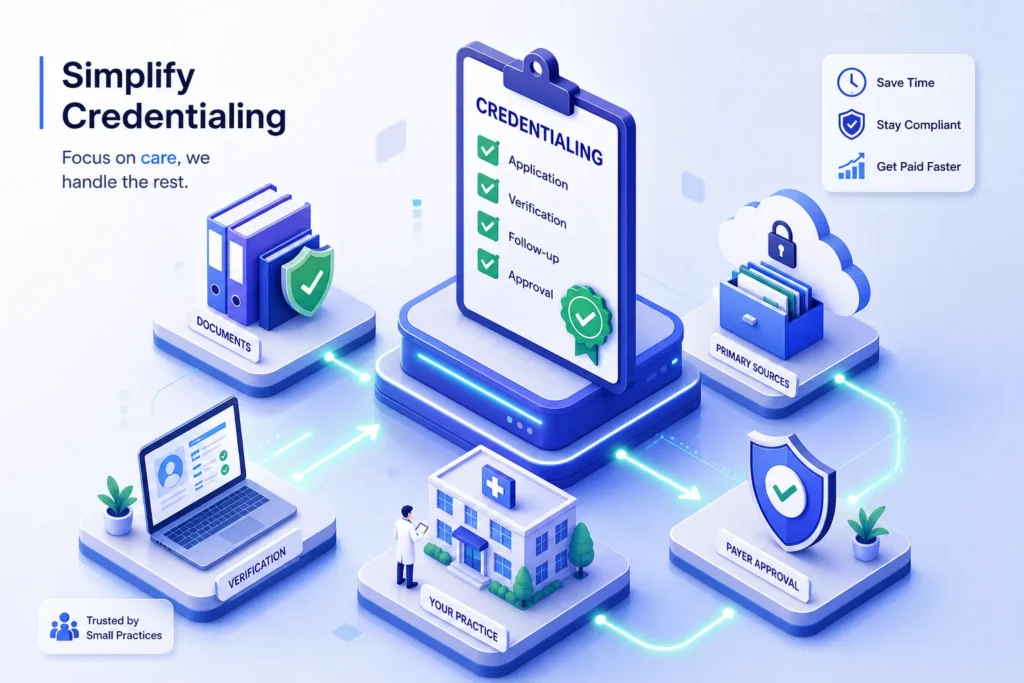
For physicians, therapists, ABA providers, physical therapists, and other clinicians, credentialing means getting verified and enrolled with insurance payers. Before a payer will reimburse your claims, they need to confirm your license, training, malpractice history, and practice details. That process typically involves setting up a CAQH ProView profile, submitting payer-specific enrollment applications, and completing payer panel contracting. Provider enrollment services like these form the core of what medical credentialing companies offer. The rest of this article covers exactly this process.
What insurance agents mean when they say “credentialing”
For licensed insurance agents and brokers, “credentialing” usually refers to carrier appointments: the authorization process that allows an agent to legally sell a carrier’s products. That process is managed through carriers directly or through agency management platforms, not through medical credentialing vendors. If this describes what you’re looking for, you’ll find better resources through your state’s Department of Insurance or your carrier’s agent portal.
Where can I find credentialing management services for healthcare providers? Your three main options
The market for payer credentialing services breaks into three distinct categories. Each has different strengths, and the right fit depends on your practice size, specialty, and whether you want credentialing bundled with your billing or handled separately.
Full-service billing partners that include credentialing support
For small practices, the most efficient path is often working with an RCM company that handles credentialing alongside billing. This eliminates the common problem of having billing set up while credentialing approval is still pending, a gap that can mean weeks of claims you can’t submit. For practices launching a new location or adding providers to existing payer panels, an integrated approach saves time and prevents coordination failures between two separate vendor relationships. WeBill Health is built around this model, combining credentialing support with billing and RCM so providers can get payer-ready without managing those functions in isolation.
Standalone credentialing firms: vetted options nationwide
If you want a dedicated credentialing specialist, the market has solid options for small practices in 2026. Here’s a practical breakdown by strength:
- P3Care: broad insurance panel enrollment support, nationwide coverage, and strong integration with RCM workflows; a good all-around option for practices of any size.
- MedUSA: focused on smaller and mid-size practices; known for high-contact, customizable service rather than a software-first approach, which suits practices that want direct communication throughout the process.
- MediBillMD: Dallas-based with nationwide coverage; particularly strong on government program enrollment including Medicare PECOS and state Medicaid applications.
- CureMD: tech-driven CAQH credentialing management with dashboard monitoring and workflow automation; a strong choice for practices that want credentialing integrated with their EHR or practice management software.
- nCred (National Credentialing Solutions): a credentialing-only specialist with national reach; a good fit for practices that want a dedicated partner for payer credentialing services without bundled practice management.
- Practolytics: combines credentialing with billing, coding, and prior authorizations; useful for practices looking to outsource multiple administrative functions at once.
- Physician Practice Specialists (PPS): strong focus on practice startup consulting, credentialing, and insurance contract negotiations; well-suited for new practices and solo practitioners getting credentialed for the first time.
For nationwide coverage, SMCG, NMS Health, and Nationwide Credentialing LLC all advertise provider enrollment services across all 50 states. Texas deserves a mention as a state requiring extra attention: major payers there operate through separate portals with specific documentation rules, and some specialties require a Facility Coverage Letter from BCBS Texas before enrollment can proceed.
Medical associations and state-level resources
State medical associations, specialty societies like APTA for physical therapists, and hospital networks don’t typically operate as full-service credentialing vendors, but they can be useful starting points. Many offer referrals to vetted vendors, guidance on state-specific documentation requirements, and educational resources on the credentialing process. For practices in states like California, New York, Illinois, or New Jersey, where credentialing timelines are longer and documentation requirements more involved, connecting with your state association early can help you avoid surprises mid-application.
What credentialing management services actually cover
Many small practices assume credentialing is a one-time form submission. It’s not. It’s an ongoing administrative process with multiple moving parts, and understanding the full scope before you hire a vendor will help you ask better questions and avoid gaps in coverage.
CAQH setup, attestation, and maintenance
CAQH credentialing (ProView) is a centralized provider data repository where you enter your credentials once and authorize participating health plans to pull that data. Setting it up requires entering your licenses, certifications, malpractice coverage, practice locations, hospital affiliations, and other professional documentation. CAQH credentialing management includes re-attestation every 120 days, meaning someone needs to log in and confirm your information is still accurate. One important clarification: CAQH is a data-sharing tool, not an enrollment engine. Payers still require separate applications to enroll you in their networks.
Payer enrollment, follow-up, and application tracking
The actual enrollment process involves submitting payer-specific applications, authorizing each payer to access your CAQH profile, and then actively managing what happens after submission. This is where most of the labor lives. Payers routinely request additional documentation, send applications back for corrections, or simply go quiet for weeks without a status update. Professional credentialing services earn their fees in the follow-up phase, not the initial paperwork. A vendor that submits applications and then waits passively is not the same as one that tracks status, responds to payer requests, and escalates stalled files.
Re-credentialing and license monitoring
Payer credentialing isn’t permanent. Most commercial payers require re-credentialing every two to three years, and Medicare has its own revalidation schedule. Licenses have expiration dates too, and a lapsed license can trigger a payer audit or suspension of billing privileges. Ongoing credentialing management means tracking all of these deadlines proactively, before they become problems. For a busy small practice, this is exactly the kind of administrative work that falls through the cracks without a dedicated partner.
What credentialing management services cost in 2026
Pricing varies by vendor, specialty, payer count, and service depth, but the market follows three recognizable models. Knowing which model applies to your situation helps you compare quotes accurately instead of being surprised by add-on charges once you’re locked into an agreement.
Per-application fees vs. flat-fee bundles
Per-application pricing typically runs $100 to $300 per payer, with some full-service or regionally complex applications reaching $500 to $750. These figures reflect vendor-reported market rates and can vary by specialty and geography. This model makes sense if you’re credentialing with a small number of targeted payers. Flat-fee bundles, which cover initial credentialing across a defined set of major payers, generally range from $1,500 to $3,000 per provider, though exact pricing varies by vendor and the number of payers included. If you’re launching a new practice and need to join multiple commercial networks at once, a flat-fee bundle is typically the better value, provided the bundle covers the payers you actually need. For a short, targeted payer list, per-application pricing may cost less overall.
Ongoing management and what actually drives the bill up
Monthly management fees for re-credentialing, CAQH maintenance, and license monitoring typically run $50 to $200 per provider per month. The variables that push costs higher include multi-state licensing, specialty complexity (behavioral health and ABA practices often face more payer scrutiny), the number of payers in your panel, and whether the vendor is doing passive form submission or active follow-up with payers. As a general rule, a vendor charging $75 per month for true ongoing management, including active follow-up, deadline tracking, and license monitoring, tends to deliver better value than one charging $150 for what amounts to automated reminders. Ask vendors specifically what actions they take between submission and approval before you compare prices.
How long payer credentialing really takes
Credentialing timelines directly affect your cash flow. A provider who isn’t credentialed can’t bill, which means every week of processing delay is a week of revenue your practice can’t recover. Professional credentialing services can shorten timelines by submitting complete applications from the start and staying on top of payer follow-up, but they can’t override payer-side processing queues.
Government payer timelines: Medicare and Medicaid
Medicare PECOS enrollment typically takes 30 to 90 days with a complete, clean application, though CMS processing times can vary. Medicaid varies more significantly by state, ranging from 45 to 120 days depending on the plan and state administrator. Government payer timelines are generally more predictable than commercial plans, but they’re less forgiving of documentation errors. A single missing item can restart the review clock.
Commercial payer timelines: BCBS, Aetna, and UnitedHealthcare
BCBS typically runs 60 to 120 days. Aetna processes most applications in 60 to 90 days but can stretch to 120 or more if additional clinical review is required. UnitedHealthcare generally lands in the 60 to 90 day range, with delays possible when a network is closed to new providers in a specific specialty or geography. Planning 90 to 120 days ahead of a practice launch is the safe standard. Practices that wait until they’re open to start credentialing routinely absorb weeks of unbillable patient visits while applications process.
Six questions to ask before hiring a credentialing vendor
These six questions will tell you more about a vendor’s service quality than any brochure they send you. They cover two areas you need to pressure-test before you sign: scope and accountability, and budget and exit protections. Use them in your first conversation with any vendor.
Questions that reveal scope and accountability
First: do you handle both CAQH setup and payer-specific enrollment applications, or only one of them? Some vendors manage CAQH profiles but leave payer enrollment to you, which means you’re only getting half the work done. Second: how do you track application status, and how often will you update me with specifics? Vague answers here are a red flag. A credentialing partner should be able to tell you where each application stands at any given time. Third: does your service include ongoing re-credentialing and license expiration monitoring, or does engagement end after initial approval? If the answer is the latter, you’ll be scrambling to find coverage when your first re-credentialing cycle comes due.
Questions that protect your practice and your budget
Fourth: is your coverage nationwide, or are there states where you don’t operate or where you subcontract? This matters if you have providers licensed in multiple states or if you operate in a high-complexity state like California or New York. Fifth: what exactly is included in the quoted price, and what triggers extra charges? Get a specific list of what’s in scope. Per-payer follow-up calls, expedited applications, and appeals for payer denials are all areas where scope creep can inflate your bill. Sixth, and most importantly: who retains ownership of the payer contracts and portal login credentials when the engagement ends? Your practice should own its payer contracts and credentials at all times. Any vendor that ties those credentials to their account and won’t transfer them cleanly is creating leverage over you that will cost money to undo.
Frequently asked questions about credentialing management services
Where can I find credentialing management services for insurance agents vs. healthcare providers?
The answer depends entirely on which type of credentialing you need. Licensed insurance agents seeking carrier appointments should contact their carrier’s agent portal or their state’s Department of Insurance, medical credentialing vendors don’t serve that market. Healthcare providers looking for payer credentialing services have three main options: full-service RCM partners (like WeBill Health) that bundle credentialing with billing, standalone medical credentialing companies, and state medical associations that can refer you to vetted vendors.
What’s the difference between CAQH credentialing management and payer enrollment?
CAQH ProView is a centralized data repository that lets you enter your credentials once and authorize health plans to access them. Payer enrollment is the separate process of applying to join each payer’s provider network. You need both, but they’re distinct steps. Many providers assume completing their CAQH profile means they’re enrolled, it doesn’t. Enrollment applications must still be submitted to each payer individually.
How much do credentialing management services cost?
Per-application fees typically run $100 to $300 per payer for standard applications. Flat-fee bundles covering multiple major payers generally range from $1,500 to $3,000 per provider. Ongoing monthly management for re-credentialing and license monitoring typically runs $50 to $200 per provider per month. Prices vary by vendor, specialty, and the number of payers in your panel.
Getting payer-ready without doing it alone
Get provider credentialing right and your practice bills from day one. Get it wrong and you absorb weeks or months of cash flow disruption while applications work through payer queues. The market has strong vendors to choose from, and your best path forward is knowing exactly which service model fits your situation before you start making calls.
For small practices that want credentialing and billing handled under one roof, the calculus is straightforward. Coordinating two separate vendors across the credentialing and billing functions creates gaps, miscommunications, and duplicated administrative work. An integrated RCM partner combines credentialing support with billing management so the practice team stays focused on patients rather than payer portals.
Whether you’re still asking where to find credentialing management services or you’ve already shortlisted vendors, the timeline guidance stays the same: start 90 to 120 days before you need approvals live. Then find a partner who can answer all six questions above without hesitation. That combination will get you payer-ready faster than any shortcut will.