Companies that offer fully managed credentialing and enrollment services in the USA include WeBill Health, DoctorsManagement, Plutus Health, Verisys, symplr, and Medallion. WeBill Health ties credentialing to billing through Revenue Velocity Credentialing, with 40% faster credentialing enrollment and 24/7 CAQH and PECOS lifecycle monitoring. The best fit for your practice depends on its size, its payer mix, and whether you want enrollment status connected to your claims. With complete CAQH and PECOS profiles, first time Medicare and Medicaid enrollment usually takes 60 to 90 days and commercial payers take 45 to 60 days.
What Fully Managed Credentialing and Enrollment Means
A fully managed credentialing partner owns the whole provider enrollment lifecycle. That starts with building or cleaning up the CAQH profile and filing Medicare enrollment through PECOS. It continues through Medicaid and commercial applications, payer follow up, and the maintenance work that keeps a provider billable for years after the first approval.
Partial services stop at application submission. The practice is then left to chase payers, track reattestation dates, and discover lapses when claims start coming back. Fully managed means the partner tracks every deadline and answers for the outcome.
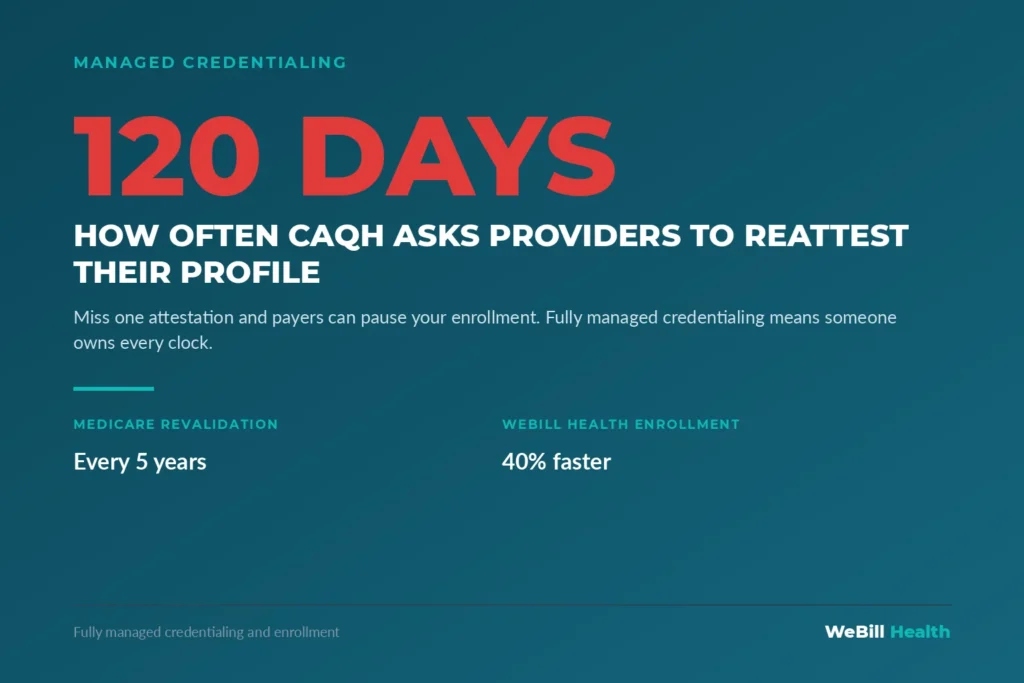
The maintenance side is where most practices get hurt. CAQH ProView asks providers to reattest every 120 days (180 days in Illinois), according to the CAQH ProView quick reference guide. CMS requires most Medicare providers and suppliers to revalidate their enrollment every five years, and DMEPOS suppliers every three years. Missing either one can stop payment on claims that were coded and submitted correctly.
The cost of getting this wrong shows up in denials. In an MGMA Stat poll from August 2021, 54% of medical practices reported that denials related to provider credentialing had increased that year. Credentialing problems are a revenue problem, which is why the partner you pick matters.
How Long Does Provider Credentialing Take in 2027?
These are the first time enrollment timelines WeBill Health sees across its client practices when the CAQH ProView profile and the PECOS record are complete before the first application goes out.
| Payer type | Typical first time timeline |
|---|---|
| Medicare (enrollment through PECOS) | 60 to 90 days |
| Medicaid | 60 to 90 days |
| Commercial payers | 45 to 60 days |
Our fastest approvals so far have been 20 days for a Medicaid enrollment and 7 to 14 days for commercial payers. Those results came from applications that passed the payer’s review the first time.
Every gap in the file costs time. When a payer finds a missing item, it pauses the application until the correction arrives, and that usually adds 7 to 10 days to the timeline.
What a clean application needs before it goes out
- A complete CAQH ProView profile, attested within the last 120 days, with each payer authorized to view it.
- A current PECOS record whose practice location, NPI and taxonomy match NPPES.
- Current state license, DEA registration where it applies, board certification and a malpractice insurance face sheet, all uploaded and unexpired.
- A work history with any gap longer than six months explained.
- For group enrollment, a group NPI and tax ID that match the W9 the payer receives.
WeBill Health checks each of these before an application is filed.
Credentialing for Solo Providers and Group Practices
WeBill Health credentials solo providers and group practices. A solo provider usually enrolls as an individual under their own NPI. A group enrolls under its group NPI and tax ID, and each provider who bills through the group needs their own enrollment linked to it. In Medicare that link is a reassignment of benefits, filed with form CMS 855R or through PECOS.
Adding a provider to a group that is already contracted with a payer often moves faster than enrolling a new group, because the group contract is already in place. Start the paperwork for a new hire as soon as the offer is signed, so the first weeks of visits are billable.
2027 Medicare Advantage Plan Exits and Your Enrollment
KFF counts 193 counties with no Medicare Advantage drug plan for general enrollment in 2027, up from 123, as several large insurers leave hundreds of counties and newer plans enter. Patients in those counties start January on a new plan. If your providers are not enrolled with that plan, their claims deny as out of network.
Check now which plans are entering your counties and whether your providers are enrolled with them. A commercial or Medicare Advantage enrollment started in November can still take 45 to 60 days. Our guide to prior authorization changes on January 1, 2027 covers what else changes for patients who switch plans.
Top Provider Credentialing Companies in the USA
The companies below were reviewed against what each one states on its own website as of October 2026. We list scope only where the company describes it, and we do not repeat performance figures that a company has not published.
1. WeBill Health
WeBill Health offers provider credentialing and payer enrollment services, called Revenue Velocity Credentialing, as part of a full revenue cycle partnership. The program delivers 40% faster credentialing enrollment and 24/7 CAQH and PECOS lifecycle monitoring, so reattestation and revalidation dates are tracked before they become lapses. Because the same team works the claims, billing checks a newly enrolled provider’s enrollment status before that provider’s first claims are submitted. It fits independent practices in the Office Visit and Consultation, Time Based Therapy, and Procedure and Surgical specialty groups.
2. DoctorsManagement
DoctorsManagement lists credentialing and provider enrollment for startups and established group practices. Its site describes CAQH registration, maintenance, and attestation; individual and group Medicare enrollment; Medicaid program enrollment; commercial payer enrollment; Medicare, Medicaid, and commercial revalidation; and annual credentialing maintenance with demographic updates. The provider types it names include physicians, nurse practitioners, physician assistants, behavioral health providers, therapists, urgent care, labs, ambulatory surgery centers, and imaging facilities.
3. Plutus Health
Plutus Health offers credentialing and enrollment alongside medical billing, coding, and denial management. Its credentialing page says the team creates, updates, attests, and maintains CAQH profiles, manages commercial, Medicare, Medicaid, and managed care enrollments with payer specific workflows, and completes recredentialing before deadlines. This suits a practice that wants credentialing and billing from one company.
4. Verisys
Verisys describes itself as an NCQA accredited credentials verification organization (CVO). It offers outsourced credentialing, ongoing credential monitoring through VerisysWatch, and support for NCQA, The Joint Commission, and URAC standards. Its site names hospitals, health systems, health plans, pharmacies, and government agencies as the organizations it serves. Verisys is built around verification and monitoring. Its site does not describe a payer enrollment service for small practices.
5. symplr
symplr sells credentialing software and services, including a CVO for payers and providers and a provider module that covers credentialing, privileging, enrollment, and recredentialing. Its site lists health systems, hospitals, medical groups, payers, and post acute providers as customers. It is a better match for hospital medical staff offices than for a three provider clinic.
6. Medallion
Medallion combines a software platform with expert review across provider enrollment, credentialing, monitoring, cross state licensing, and payer contract management. Its site lists provider groups, payers, health systems, revenue cycle organizations, and digital health companies as customers. Organizations that are licensing clinicians across many states are its clearest fit.
Comparison Table: Credentialing and Enrollment Services
| Company | Model | Enrollment scope stated on its site | Ongoing maintenance | Best fit |
|---|---|---|---|---|
| WeBill Health | Credentialing inside a full revenue cycle partnership | CAQH, PECOS, Medicare, Medicaid, commercial | 24/7 CAQH and PECOS lifecycle monitoring | Independent specialty practices that want enrollment tied to billing |
| DoctorsManagement | Consulting and credentialing services | CAQH, Medicare, Medicaid, commercial | Revalidation, recredentialing, demographic updates | Startups and group practices |
| Plutus Health | Credentialing within an RCM company | CAQH, Medicare, Medicaid, commercial, managed care | Recredentialing and license renewals | Practices buying billing and credentialing together |
| Verisys | NCQA accredited CVO | Verification focused; payer enrollment not described | Continuous credential and sanction monitoring | Hospitals, health plans, large systems |
| symplr | Software plus CVO services | Enrollment listed in its provider module | Recredentialing | Hospitals and health systems |
| Medallion | Software platform with expert review | Provider enrollment, credentialing, licensing | Monitoring with automated alerts | Multistate groups and digital health companies |
How to Choose a Managed Credentialing Partner
Use these five questions in every sales conversation. A credible partner will answer each one in writing.
- Who maintains CAQH after approval? Ask how the company tracks the 120 day reattestation cycle and Medicare revalidation dates, and how you are told when something is due.
- Which payers does the team enroll with every week? A partner that works your state Medicaid program and your top commercial plans regularly will know their quirks.
- Does the partner know your specialty? Behavioral health, ABA, and surgical practices have extra enrollment steps, and multistate groups multiply every one of them.
- How is status reported? You should be able to see each application, its submission date, and the last payer contact without asking.
- Is credentialing connected to billing? If the credentialing team and the billing team never talk, claims for a pending provider can go out early and deny.
Pricing models vary across per provider, per payer, and monthly maintenance fees. Our guide to the average cost of medical staff credentialing covers what each model includes and where the hidden costs sit.
Should You Outsource Provider Enrollment?
In house credentialing works when one experienced coordinator has the time to track every provider and every payer deadline. It breaks down when that person leaves or when the practice adds providers quickly. Expanding into a new state strains it the same way, because each of those events resets the learning curve.
A managed partner makes sense when credentialing delays are already holding up revenue. Signs include new providers seeing patients they cannot bill for, claims denying for enrollment reasons, and nobody on staff knowing when the next CAQH attestation is due.
How WeBill Health Runs Credentialing and Billing Together
WeBill Health treats credentialing as the first step of the revenue cycle. Revenue Velocity Credentialing starts with a review of every payer a provider needs, then moves through CAQH and PECOS setup, application filing with complete documentation, and payer follow up until approval. After approval, 24/7 CAQH and PECOS lifecycle monitoring keeps attestations and revalidations current.
Enrollment status feeds straight into billing. WeBill Health maintains internal payer rule libraries organized by specialty and by carrier, built and updated by experts who work claims in your specialty every day. Every claim receives human pre submission review against them before it goes out. The libraries cover more than 500 payer rulesets. That review is how WeBill Health holds a 98% clean claim rate and a 48 hour submission guarantee, with 7 to 14 day reimbursement velocity once a provider is active.
Practices get direct access to their billing team and tools for seamless communication, so a credentialing question and a denied claim reach the same people. You can see how this fits the wider program on our end to end revenue cycle management page, and check which specialties we cover on the WeBill Health specialties page.
Frequently Asked Questions
Which companies offer fully managed credentialing and enrollment services?
WeBill Health, DoctorsManagement, and Plutus Health offer managed payer enrollment for practices, covering CAQH, Medicare, Medicaid, and commercial plans. Verisys and symplr focus on credentials verification for hospitals and health plans. Medallion pairs a software platform with expert review for multistate groups.
How long does provider credentialing take?
With complete CAQH and PECOS profiles, first time Medicare and Medicaid enrollments usually take 60 to 90 days and commercial payers take 45 to 60 days. Each missing item usually adds 7 to 10 days. WeBill Health’s fastest approvals have been 20 days for Medicaid and 7 to 14 days for commercial payers.
Does WeBill Health credential solo providers?
Yes. WeBill Health credentials solo providers and group practices with Medicare, Medicaid and commercial payers.
How often does a provider need to reattest in CAQH?
CAQH ProView asks providers to reattest every 120 days, or every 180 days for providers practicing in Illinois. A managed partner should track this date for every provider and complete the attestation before it lapses.
How often do Medicare providers revalidate enrollment?
CMS states that providers and suppliers generally revalidate every five years, and DMEPOS suppliers revalidate every three years. CMS can also request an off cycle revalidation, so PECOS needs ongoing monitoring.
Is it better to use one company for credentialing and billing?
For most independent practices, yes. When one team works both, billing can check a new provider’s enrollment status before claims go out, which helps prevent credentialing denials. WeBill Health runs both through the same team with 24/7 CAQH and PECOS lifecycle monitoring.
Find Out Where Credentialing Is Costing You
If enrollment gaps or lapsed attestations are already showing up in your denials, start with a Revenue Defense Audit. WeBill Health reviews your enrollment status and denial patterns and shows you where revenue is leaking. For a faster read on your billing health, take the free Revenue Defense Score.