
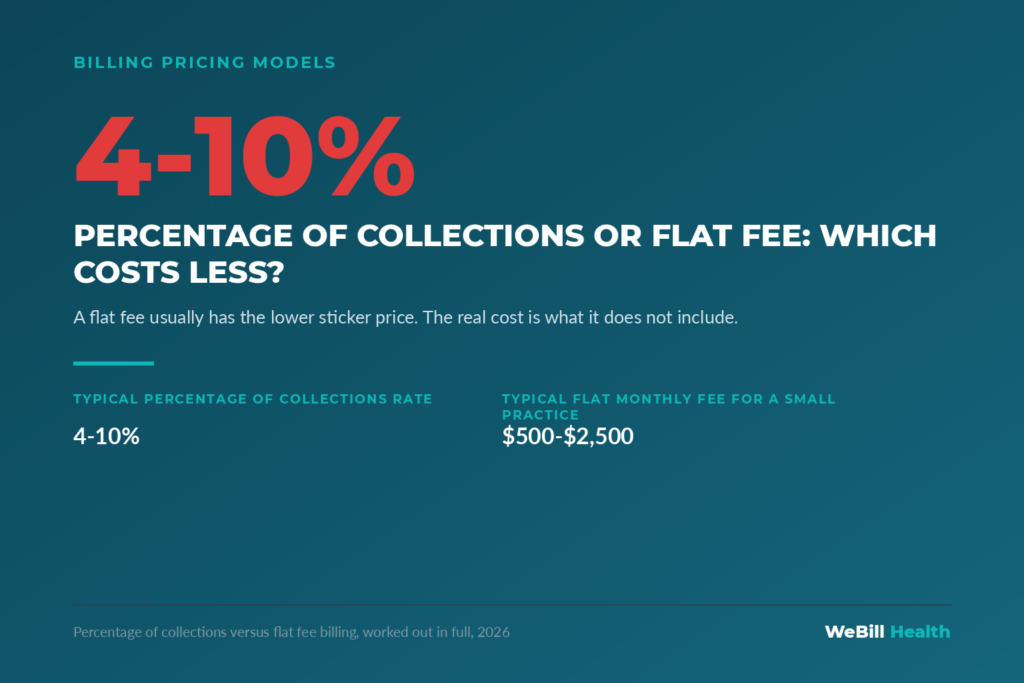
At $150,000 to $600,000 in monthly collections, a flat monthly fee almost always carries the lower sticker price. A typical flat quote for a 3 to 5 provider practice runs $1,500 to $3,500 a month, which works out to well under 2 percent of collections at every volume in that range. Percentage of collections runs 4 to 10 percent industry wide. On the invoice alone, flat fee wins by a wide margin. The real cost difference shows up somewhere the invoice never mentions.
Every practice owner who compares a percentage quote against a flat quote runs the same math within about thirty seconds, and the math looks conclusive. A flat $2,000 a month against 7 percent of $300,000 in collections is $2,000 versus $21,000. Nobody needs a calculator to see which number is smaller.
That comparison is honest as far as it goes, and it does not go far enough. A billing invoice is the visible cost. What a billing model does to the claims nobody follows up on, the small denials nobody appeals, and the aged accounts nobody chases is the cost nobody puts on an invoice. This is the arithmetic worked out in full, sourced to the same industry benchmarks behind our percentage pricing breakdown and our in house staffing comparison, so you can see where each model actually wins.
How do the two pricing models actually work?
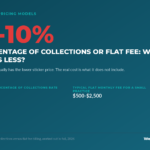
Percentage of collections charges a share of what a practice actually collects, commonly 4 to 10 percent industry wide, with 3 to 5 provider practices typically quoted 5 to 8 percent. The vendor is paid only when the practice is paid, which ties the vendor’s revenue to the practice’s revenue.
Flat fee charges a fixed amount regardless of collections, either as a single monthly rate for the practice or as a rate per provider per month. Billing companies that price this way commonly quote $500 to $2,500 a month at the practice level, or $200 to $1,000 or more per provider each month, according to multiple 2026 vendor pricing surveys. The vendor is paid the same amount whether collections are strong or weak that month.
| Percentage of collections | Flat monthly fee | |
|---|---|---|
| Typical rate | 4 to 10 percent of collections | $500 to $2,500 a month, or $200 to $1,000+ per provider |
| Who carries the risk | Shared. Vendor revenue falls if collections fall | The practice. The fee is fixed either way |
| Incentive to fight a small denial | Present. Every recovered dollar earns the vendor something | Weak. The invoice is the same whether the denial gets appealed or written off |
| Cost predictability | Varies with revenue | Fixed and easy to budget |
What does the arithmetic look like at $150,000, $300,000 and $600,000 in monthly collections?
The percentage model scales directly with revenue, so its dollar cost grows every month collections grow.
| Monthly collections | At 4 percent | At 6 percent | At 8 percent | At 10 percent |
|---|---|---|---|---|
| $150,000 | $6,000 | $9,000 | $12,000 | $15,000 |
| $300,000 | $12,000 | $18,000 | $24,000 | $30,000 |
| $600,000 | $24,000 | $36,000 | $48,000 | $60,000 |
A representative flat fee for a 3 to 5 provider practice, $1,500 to $3,500 a month, does not move with those numbers at all. Expressed as a share of collections instead of a dollar figure, the same flat fee shrinks the larger a practice gets.
| Monthly collections | $1,500 flat fee as a share | $3,500 flat fee as a share |
|---|---|---|
| $150,000 | 1.0 percent | 2.3 percent |
| $300,000 | 0.5 percent | 1.2 percent |
| $600,000 | 0.25 percent | 0.6 percent |
At every volume tested, a flat fee in this range costs less than a percentage quote in the 4 to 10 percent range, and the gap widens as collections grow. A practice would need to fall to roughly $15,000 to $40,000 in monthly collections, well below the range a 3 to 5 provider practice normally bills, before a percentage rate of 6 to 10 percent would actually cost less than a $1,500 to $2,500 flat fee. On sticker price alone, flat fee is the cheaper model for almost every established small practice.
Get your Revenue Defense Score before you sign either kind of quote. Six questions and sixty seconds shows you where your current billing setup is already leaking revenue, which is the number that actually decides whether a cheaper invoice is a cheaper practice.
So why doesn’t every practice just run on the cheaper flat fee?
Because the invoice is not measuring the same job. A flat fee quote low enough to beat a percentage rate at $300,000 in collections is rarely quoting the same scope of work. Ask what is actually included before comparing the number.
Three things determine whether a flat fee is genuinely cheaper or just narrower. Scope is the first: many flat quotes cover claim submission and payment posting only, with prior authorization, eligibility verification, denial appeals and aged accounts receivable recovery priced separately or not offered at all. A percentage quote in the 6 to 8 percent range commonly bundles all of that into one number. Compare the flat fee against a percentage quote covering the same list of tasks, not against the smallest task on the list.
Volume caps are the second: a flat monthly rate is usually built around an assumed claim volume. A practice that grows past that assumption either pays overage fees that were not in the original comparison, or gets service that quietly degrades as one biller’s fixed capacity gets spread across more claims than it was priced for.
Incentive is the third, and it is the one an invoice never shows. A flat fee vendor is paid the same amount whether a denial gets appealed or written off, whether an aged claim gets chased or abandoned, whether a payer policy change gets caught or missed. None of that shows up as a line item. It shows up months later as collections that are quietly lower than they should be, on a bill that still says the same fixed number. A percentage vendor loses money on every dollar that goes uncollected, which is a weaker argument for flat fee than the invoice alone suggests.
What should a 3 to 5 provider practice actually do with this?
Run the comparison on scope, not price. Request an itemized list of what a flat quote includes and excludes, specifically prior authorization, eligibility verification, denial appeals and aged accounts receivable recovery, and price those exclusions separately before comparing the total to a percentage quote. A flat fee that excludes half of what a percentage quote bundles is not actually the cheaper option once you add the missing pieces back in.
Ask what happens to a denied claim under each model. A vendor with no financial stake in the outcome and a vendor who only earns when the claim pays will not behave the same way when a denial requires three follow up calls and a written appeal to overturn. That difference does not appear on either invoice, and it is usually larger than the gap between the two invoices themselves.
Watch your own collections volume, not just your provider count. A practice at the lower end of $150,000 in monthly collections sits closer to the crossover point than a practice at $600,000, and the pricing model that made sense a year ago can stop making sense as collections grow. This is also why WeBill Health prices flat below $10,000 in monthly collections and percentage above it, rather than picking one model and applying it regardless of volume. Every claim under either structure gets the same human pre submission review against payer rule libraries, so the incentive gap described above does not exist inside our own pricing.
Frequently asked questions
Is a flat fee always cheaper than percentage of collections?
On sticker price, almost always for a practice collecting $150,000 or more a month, since a typical flat fee of $1,500 to $3,500 works out to well under 2 percent of collections at that volume. The comparison stops being reliable once scope, volume caps and incentive to fight denials are factored back in.
What is a typical flat fee for a 3 to 5 provider practice?
Vendor pricing surveys from 2026 put flat monthly fees at roughly $500 to $2,500 at the practice level, or $200 to $1,000 or more per provider each month. The wide range reflects very different amounts of included work, not just different vendors.
What is the industry standard percentage for medical billing?
Most outsourced billing companies charge 4 to 10 percent of collections, with 3 to 5 provider practices typically quoted 5 to 8 percent depending on specialty complexity and payer mix.
Not certain what your practice actually needs? A Revenue Health Audit reviews your real claim mix before you sign either kind of contract.
At what collections volume does percentage cost more than a flat fee?
Roughly $15,000 to $40,000 a month, depending on the specific flat fee and percentage rate compared. Above that volume, which covers nearly every established 3 to 5 provider practice, a flat fee in the typical range costs less on the invoice.
Why would a percentage model still be worth paying more for?
Because the vendor only earns when the practice collects, which means every denial worth appealing and every aged claim worth chasing is worth the vendor’s time too. A flat fee vendor is paid the same amount regardless, so that same follow up work competes with every other fixed cost obligation the vendor has.
Does a flat fee ever include prior authorization and denial appeals?
Sometimes, but often not without an added charge. Confirm this in writing before comparing a flat quote to a percentage quote, since a percentage quote in the 6 to 8 percent range commonly bundles prior authorization, eligibility verification and denial appeals into the same number.
Find out which model actually fits your practice
The arithmetic above uses illustrative figures. Your actual crossover point depends on your real collections, your claim complexity and what a vendor is actually willing to put in writing.
Request your Revenue Health Audit. We review your existing claim mix and show you what a properly scoped comparison actually looks like for your practice, whichever pricing model you land on.
Prefer to talk it through? Book a 30 minute call with a US based billing manager who works your specialty.