
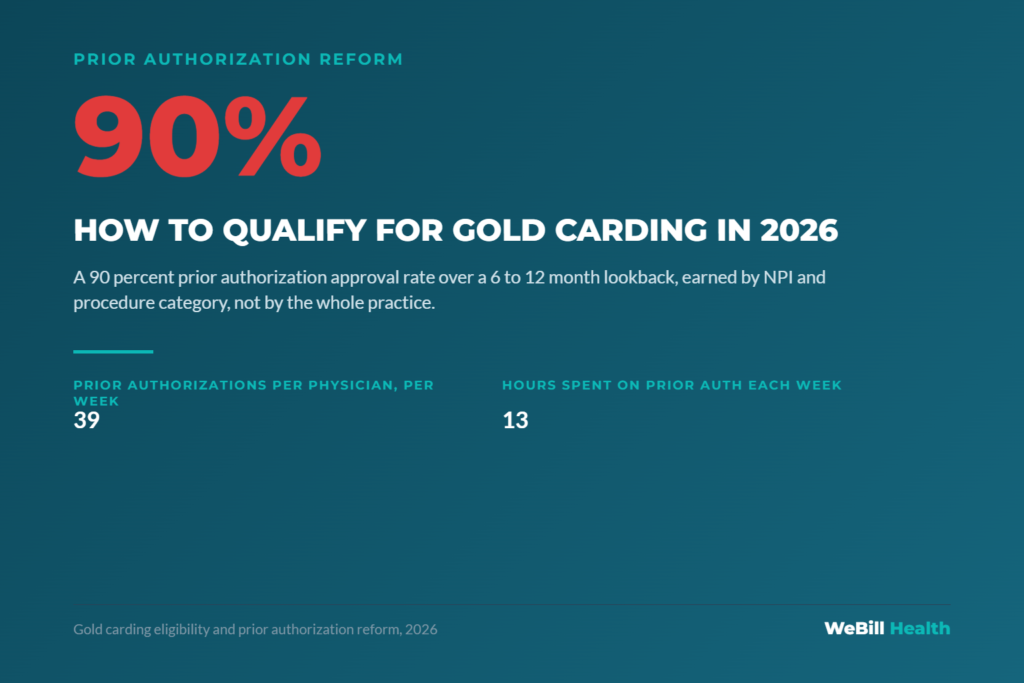
Gold carding exempts a provider from prior authorization on a specific service once they clear roughly a 90 percent approval rate over a 6 to 12 month lookback. It is not one federal program. It is a patchwork of state laws, payer specific pilots, and now a 2026 CMS exemption for DME suppliers, and it is earned by NPI, one procedure category at a time, through documentation clean enough that a payer stops asking twice.
The average physician now submits 39 prior authorization requests a week and spends 13 hours on them, according to the American Medical Association’s most recent survey of 1,000 physicians. Almost 9 in 10 say the process increases burnout. Gold carding is the first real relief valve regulators have offered, and 2026 is the year it stopped being a niche state experiment and started showing up in federal rulemaking.
What follows is the actual eligibility bar, sourced to CMS, the American Podiatric Medical Association, and the state laws already in effect, plus what earns it in practice, not just on paper.
What gold carding actually is in 2026
Texas passed the first gold carding law in 2021 under House Bill 3459. Louisiana followed with Act 220 in 2022, West Virginia with Senate Bill 267 in 2023, and Vermont, Colorado, and Michigan have since enacted their own variations. Separately, UnitedHealthcare and Cigna run voluntary gold carding programs that are not tied to any state law at all.
CMS entered the picture directly in 2026. Durable medical equipment suppliers with a prior authorization approval rate of 90 percent or higher now qualify for an exemption from that requirement, reviewed annually by the DME Medicare Administrative Contractors with at least 60 days notice before an exemption period begins. The American Podiatric Medical Association called it a direct result of years of advocacy, then noted CMS added a new prior authorization requirement for a specific orthotic code the same year. Gold carding is expanding and prior authorization itself is still expanding alongside it. Neither trend is canceling the other out.
The eligibility bar, not the marketing version
| Requirement | What it actually means |
|---|---|
| Approval rate | 90 percent or higher on a specific procedure or service category, not your overall practice average |
| Lookback period | 6 to 12 months of your own submission history, depending on the state or payer program |
| Minimum volume | A floor of roughly 5 to 30 submissions in that category, so a single lucky quarter does not qualify you |
| Who it applies to | Your individual NPI, for that specific service, not your practice as a whole |
| Renewal | Every 6 to 12 months, with the exemption revoked if your approval rate drops below the threshold |
Two details in that table catch most practices off guard. Gold carding is earned per procedure, per provider, not once for the whole practice, so a physician can be exempt from prior authorization on one imaging code and still need it on everything else. And it typically covers only 10 to 30 percent of total prior authorization volume, since high cost drugs, complex surgery, and experimental procedures are usually carved out regardless of your approval rate.
What actually earns it
Nobody qualifies for gold carding by asking for it. The 90 percent threshold is a byproduct of documentation that answers the payer’s medical necessity question completely on the first submission, every time, for that service. A clean prior authorization has the right diagnosis code, the clinical notes that support it, and the payer specific documentation that request actually requires, since every payer’s checklist is different for the same CPT code. Most denials at this stage are not clinical disagreements. They are missing fields, a diagnosis code that does not match the documentation behind it, or a request submitted against the wrong payer policy version. Fix that pattern and the approval rate climbs on its own, which is the entire mechanism gold carding is built to reward.
This is what Clinical Virtual Assistant is built to catch before submission, not after a denial arrives. EHR certified Clinical VMAs manage prior authorizations and real time eligibility verification against the specific payer requirements for your specialty, so the request that goes out the door the first time is the one that gets approved the first time. That is the same approval rate gold carding is measuring.
What to check before you assume you qualify
Pull your own prior authorization approval rate by procedure code over the last 6 to 12 months, not your gut sense of how things have been going. Most practices have never actually run this number, and gold carding eligibility is decided by the number, not the impression. If you practice in Texas, Louisiana, West Virginia, Vermont, Colorado, or Michigan, check whether your state’s specific statute already applies to your specialty and payer mix, since coverage details vary by state. If you are a DME supplier, the 2026 CMS exemption uses the same 90 percent bar with its own annual review cycle.
Frequently asked questions
What is gold carding in medical billing?
It is an exemption from prior authorization on a specific service, earned once a provider demonstrates a high approval rate, typically 90 percent or higher, over a defined lookback period. It applies by individual NPI and by procedure category, not to an entire practice.
How do I qualify for gold carding in 2026?
Maintain a prior authorization approval rate of 90 percent or higher on a specific procedure category over 6 to 12 months, with a minimum submission volume, then check whether your state or payer has a gold carding program that covers that service.
Which states have gold carding laws?
Texas, Louisiana, West Virginia, Vermont, Colorado, and Michigan have enacted gold carding legislation as of 2026. UnitedHealthcare and Cigna also run voluntary gold carding programs independent of state law.
Does gold carding eliminate prior authorization entirely?
No. It typically covers only 10 to 30 percent of total prior authorization volume for a qualifying provider, since high cost drugs, complex surgery, and experimental procedures are usually excluded regardless of approval rate.
Can I lose gold carding status once I have it?
Yes. Status is reviewed every 6 to 12 months, and an approval rate that drops below the threshold, or a compliance issue, ends the exemption at the next review.
What is the fastest way to improve my prior authorization approval rate?
Fix the documentation pattern behind your denials, usually a diagnosis code that does not match the clinical notes, a missing payer specific field, or a request submitted against an outdated policy version. A Clinical Virtual Assistant catches these before submission rather than after a denial.
Find out where your approval rate actually stands
Gold carding eligibility is a number you either have or do not, and most practices have never pulled it.
Request your Revenue Defense Audit. We pull your actual prior authorization approval rate by procedure code, show you exactly where the denials are coming from, and tell you honestly whether gold carding is realistically in reach for your specialty and state.
Prefer to talk it through? Book a 30 minute call with a US based billing manager who works your specialty.
Sources
- CMS Signals Gold Carding Progress While Adding a New Prior Authorization Requirement, American Podiatric Medical Association
- CMS Interoperability and Prior Authorization Final Rule (CMS-0057-F), Centers for Medicare and Medicaid Services
- Fixing Prior Auth: Nearly 40 Prior Authorizations a Week Is Way Too Many, American Medical Association
- Gold Carding for Prior Authorization: How It Works in 2026, Linear Health
- Clinical Virtual Assistant, WeBill Health