
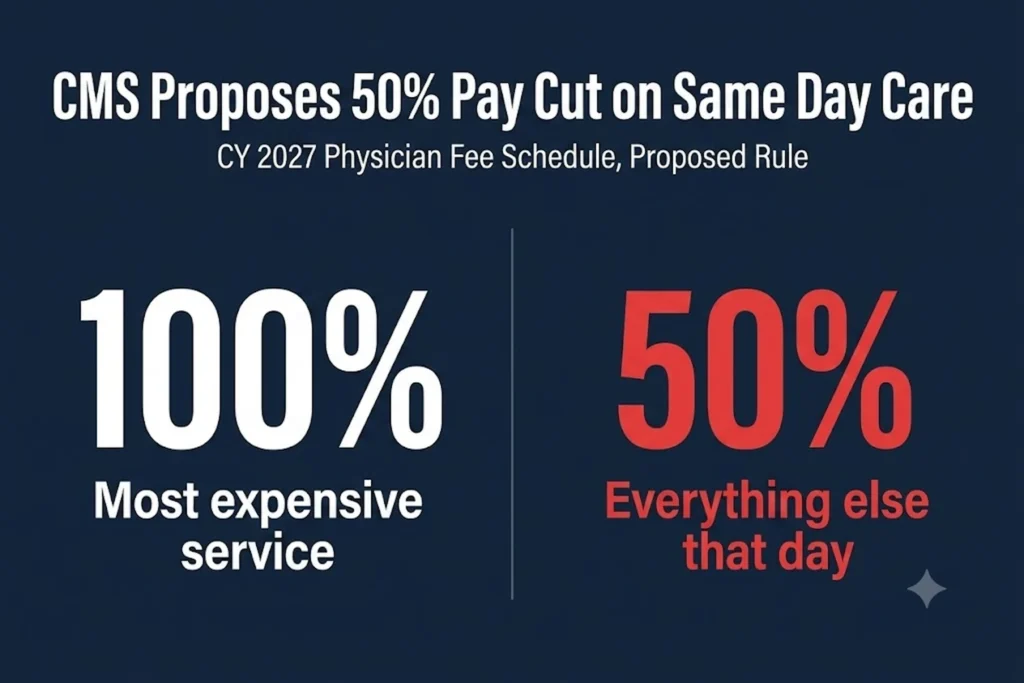
Yes. In the CY 2027 Medicare Physician Fee Schedule proposed rule, CMS proposed paying 100 percent for the most expensive service and 50 percent for every other E/M visit or procedure furnished on the same day by the same physician or group practice. It is a proposal, not final policy. The comment period closes September 14, 2026.
That single paragraph is the whole mechanic, and it is worth reading twice, because it does not behave like anything your billing team currently fights. This is not a denial you appeal. It is not a modifier you correct and resubmit. It is a rate reduction applied at adjudication, on claims that are coded correctly, documented correctly, and fully compliant with CPT guidance on Modifier 25.
Most practices we talk to are still budgeting against the conversion factor. That is the wrong number to watch this year. The conversion factor moves your revenue by roughly one and a half percent. This proposal moves same day encounter revenue by fifty percent on the lesser service, and for a practice whose visit mix is built on procedures performed during office visits, that is a far larger number.
Update, September 8, 2026: more than 150 medical societies, led by the American Medical Association, have formally asked CMS to withdraw this proposal. See what the AMA’s letter argues and what to document now.
What exactly did CMS propose for same day E/M and global procedures?
CMS released the CY 2027 Physician Fee Schedule proposed rule on July 14, 2026. Inside it is a provision titled “Accounting for Overlap Between Stand Alone E/M Visits and Global Periods.” The rule text is short and unambiguous.
| Condition | What CMS proposed |
|---|---|
| Two services, same date of service | Policy triggers |
| Same physician, or a physician in the same group practice | Policy triggers |
| Procedure carries a 0 day, 10 day, or 90 day global period | Policy triggers |
| Most expensive service that day | Paid at 100 percent |
| Every other surgical procedure or E/M visit that day | Paid at 50 percent |
The American Medical Association has confirmed it will oppose the policy, describing it in its July 31, 2026 advocacy update as a proposed reduction in payment for Modifier 25 claims. That framing is the correct one. Modifier 25 exists precisely to identify a significant, separately identifiable E/M service performed on the same day as a procedure. This proposal does not question whether that service happened. It pays half for it anyway.
Which specialties lose the most revenue under this proposal?
Exposure is not evenly distributed. It concentrates in practices whose normal clinical day involves an evaluation and a procedure in the same encounter. If you want the full specialty by specialty breakdown of where revenue leaks, we maintain one, but the short version for this rule is below.
| Specialty group | Typical same day pattern | Exposure |
|---|---|---|
| Family Medicine, Internal Medicine, Pediatrics, Urgent Care | Office visit plus lesion removal, joint injection, laceration repair, skin biopsy | High. Modifier 25 is already the largest denial category in this group. |
| Orthopedics, Podiatry, Pain Management, Physiatry | Evaluation plus injection or minor procedure inside a 10 day or 90 day global window | High. Compounds existing bundling and global period losses. |
| Dermatology, ENT, Gastroenterology, Urology | Consultation plus same day procedure | High. Procedure driven visit economics. |
| OBGYN | Office visit plus procedure outside the maternity global package | Moderate to high, depending on global package boundaries. |
| Behavioral health, Physical Therapy, Occupational Therapy | Time based coding without same day global procedures | Low direct exposure here. Unit level risk sits in the 8 minute rule instead. |
If your practice sits in the first three rows, this is not a policy story. It is a forecast revision.
Why does CMS say the current payment is duplicated?
CMS justifies the reduction by arguing there are efficiencies when the same physician provides an E/M service in conjunction with a procedure carrying a global period, and that the current methodology is, in the agency’s own words, “likely duplicating payment.”
Here is the part almost no one covering this rule has connected, and it is the reason we think the provision is analytically weak rather than merely unpopular.
In the practice expense section of the same proposed rule, CMS describes the data underpinning that very methodology as “resource intensive but ultimately unreliable surveys with low response rates,” and commits to a multi year effort to replace it with what the agency calls objective, auditable, routinely updated cost data.
Read the two positions together. CMS is asserting that it can detect payment duplication inside a cost methodology it simultaneously calls unreliable enough to dismantle. Either the practice expense data is precise enough to prove duplication exists, in which case the overhaul is unnecessary, or it is not precise enough, in which case a fifty percent reduction is resting on numbers the agency has already disowned. Both positions cannot be true at once, and CMS does not reconcile them anywhere in the rule.
The American Academy of Family Physicians made the underlying version of this argument in 2018, when Blue Cross Blue Shield of Rhode Island attempted an identical fifty percent policy. The AAFP position was that the resource based relative value scale already accounts for redundancy when a minor procedure occurs during an E/M encounter. Applying a further fifty percent cut on top of that does not correct double payment. It creates double counting in the opposite direction.
That argument was correct in 2018 and it is stronger in 2026, because CMS has now put in writing that the redundancy calculation it relies on is built on data it does not trust.
You do not need a final rule to know what this costs you
Most practices reading this will do nothing until November, when the final rule drops. That is the expensive choice, and here is why.
The exposure already exists in your claims data. Every same day encounter you billed in the last twelve months where an E/M visit accompanied a global procedure is a line item that would have been cut in half under this policy. That number is knowable today. It is sitting in your accounts receivable right now, and almost no practice has run it.
Knowing the number changes what you do next. If it is small, you stop worrying and redirect attention to credentialing or A/R aging. If it is large, you have six weeks to file a comment that cites your own data, and a year to tighten the documentation that will decide whether these encounters survive the audit scrutiny that follows any high visibility payment policy.
Most practices do not know where they sit on that spectrum, because the exposure lives across three separate places: how clean your claims go out, how your denials cluster by root cause, and how long your money sits in A/R. Those three together are what a Revenue Defense Score measures.
Get your Revenue Defense Score. Six questions, sixty seconds, and a benchmarked view of how well your practice prevents, detects, and recovers lost revenue in your specialty. It will not tell you your exact Modifier 25 exposure, no six question estimate can. It will tell you whether your revenue defense posture can absorb a policy like this one at all.
Has a 50 percent Modifier 25 cut been tried before?
Twice, and the history matters.
CMS proposed a structurally similar policy in the CY 2019 Physician Fee Schedule proposed rule and did not finalize it. In the 2027 rule, CMS explicitly notes that it declined to finalize the earlier version but “continued to believe” the duplication exists. That is not an agency abandoning a position. That is an agency restating an eight year old conviction and waiting for a better moment.
On the commercial side, Blue Cross Blue Shield of Rhode Island implemented a fifty percent reduction for E/M services billed with a same day procedure in 2018. Anthem announced a version of the same policy and then halted it after physician pushback. Both events predate any federal action.
The practical conclusion for your practice is uncomfortable. Commercial payers do not need CMS to finalize anything. They have run this play before, and a federal proposed rule gives every payer policy committee in the country cover to revisit it. Whether CMS finalizes the provision in November changes the Medicare math. It does not remove the commercial risk.
What does this rule reveal about how CMS is thinking?
Look at the 2027 rule as a whole and a pattern emerges that we think is the real story.
In the same proposed rule, CMS moved to bar payment for remote physiologic and remote therapeutic monitoring when those services are delivered by contracted clinical staff rather than staff employed by the practice. The stated concern traces to Office of Inspector General findings that flagged 45 outlier practices out of more than 4,600 that billed remote monitoring in 2024, including one entity billing for tens of thousands of enrollees it had no prior relationship with.
Forty five practices out of forty six hundred is roughly one percent. The proposed remedy applies to all of them.
That is the same structural choice CMS made on Modifier 25. In both cases the agency reached for a blanket rule affecting every compliant practice, where targeted enforcement against identified outliers was available and, in the remote monitoring case, where OIG had already demonstrated that ordinary claims analysis finds the violators.
The AAFP asked Blue Cross Blue Shield of Rhode Island to identify outliers rather than penalize every physician in the market. That request is eight years old. It is still the right request, and it is still unanswered.
Our read, stated plainly: CMS is choosing structural rate policy over enforcement because structural policy is cheaper to administer and produces predictable budget savings. Enforcement requires investigators and appeals. A rate cut requires a line of regulatory text. Practices that document well and bill correctly subsidize the difference.
What should your practice do before September 14, 2026?
- Quantify your same day encounter volume. Pull twelve months of claims where an E/M visit with Modifier 25 was billed alongside a 0 day, 10 day, or 90 day global procedure. Calculate the dollars that would be reduced by half. This is your actual exposure, not an industry estimate.
- Audit your Modifier 25 documentation against the standard, not against your denial rate. A low denial rate today does not mean the documentation would survive review. It means nobody has looked yet. The standard is a significant, separately identifiable service, documented as such. If you are not already tracking which denial codes your practice repeats, start there.
- File a comment with your own numbers. CMS accepts comments through September 14, 2026. Comments containing practice specific financial data and access consequences carry substantially more weight than form letters. The 2019 precedent shows this provision is capable of being withdrawn.
- Check your commercial contracts for existing same day reduction language. Some payers already apply a version of this. Practices frequently discover the clause during a dispute rather than during contracting.
- Model the downside into your 2027 budget now. If the provision is finalized in November, you will have six weeks before it takes effect on January 1. That is not enough time to restructure visit workflows.
How WeBill Health defends same day encounter revenue
We are going to be precise about what we do, because this industry is full of vendors describing software they do not have.
WeBill Health maintains internal payer rule libraries organized by specialty and by carrier. Those libraries are built and updated by people who work claims in your specialty every day, and every claim receives human pre submission review against them before it goes out. There is no black box and no algorithm we ask you to take on faith. When a payer changes a policy, a person updates the library and a person applies it to your claims.
For a provision like this one, that means our coders know which of your encounters pair an E/M visit with a global procedure, whether the documentation carries the separately identifiable burden Modifier 25 requires, and which of your carriers already applies a same day reduction in contract language most practices never read. That root cause work is what Denial Defense 2.0 exists to do, and it runs across the whole revenue cycle, not just the appeals queue.
Our providers operate on a 98 percent clean claim rate, a 48 hour submission guarantee, and a 40 percent average reduction in accounts receivable. Every claim is coded and documented to hold up under audit from the day it is submitted, not from the day an auditor arrives. Under the Transparency Protocol you get a dedicated US based billing manager reachable by direct line and weekly velocity reports showing exactly where your money sits.
We operate on a revenue share model. When your collections fall, our revenue falls with them. That is why a proposed rule that threatens half the payment on your same day encounters is our problem before it is your problem.
Frequently asked questions
Is the CMS Modifier 25 payment cut final?
No. It is a proposal contained in the CY 2027 Medicare Physician Fee Schedule proposed rule issued July 14, 2026. CMS accepts public comments through September 14, 2026, and typically issues the final rule in early November. CMS proposed a structurally similar policy in 2019 and did not finalize it.
How much would my practice lose under the proposed rule?
It depends entirely on how many of your encounters pair an E/M visit with a 0 day, 10 day, or 90 day global procedure on the same date of service. The lesser paid of the two services would be reduced by 50 percent. Practices in family medicine, orthopedics, podiatry, pain management, dermatology, and gastroenterology carry the highest exposure because same day evaluation and procedure is their standard clinical pattern.
Does this apply if a different physician in my group performs the procedure?
Yes. As proposed, the policy applies when the services are furnished by the same physician or by a physician in the same group practice. Splitting the encounter between two providers in the same group does not avoid the reduction.
Will correct Modifier 25 documentation prevent the reduction?
No. This is a payment policy, not a denial rule. Correct documentation determines whether the claim is payable and whether it survives an audit. It does not determine the rate. That distinction is why appealing will not work and why documentation still matters enormously for audit exposure.
Can commercial payers apply the same 50 percent reduction?
Yes, and some already do. Blue Cross Blue Shield of Rhode Island implemented a 50 percent reduction for E/M services billed with same day procedures in 2018. Anthem announced and then withdrew a similar policy. Commercial payers set their own reimbursement policy and do not require CMS to finalize this provision first.
Find out what this actually costs your practice
Industry estimates will not tell you your number. Your claims will.
Request your Revenue Health Audit. We run a forensic review of your existing accounts receivable, quantify your same day encounter exposure under the proposed rule, and show you exactly where your Modifier 25 documentation would fail a payer review today. You get the number, whether or not you ever work with us.
Prefer to talk it through first? Book a 30 minute Revenue Defense Audit call with a US based billing manager who works your specialty. No cost, no obligation, no call center.
Sources
- Calendar Year (CY) 2027 Medicare Physician Fee Schedule Proposed Rule, CMS Fact Sheet, July 14, 2026
- CY 2027 Payment Policies Under the Physician Fee Schedule, Federal Register
- July 31, 2026 National Advocacy Update, American Medical Association
- AAFP Decries 50 Percent Cut for E/M Codes with Modifier 25, American Academy of Family Physicians
- CMS proposed ban on contracted RPM staff should not survive the comment period, Medical Economics
- CMS Issues CY 2027 Medicare Physician Fee Schedule Proposed Rule, Holland and Knight