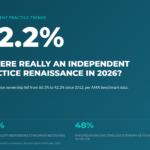

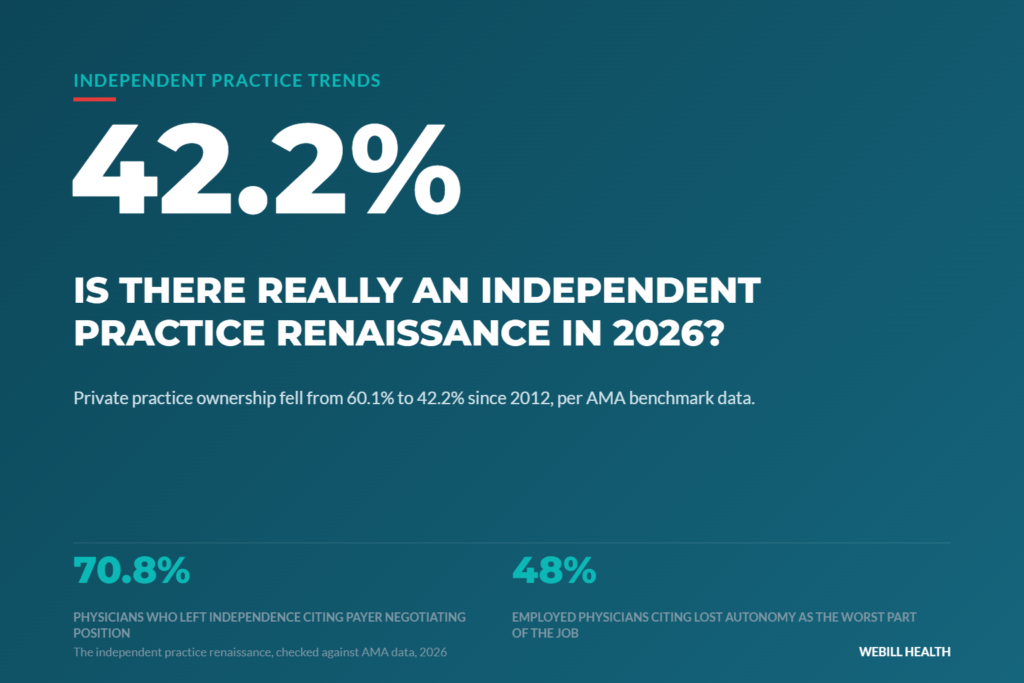
The share of physicians in private practice fell from 60.1 percent in 2012 to 42.2 percent in 2024, according to the American Medical Association’s own benchmark survey. Hospital and corporate employment kept climbing every year in between. By the numbers, there is no independent practice renaissance happening in 2026. There is a widening gap between how many physicians want to leave and how many actually do, and that gap is where the real story is.
Healthcare media has been running the renaissance narrative for a while now, physicians reclaiming autonomy, brokers and associations publishing guides on what independence requires. Some of that is real. Physicians who are self employed consistently rate autonomy higher and burnout lower than their employed peers. But wanting out of employment and successfully building an independent practice are two different events, and the data shows most of the movement is still happening in one direction.
What follows is what the actual numbers say, sourced to the AMA’s own practice benchmark data, so you can see past the headline and into what is really stopping physicians from making the leap.
What the data actually shows
The AMA’s practice benchmark survey found private practice ownership dropped from 60.1 percent of physicians in 2012 to 42.2 percent in 2024, a 17.9 percentage point decline. Over the same period, hospital owned practice employment rose from 23.4 percent to 34.5 percent, and direct hospital employment or contract arrangements rose from 5.6 percent to 12.2 percent. Practices with 10 or fewer physicians shrank from 61.4 percent of the physician workforce to 47.4 percent.
Consolidation pressure compounds the trend from a separate angle. A December 2025 Progressive Policy Institute report found the share of physicians employed by hospitals, health systems, or corporate entities rose from 62 percent in 2019 to 78 percent in 2023. Whichever survey you look at, the direction is the same. Independence is a shrinking share of the physician workforce, not a growing one.
So why does the renaissance narrative keep circulating
Because the desire is real, even where the outcome isn’t yet. Medscape’s 2025 Self Employed Physicians Report found 65 percent of self employed physicians rate autonomy as very important to their satisfaction, and Medscape’s companion Employed Physicians Report found 48 percent of employed physicians say diminished autonomy is the worst part of their job. Overall physician burnout has come down from a pandemic peak of 62.8 percent in 2021 to 43.2 percent in 2024, according to AMA tracked data, and independent physicians consistently report lower burnout than employed physicians within that overall improvement.
That combination, high value placed on autonomy and a documented cost to losing it, is exactly the fuel behind every renaissance headline. It is a real sentiment. It has just not yet translated into a reversal of the ownership numbers above.
The real reason most who want out don’t leave
Physicians who left independent practice were asked why they made that move, and the top answers were not clinical. A stronger negotiating position with payers ranked highest at 70.8 percent, followed by better access to costly resources at 64.9 percent, and better management of payer regulatory and administrative requirements at 63.6 percent. Medicare physician payment has also declined 33 percent from 2001 to 2025 once adjusted for inflation, which raises the stakes on every one of those three answers.
Read that list again from the other direction. Those are not reasons independence is a bad decision. They are the exact three problems a billing and revenue infrastructure has to solve before independence is survivable: payer contracting position, resource access, and administrative load. Physicians are not choosing employment because they prefer it. They are choosing it because nobody handed them a credible answer to those three problems before they had to sign.
What actually has to be in place before the leap
A newly independent practice cannot bill most payers until its providers are credentialed, which is why Revenue Velocity Credentialing exists as an entry point rather than an afterthought, running CAQH attestation and PECOS enrollment continuously instead of on a manual once a week check. Once billing starts, the administrative burden that pushed 63.6 percent of physicians back toward employment does not disappear on its own. It has to be replaced with specialty specific coding, human pre submission claim review against internal payer rule libraries, and a revenue share alignment model where WeBill Health’s outcome is tied to the practice’s collections instead of claim volume.
None of that is a reason to stay employed. It is the checklist that makes leaving survivable instead of a two year cash flow gamble.
Request a Revenue Defense Audit before you make the leap, not after. We show you what your actual payer mix, credentialing timeline, and collections would look like independent, using your own numbers instead of a national average.
Frequently asked questions
Is independent medical practice actually growing in 2026?
No, not by the AMA’s own numbers. Private practice ownership fell from 60.1 percent of physicians in 2012 to 42.2 percent in 2024. The renaissance narrative reflects rising physician interest in autonomy, not a reversal in the ownership data.
Why do so many physicians want to leave employed practice if the numbers show consolidation?
Medscape’s 2025 surveys found 65 percent of self employed physicians rate autonomy as very important, while 48 percent of employed physicians cite diminished autonomy as the worst part of their job. Desire to leave is high even where actual departures remain low.
What actually stops a physician from going independent?
AMA survey data on physicians who left independent practice found a stronger payer negotiating position, access to costly resources, and payer administrative burden were their top reasons, at 70.8 percent, 64.9 percent, and 63.6 percent respectively. Those are operational and financial barriers, not clinical preferences.
Has physician burnout gotten better or worse recently?
Better overall. AMA tracked data shows burnout fell from a pandemic peak of 62.8 percent in 2021 to 43.2 percent in 2024, though independent physicians still report lower burnout than employed physicians within that broader improvement.
What does a physician need in place before opening an independent practice?
Credentialing across CAQH and PECOS before the first claim can be billed, a coding and claims review process built for the specialty rather than generic, and a payer contracting strategy, since payer negotiating position is the single largest reason physicians cite for leaving independence in the first place.
Does private equity consolidation make independence riskier?
It changes the competitive landscape more than the operational requirements themselves. A December 2025 Progressive Policy Institute report found corporate and health system physician employment rose from 62 percent in 2019 to 78 percent in 2023, which means independent practices increasingly compete against better capitalized, larger organizations for patients and staff.
Considering the leap yourself
The renaissance headlines are ahead of the actual numbers. That gap is exactly where a practice that gets its billing infrastructure right before opening its doors has room to move.
Request your Revenue Defense Audit. We pull the real numbers for your specialty and market before you decide, not after you have already signed a lease.
Prefer to talk it through? Book a 30 minute call with a US based billing manager who works your specialty.
Sources
- Smaller share of doctors in private practice than ever before, American Medical Association
- Good news for private practice, Becker’s Physician Leadership, citing a December 2025 Progressive Policy Institute report and Medscape’s 2025 Self Employed and Employed Physicians Reports
- Revenue Velocity Credentialing, WeBill Health
- Revenue Defense Audit, WeBill Health