
Why Is My Orthopedic Surgery Claim Being Denied for Bundled Procedures?
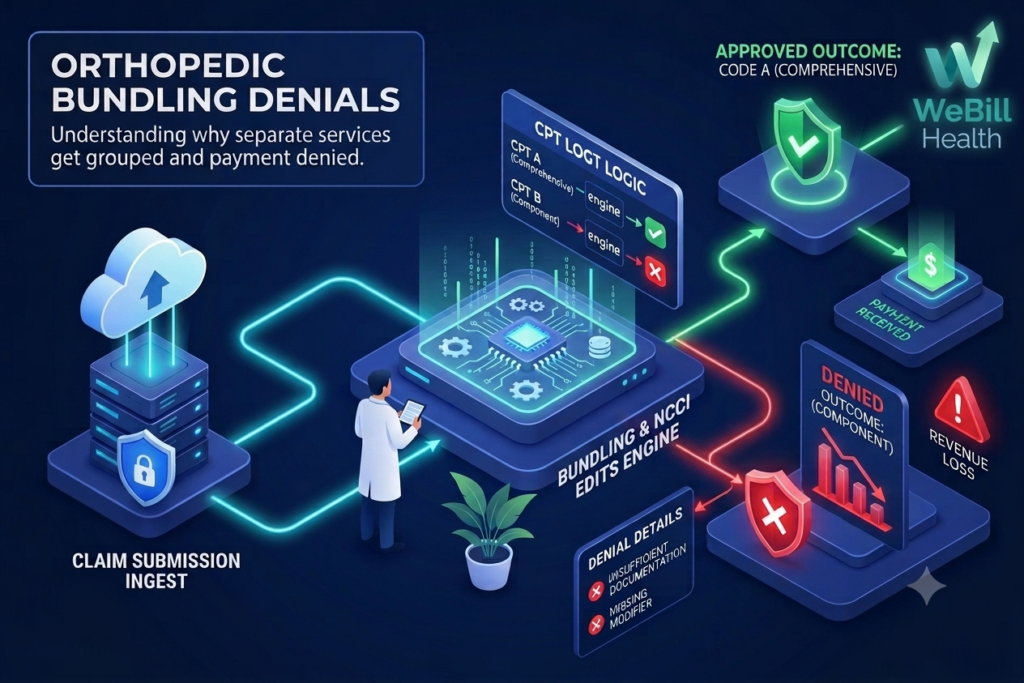
Payers bundle component procedures with primary procedures under the National Correct Coding Initiative (NCCI) edits unless separated by the correct modifier and supported by operative documentation. When a surgeon performs multiple procedures during the same operative session on the same anatomical site—meniscectomy and chondroplasty in a knee arthroscopy, or rotator cuff repair combined with extensive shoulder debridement—payers treat the secondary code as a component of the primary procedure and deny it as “included.” Without proper modifier strategy before claim submission, secondary procedures deny automatically.
The core issue is not medical necessity. The surgeon performed three distinct procedures with separate clinical indications. The issue is technical coding. Payers pay based on code pairs. If your biller submits multiple codes without the correct modifier override, the payer’s automated system applies NCCI bundling edits and denies the secondary codes. The solution requires identifying each code pair in advance, running it against NCCI edits, determining whether Modifier 59 or an X-modifier is permitted, documenting distinct anatomical sites or separate services in the operative report, and validating the claim before submission.
This is not reactive appeals work. This is preventive claim validation. The difference between bundling denials and clean claims is whether your billing process validates code pairs against NCCI before the claim is ever sent to the payer.
SCENARIO 1: Knee Arthroscopy with Multiple Therapeutic Interventions Without Proper Modifier
The Case
A knee surgeon performs arthroscopy with meniscectomy (CPT 29881), chondroplasty of the articular cartilage (CPT 29877), and limited synovectomy in a secondary compartment (CPT 29875). All three procedures occur during the same operative session on the same knee. The surgeon documents three distinct findings in the operative report: a medial meniscus tear, cartilage degradation in the lateral compartment, and synovial inflammation in the suprapatellar pouch. Each procedure is medically necessary and documented. The claim is submitted with all three codes, no modifiers appended.
What Happens:
The payer receives the claim and runs it against NCCI edits. The system identifies that CPT 29877 (chondroplasty) is bundled into CPT 29881 (meniscectomy) under NCCI rules. The system also identifies that CPT 29875 is a “separate procedure” that cannot be billed with other knee arthroscopy codes on the same knee without a modifier. The payer denies both the chondroplasty and the synovectomy. The meniscectomy approves. The remittance advice shows remark code M15: “Separately billed services/tests have been bundled as they are considered components of the same procedure.”
The practice loses $3,200 in immediate reimbursement and must now pursue an appeal or resubmit with corrected coding.
Root Cause Analysis: Why the Bundling Rule Triggered
1. No Pre-Submission NCCI Edit Validation The biller did not query the NCCI Edits database before submitting the claim. If they had, they would have discovered that codes 29881 and 29877 carry a Modifier Indicator of 1 (meaning modifiers are permitted) and are flagged as bundled. The same check would have shown that 29875 requires a modifier override to be separately reportable.
2. Modifier 59 Not Applied The biller submitted the claim without appending Modifier 59 (Distinct Procedural Service) to the secondary codes. Modifier 59 signals to the payer that the chondroplasty was performed in a distinct anatomical compartment or as a separate intervention, not as part of the routine meniscectomy.
3. Documentation Not Linked to Modifier Logic The operative report documents the three procedures but does not explicitly state that each was performed in a different compartment or with separate clinical rationale. The documentation supports the medical necessity but does not provide the technical justification for the modifier override.
4. Payer-Specific NCCI Rule Misunderstanding NCCI edits apply across Medicare, but some commercial payers (UnitedHealthcare, BCBS) have additional proprietary bundling rules. The biller did not verify whether UnitedHealthcare had updated its bundling rules—which it did in Q3 2025 by adding 847 new code pairs to its unbundling detection list.
5. Claim Submitted Without Running Bundling Checks The claim went directly to the payer without passing through a claims validation system (such as CCI software or an encoder). No edits flagging the bundling conflict were caught before payer submission.
The Prevention Framework: How to Prevent This Bundling Denial
Step 1: Pre-Submission NCCI Edit Validation Before assembling the claim, query the NCCI Edits database for every code pair. For the knee arthroscopy case:
- Query: 29881 paired with 29877. Result: Bundled. Modifier Indicator: 1 (modifiers allowed).
- Query: 29881 paired with 29875. Result: Bundled. Modifier Indicator: 1 (modifiers allowed).
- Document these findings in the claim worksheet before the biller touches the claim.
Step 2: Correct Modifier Strategy
- For CPT 29877: Append Modifier 59 to signal distinct cartilage work performed in a different knee compartment than the meniscectomy.
- For CPT 29875: Append Modifier 59 to signal distinct synovectomy in a separate anatomical area.
- Do not use Modifier 51 (Multiple Procedures), which triggers automatic payment reduction.
Step 3: Operative Documentation Alignment
- Review the operative report.
- Confirm explicit documentation of each distinct procedure: “Medial meniscectomy of the medial compartment,” “Chondroplasty of the lateral femoral condyle,” and “Synovectomy of the suprapatellar pouch.”
- Link operative findings to the modifier logic: the chondroplasty occurred in a different compartment than the meniscectomy, making it separately reportable.
Step 4: Payer-Specific Rule Verification
- Before claim submission, verify that your payer (UnitedHealthcare, BCBS, Aetna) does not have additional proprietary bundling rules that override NCCI.
- Check the payer’s LCD (Local Coverage Determination) and bundling guidance.
Step 5: Claims Validation Before Submission
- Run the completed claim through a claims validation system.
- Validate all code pairs against NCCI edits.
- Ensure modifiers are correctly appended and that the payer’s bundling rules accept the override.
- Reject any claim that flags a bundling conflict.
- Only submit claims that pass all validation checks.
Expected Outcome
The surgeon recovers the full $3,200 in denied reimbursement. All three codes approve for separate payment because the claim now clearly documents distinct services with correct modifier application and operative support. Future multi-compartment knee arthroscopy cases follow the same validation protocol, and bundling denials on this procedure combination drop to near zero.
A: Payers bundle component procedures under NCCI edits unless separated by Modifier 59 and supported by operative documentation that explicitly links distinct anatomical work to each code. Chondroplasty performed in a different knee compartment than the meniscectomy is separately reportable if documented as such and submitted with Modifier 59. The solution requires pre-submission NCCI validation to identify bundling rules, correct modifier application to override bundling, and operative documentation that connects distinct services to separate codes before claim submission.
SCENARIO 2: Shoulder Arthroscopy with Rotator Cuff Repair and Debridement Submitted with Modifier 51
The Case
A shoulder surgeon performs diagnostic arthroscopy, extensive debridement of the subacromial space (CPT 29823), and rotator cuff repair with a single-row technique (CPT 29827). The operative report documents significant calcific deposits requiring removal, chronic rotator cuff pathology, and a complete rotator cuff tear requiring repair. The procedures are clinically distinct: the extensive debridement removes scar tissue and calcium; the rotator cuff repair reattaches the tendon.
The biller submits the claim with all three codes and appends Modifier 51 (Multiple Procedures) to codes 29823 and 29827, intending to signal that multiple procedures occurred in the same session.
What Happens:
The payer receives the claim. Its system applies NCCI bundling logic. The system identifies that extensive shoulder debridement (29823) is not bundled with rotator cuff repair (29827)—they are separately reportable. However, the presence of Modifier 51 triggers additional scrutiny. The payer applies its Multiple Procedure Payment Reduction (MPPR) logic and pays the secondary code at 50% of its normal fee schedule amount.
Instead of receiving $4,800 for the rotator cuff repair, the practice receives $2,400. The modifier selection reduced payment by $2,400 on a single case.
Root Cause Analysis: Why the Modifier Selection Triggered Payment Reduction
1. Modifier Confusion: When to Use Modifier 51 vs. Modifier 59 Modifier 51 signals “multiple independent procedures” and automatically triggers a payment reduction. Modifier 59 signals “distinct procedural service” and overrides bundling without reduction. The biller used Modifier 51 when Modifier 59 was correct because they were thinking “multiple procedures” rather than “are these codes bundled?”
2. No NCCI Pairing Analysis Before Claim Submission The biller did not check whether codes 29823 and 29827 are bundled under NCCI. They are not. These are separately reportable without any modifier. The correct approach would have been to submit the codes without modifiers and let them approve as separate services.
3. Procedure Hierarchy Misunderstanding in Arthroscopic Cases The biller assumed that multiple procedures in the same shoulder session required Modifier 51. In fact, arthroscopic shoulder codes are designed to be reported separately when distinct work is performed at different anatomical locations (bursa, rotator cuff, biceps, AC joint). The question is not “are there multiple procedures?” The question is “are these codes bundled?”
The Prevention Framework: How to Prevent This Modifier Selection Error
Step 1: NCCI Edit Pairing for All Arthroscopic Codes Query NCCI for codes 29823 and 29827. Result: Not bundled. No modifier required. The codes are independently reportable.
Step 2: Correct Modifier Strategy
- Do not append any modifier to either code.
- Only append Modifier 59 when NCCI indicates that codes are bundled (Modifier Indicator of 1) but are separately reportable in this case.
- Never append Modifier 51 to arthroscopic component codes.
Step 3: Documentation Requirement
- The operative report must document that the debridement and rotator cuff repair were performed in distinct anatomical areas.
- State: “Extensive debridement of subacromial space with removal of calcific deposits” and separately “Rotator cuff repair of the supraspinatus tendon.”
Step 4: Payer-Specific Validation
- Verify that your payer recognizes 29823 and 29827 as separately reportable.
- For UnitedHealthcare and BCBS, check their proprietary bundling rules in addition to NCCI.
Step 5: Claims Validation Before Submission
- Run the claim through validation.
- Confirm that both codes submit cleanly without modifiers.
- Verify that the payer’s system does not flag an unbundling warning.
- Submit only after validation confirms both codes are separately payable.
Expected Outcome
The practice receives full reimbursement: $4,800 for the rotator cuff repair plus the base fee for debridement. No payment reduction. Future shoulder arthroscopy cases with multiple procedures follow the same validation protocol, preventing systematic underpayment on high-value cases. The practice recovers $2,400 on this single case and prevents ongoing losses on future cases.
A: Modifier selection determines payment logic. Modifier 51 (Multiple Procedures) triggers an automatic payment reduction. Modifier 59 (Distinct Procedural Service) overrides bundling without reduction. If your secondary codes are not bundled under NCCI (meaning they are independently reportable), submit them without any modifier. Never use Modifier 51 to bypass bundling—use it only when multiple independent procedures occur and both merit full payment. Always validate code pairs against NCCI before claim submission to determine whether any modifier is needed at all.
SCENARIO 3: Emergency Orthopedic Trauma with Complex Fracture Fixation and Modifier Misapplication
The Case
A patient arrives in the emergency department with a complex proximal humerus fracture involving the surgical neck, tuberosity, and articular surface. The surgeon performs an open reduction internal fixation (ORIF) with plate and screw fixation (CPT 23616), rotator cuff repair (CPT 23412) due to intra-operative discovery of a complete supraspinatus tear, and subacromial decompression (CPT 23130) to allow proper rotator cuff healing.
The biller, recognizing the emergency status and knowing that multiple high-value procedures were performed, appends Modifier ET (Emergency Treatment) to all secondary codes, believing this will override normal bundling restrictions and signal emergency clinical necessity.
What Happens:
The claim is submitted to Medicare with Modifier ET on codes 23412 and 23130. Medicare receives the claim and processes it. The modifier ET is recognized, but it is a facility-level modifier valid only for ASC (Ambulatory Surgical Center) claims and emergency department facility charges, not for professional/surgeon billing. The payer rejects the modifier as invalid for a professional claim and denies the secondary codes as bundled.
The practice loses $8,200 in denied reimbursement on a high-value emergency case and must appeal with new documentation, which delays payment by 45+ days.
Root Cause Analysis: Why Medical Necessity Does Not Override Bundling Rules
1. Modifier ET Misapplication (Facility Modifier, Not Professional) Modifier ET signals emergency facility services and is valid only for facility claims. It is not valid for surgeon/professional claims. The biller assumed emergency status overrides coding rules. It does not.
2. Assumption That Medical Necessity Overrides Bundling Edits The biller correctly identified that all three procedures were medically necessary. However, medical necessity is the clinical foundation—it does not override NCCI bundling edits. Correct coding and modifiers are the technical path to payment.
3. No Pre-Submission Modifier Validation The biller did not check whether Modifier ET is valid for professional claims or verify the bundling status of the code pairs. A simple NCCI query would have shown that CPT 23412 and 23130 are separately reportable from CPT 23616 with appropriate modifiers (or no modifiers at all, depending on the payer).
The Prevention Framework: How to Handle Complex Emergency Coding
Step 1: Identify the Primary Procedure and NCCI Pairings
- Primary: CPT 23616 (ORIF proximal humerus with plate fixation).
- Secondary 1: CPT 23412 (rotator cuff repair).
- Secondary 2: CPT 23130 (subacromial decompression).
- Query NCCI for each pair. Determine bundling status and modifier indicators.
Step 2: Determine Correct Modifier Strategy
- Do not use Modifier ET for professional claims.
- Use Modifier 59 only if NCCI indicates bundling with Modifier Indicator of 1.
- If the procedures are separately reportable under NCCI, submit without modifiers.
- If NCCI indicates no override permitted (Modifier Indicator of 0), the secondary codes cannot be separately billed.
Step 3: Document Operative Findings That Support Distinct Coding
- The operative report must document: “Rotator cuff repair required due to full-thickness supraspinatus tear discovered intra-operatively” and “Subacromial decompression performed to allow rotator cuff healing and prevent impingement.”
- Each procedure requires its own operative documentation—separate findings, separate clinical indication, separate technique.
Step 4: Submit a Cover Letter Explaining the Emergency Context
- Do not assume emergency status overrides bundling rules. Instead, submit a cover letter that explains the emergency presentation and the separate clinical indications for each procedure.
- Example: “This patient presented emergently with a complex proximal humerus fracture requiring ORIF and intra-operative discovery of a complete rotator cuff tear requiring concurrent repair and subacromial decompression. Each procedure is separately documented and distinct.”
Step 5: Validate All Code Pairs Before Resubmission
- Run the claim through validation with corrected modifiers.
- Ensure all code pairs pass NCCI validation.
- Confirm the payer’s system does not flag bundling warnings.
- Submit only after validation confirms clean claim status.
Expected Outcome
The practice resubmits with correct modifier strategy and operative documentation. All three codes now approve for separate payment. The practice recovers the full $8,200 in denied reimbursement. The operative report clearly documents the emergency presentation and separate clinical indications, protecting the practice from post-payment audit exposure. Future emergency trauma cases follow the same validation protocol.
Q: What do I do when my emergency orthopedic surgery claim is denied as bundled despite documented medical necessity?
A: Modifier selection determines payment logic. Modifier 51 (Multiple Procedures) triggers an automatic payment reduction. Modifier 59 (Distinct Procedural Service) overrides bundling without reduction. If your secondary codes are not bundled under NCCI (meaning they are independently reportable), submit them without any modifier. Never use Modifier 51 to bypass bundling—use it only when multiple independent procedures occur and both merit full payment. Always validate code pairs against NCCI before claim submission to determine whether any modifier is needed at all.
DENIAL PREVENTION FRAMEWORK: The WeBill Approach
How to Prevent Bundling Denials Before They Happen
Bundling denials follow predictable patterns. They are not random. Orthopedic practices can prevent them by implementing a pre-submission validation process before claims are sent to payers.
Layer 1: Pre-Submission NCCI Edit Validation
Query the NCCI Edits database for every code pair submitted on the same date of service. Identify bundling status (bundled or not bundled). Note the modifier indicator: 1 means modifiers are allowed; 0 means no override is permitted; 9 means payer-specific rules apply. Document findings before claim assembly.
Layer 2: Modifier Strategy Development
For each bundled code pair where Modifier Indicator is 1, select Modifier 59 (or the specific X-modifier: XS for separate structure, XE for separate encounter, XP for separate practitioner, XU for unusual non-overlapping service). For code pairs that are not bundled, submit without modifiers. Do not use Modifier 51 for bundled component codes. Do not use facility modifiers (ET, EM, EP) on professional claims. Verify modifier rules with the specific payer before claim submission.
Layer 3: Operative Documentation Alignment
Pull the operative report. Confirm explicit documentation of each distinct procedure: location, technique, clinical indication. Link operative findings to the modifier logic. For example: “Debridement of the subacromial space (separate location from the rotator cuff repair)” or “Chondroplasty of the lateral compartment (distinct anatomical site from meniscectomy in medial compartment).” Ensure documentation supports the “distinct procedural service” claim.
Layer 4: Claims Validation Before Submission
Run the claim through a claims edits system (CCI software, Encoder Pro, payer-specific tools). Validate all code pairs against NCCI edits. Validate all modifiers against modifier indicator rules. Reject any claim that flags a modifier mismatch or bundling conflict. Only submit claims that pass all validation checks.
Key Principle
The goal is not to manage denials after they happen. The goal is to prevent them before claim submission. This requires real-time NCCI validation and modifier verification, not reactive appeals and resubmissions.
Implementation Timeline and Results
Practices implementing pre-billing NCCI checks report 87% reductions in NCCI denials and recovery of $52,000 in previously denied revenue within six months. Claim cycle time decreases because fewer claims require resubmission. Overall A/R aging improves because bundling denials no longer block cash flow. Orthopedic surgeons operate with confidence that claims are accurate before submission.
FREQUENTLY ASKED QUESTIONS
Q1: What is NCCI bundling? How does it work?
A: The Correct Coding Initiative (NCCI) is a CMS program that bundles CPT code pairs to prevent inappropriate payment of component procedures as if they were separate services. When two codes are bundled under NCCI, the payer combines them into a single reimbursement unless the coder appends a modifier that signals the procedures are distinct. NCCI bundles are code-pair specific and include a modifier indicator that tells you whether overrides are permitted.
Q2: When do I use Modifier 59 vs. Modifier 51?
A: Modifier 59 (Distinct Procedural Service) overrides NCCI bundling edits. Use it when two procedures are bundled under NCCI but were performed as distinct services. Modifier 51 (Multiple Procedures) signals that multiple independent procedures were performed in the same session. Do not use Modifier 51 to override bundling edits. Do not use Modifier 51 on add-on codes. Use the correct modifier for the specific situation.
Q3: Does medical necessity override bundling rules?
A: No. Medical necessity supports the clinical justification for reimbursement, but it does not override NCCI bundling edits. You must use correct coding, appropriate modifiers, and operative documentation that links distinct services to separate CPT codes. Medical necessity plus correct coding together result in reimbursement. Medical necessity alone does not.
Q4: How far in advance should I validate code pairs for bundling?
A: Validate code pairs before claim assembly. Ideally, validate them in the pre-operative planning phase if multiple procedures are anticipated. At minimum, validate them in the billing office before the claim is submitted to the payer. The earlier you identify bundling issues, the earlier you can apply correct modifiers and link operative documentation.
Q5: What happens if I submit a claim with bundling conflicts and no modifier override?
A: The payer applies the NCCI bundling edit and denies the secondary code(s). The primary code may approve, but secondary codes bundle into it and deny as “included in the primary procedure.” You must then appeal with operative documentation and request modifier override retroactively, which delays payment by 30 to 60 days.
Q6: Are bundling rules the same across all payers?
A: NCCI bundles (Medicare) are consistent. However, some commercial payers like UnitedHealthcare have updated their proprietary bundling edit library with 847 new code pairs, creating exposure for orthopedic groups of $28,000 to $65,000 annually. Always verify payer-specific bundling guidance before claim submission, especially for commercial carriers (UnitedHealthcare, BCBS, Aetna).
KEY TAKEAWAYS
Bundling denials follow code pair logic, not medical justification. The surgeon may have performed three medically necessary procedures, but the payer’s system sees code pairs. If those codes are bundled under NCCI and submitted without the correct modifier, the secondary codes deny automatically.
Medical necessity is the foundation. Correct coding is the proof. A practice wins bundling appeals not by arguing that the procedures were necessary, but by proving that the codes are separately reportable under NCCI and that the operative report documents distinct anatomical or procedural work supporting that separation.
The modifier you choose determines payment logic. Modifier 51 triggers payment reduction. Modifier 59 overrides bundling without reduction. Modifier ET is valid only for facility claims. Choosing the wrong modifier is the fastest way to underpayment or denial on high-value orthopedic cases.
Pre-submission validation prevents 87% of bundling denials. Orthopedic practices that implement NCCI validation before claim submission reduce bundling denials, accelerate claim approval, and improve A/R aging. The validation process takes 5 to 10 minutes per claim and saves weeks of appeal cycles.
Your operative report is your insurance policy. When a claim faces bundling scrutiny, the operative report determines whether an appeal succeeds or fails. Documentation must explicitly link distinct anatomical work, separate clinical indications, or different procedural compartments to each code. “Three procedures performed” is not enough. You must document why each code is separately reportable.
This is not a compliance box. This is a revenue defense system. Bundling denials cost orthopedic practices $28,000 to $65,000 annually per payer. A practice with five payers operating at bundling denial rates above 10% is losing $150,000 to $300,000 per year in preventable denials. The four-layer prevention framework outlined above eliminates that leakage at the source.
What Comes Next: The Revenue Health Audit
Many orthopedic practices do not know their baseline bundling denial rate or where those denials originate. A Revenue Health Audit forensically reviews the practice’s A/R from the past 12 months, identifies patterns in bundling denials, and quantifies the total revenue leakage from bundling errors.
The audit reveals:
- What percentage of claims are denied for bundling
- Which code pairs are most frequently bundled incorrectly
- Which payers are denying bundling codes at highest rates
- The total dollar impact of bundling denials over 12 months
- Specific cases where operative documentation did not support modifier overrides
From that foundation, WeBill Health builds a custom NCCI validation and modifier strategy tailored to the practice’s specific case mix and payer panel. Implementation begins with pre-submission claims validation, surgeon-specific documentation templates, and quarterly NCCI update monitoring to catch payer rule changes before they create denials.
Bundling denials are not inevitable. They follow rules. Once you understand the rules and validate against them before submission, they become preventable. The practices that do this recover thousands of dollars per month and protect their revenue from the moment the claim hits the payer’s system.