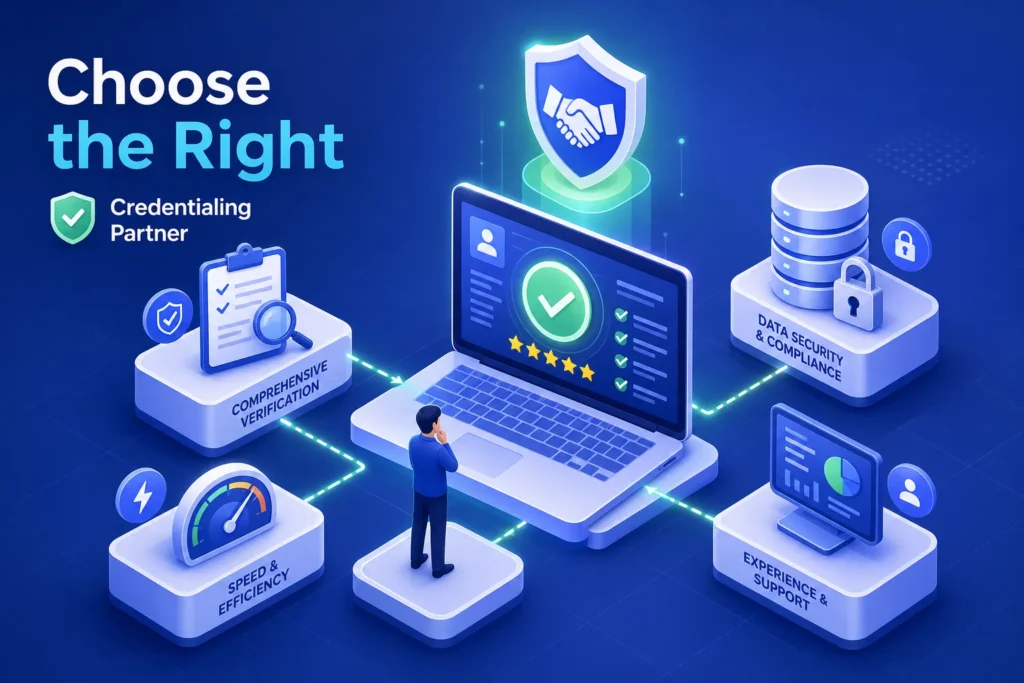
If you’ve been asking what are the best online platforms for professional credentialing services, you’re not alone, and the answer isn’t one-size-fits-all. Most practices think about credentialing the way they think about getting a driver’s license: handle it once, file it away, move on. The reality is closer to a leaky pipe. Every day a provider isn’t recognized in a payer’s system is a day you can’t bill for the care that provider delivers. The longer that gap stays open, the deeper the hole in your cash flow.
The problem isn’t just slow paperwork. The wrong credentialing platform introduces errors that follow a provider for months: NPI mismatches, CAQH inconsistencies, outdated attestations. Those errors don’t stay in the enrollment file, they show up downstream as denied claims. That’s why at WeBill Health, we treat credentialing as the foundation of the entire revenue cycle. Clean enrollment feeds clean billing. When one breaks, the other suffers.
This guide is built for independent practices, small groups, and specialty clinics that are actively shopping for a credentialing platform. By the end, you’ll have a shortlist of options that match your practice size, specialty, and budget, along with a clear set of questions to ask before you sign anything.
Why delayed credentialing quietly drains your practice revenue
When a new provider joins your practice, there’s a gap between their first day and the day a payer officially recognizes them as an enrolled, billable provider. That gap is longer than most practice owners expect, typically 60 to 120 days, and it can stretch further depending on your payer mix and specialty. During that window, you have two bad options: absorb the revenue loss or submit claims that get rejected on enrollment status.
Neither is acceptable for a small practice running on thin margins. The enrollment gap is a business problem, not just an administrative inconvenience. A single mid-level provider generating $8,000 to $12,000 a month in billable services can cost a practice $50,000 or more in delayed or lost revenue during a prolonged credentialing process.
How credentialing errors feed directly into claim denials
Even after enrollment is complete, credentialing data quality continues to affect your billing outcomes. Incomplete CAQH profiles, outdated forms, and NPI taxonomy mismatches are root causes of preventable claim denials. These aren’t billing errors in the traditional sense. They originate in the credentialing file and only become visible when a claim hits the payer’s system and fails validation.
This is the exact scenario where a billing partner who monitors enrollment status adds measurable value. At WeBill Health, we catch these upstream issues before claims go out the door. But that only works if the digital credentialing platform feeding the enrollment data is doing its job accurately. Learn more about our Provider Credentialing, WeBill Health services.
What are the best online platforms for professional credentialing services: top options compared
The market for provider credentialing software has matured significantly. There are now online platforms for professional credentialing services purpose-built for solo practices, multi-provider groups, and full health systems, and the feature gap between them is real. Here’s how the major options stack up. For an independent roundup of the top medical credentialing companies, see the industry comparisons available externally.
CAQH ProView and CAQH PSV: the industry baseline
CAQH ProView is the standard data collection and sharing portal that most commercial payers and CMS-participating plans rely on. If you’re credentialing with any major payer, your providers almost certainly need an active, attested CAQH profile. The platform meets data collection requirements for NCQA, URAC, and Joint Commission standards, making it a compliance-safe foundation for any practice.
CAQH PSV (Primary Source Verification) is the separate, NCQA-certified verification arm. It’s built for organizations that need documented, audit-ready verification directly from issuing sources: medical schools, licensing boards, and certification bodies. One important caveat: CAQH ProView and PSV are foundational infrastructure, not full-featured workflow tools. You’ll likely need a complementary platform for task management, tracking, and automation. For plan-specific details about PSV, review the CAQH PSV FAQs for health plans. For a helpful primer on CAQH primary source verification and how it ties into NCQA requirements, see the Relias guide to CAQH primary source verification.
Medallion: built for speed and automation
Medallion markets itself on turnaround velocity, and the published benchmarks support that positioning. The platform generates committee-ready credentialing files in three days and, according to those benchmarks, can accelerate provider onboarding by approximately 19 days compared to manual processes. It covers credentialing, payer enrollment, license management, and provider data management in a single automated workflow.
Medallion is a reasonable fit for practices in the 1-to-10 provider range that are growing and need automation rather than manual tracking. Pricing is custom and sales-led, not publicly listed, so you’ll need to request a demo to get actual numbers for your organization’s size.
MedTrainer and Assured: workflow depth for larger organizations
MedTrainer offers all-in-one credentialing management with built-in task automation. It’s designed for organizations with 10 or more providers and handles the full credentialing lifecycle from document collection through re-credentialing cycles. The platform emphasizes compliance workflow management over speed, which in practice means stronger support for document retention policies and committee packet formatting rather than raw enrollment velocity.
Assured operates as an NCQA-certified CVO with automated primary source verification across hundreds of sources. It includes real-time monitoring against OIG, SAM, NPDB, and state board actions, and generates committee-ready packets on demand. If your practice needs a compliance-heavy, audit-defensible credentialing process, Assured is among the more rigorous options available. Both MedTrainer and Assured are better suited to clinics scaling beyond solo or two-provider practices.
VerityStream and Modio Health: health system-grade options
VerityStream’s CredentialStream platform handles the full credentialing lifecycle and is deployed primarily at hospitals and health systems. Modio Health is known for provider data management with strong visibility features that reduce administrative burden across large provider networks. Both platforms offer comprehensive feature sets, but they come with implementation complexity and pricing structures that make them cost-prohibitive for most independent practices.
Compliance features that separate reliable platforms from risky ones
Vendor marketing is full of words like “streamlined,” “automated,” and “compliant.” What you actually need to verify is whether the platform holds specific certifications and performs verification processes that payers and accreditation bodies will accept.
NCQA certification and what it actually means for your practice
NCQA-certified CVO status means a platform has been independently reviewed for the quality and reliability of its primary source verification process. NCQA certification covers 11 verification elements and requires documented policies, quality improvement processes, and a minimum errors-and-omissions insurance threshold. For practices seeking payer network participation or preparing for accreditation, using a non-certified platform introduces real compliance risk.
CAQH PSV and Assured are explicitly NCQA-certified. symplr and Verifiable have also publicly confirmed NCQA CVO certification across all 11 elements. Before committing to any platform, ask the vendor to confirm their current certification status directly. Certifications expire and get renewed, and you want to see current documentation, not a marketing claim from two years ago.
Primary source verification, sanctions monitoring, and ongoing compliance
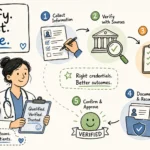
Primary source verification confirms credentials at their origin: the medical school that issued the degree, the licensing board that issued the license, the certification body that issued the specialty credential. This is not the same as checking a database. Platforms that rely on secondary databases introduce verification gaps that primary sources would catch.
Ongoing sanctions monitoring against OIG, SAM, NPDB, and state boards is a separate requirement, and one that many practices underestimate. It’s not a one-time check at initial credentialing. Payers and accreditation bodies require continuous monitoring, and the re-credentialing cycle (typically every two to three years) is your liability exposure window. Platforms like Assured and Medallion automate this monitoring. Platforms that don’t include it as a core feature usually charge for it as an add-on.
Turnaround times and pricing: what the data actually shows
The fastest credentialing platforms advertise impressive timelines. Medallion claims three days for a committee-ready file. Primoris and Fifth Avenue Healthcare Services report payer enrollment completions under 30 days, with some payer-specific cases completing faster. QuickEnroll Pro averages under 25 days. These are real performance metrics, but they describe the vendor-side preparation process, not the payer’s review timeline.
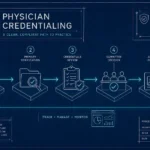
No credentialing platform controls how long a payer takes to process and approve an enrollment application. The industry baseline for full payer credentialing and enrollment is still 60 to 120 days, and it can extend beyond 90 days for complex specialties or state Medicaid plans. What a fast platform actually delivers is a clean, complete application submitted quickly. That matters, because incomplete submissions reset the clock.
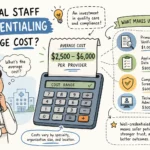
On pricing, most platforms use per-provider or subscription-based models, with enterprise platforms like VerityStream and Assured using custom pricing for larger organizations. Solo practitioners and small groups will pay less in absolute dollars, but they also have less negotiating leverage. The key question to ask any vendor is whether ongoing sanctions monitoring and re-credentialing support are included in the base price or billed as separate line items. The difference between a base subscription and a fully loaded plan is often significant.
How to choose the best online platforms for professional credentialing services for your practice size and specialty
The best credentialing platform for a solo psychiatrist is not the best platform for a 15-provider physical therapy group. Matching the platform to your specific context eliminates a lot of the noise in vendor comparisons.
Solo and small independent practices: prioritize simplicity and payer breadth
For practices with fewer than 10 providers and no dedicated credentialing staff, the priority is minimal setup time, built-in CAQH integration, and automated reminders for expirations and re-credentialing cycles. Medallion and MedTrainer both perform well in this range. Look for transparent per-provider pricing with no hidden fees for monitoring or re-credentialing. A platform that requires a dedicated administrator to manage daily is not a net win for a small practice. For billing considerations tailored to smaller clinics, see our Medical Billing Services for Small Practices: Complete Guide to Streamlined Revenue, WeBill Health.
Specialty-specific considerations: behavioral health, ABA, and physical therapy
Specialty practices face credentialing complexity that generic platforms often underestimate. Behavioral health provider enrollment services involve payer-specific panels, carve-out program enrollment, and NPI taxonomy matching for licensure types including LCSWs, LPCs, psychologists, and psychiatrists. ABA therapy practices face BACB credential verification requirements and supervision documentation that most standard platforms aren’t configured to handle. Physical therapy practices need platforms that correctly map specialty enrollment requirements by payer.
SimiTree explicitly supports ABA provider credentialing. CureMD and Behave Health are built around behavioral health workflows. Before committing to any platform, confirm it supports your specialty’s specific payer mix. A platform that works well for primary care may leave specialty providers with manual gaps that defeat the purpose of automation.
Questions to ask any vendor before signing
- Is your platform NCQA-certified for primary source verification, and can you provide current documentation?
- Does your base pricing include ongoing sanctions monitoring, or is that a separate add-on?
- How do you handle CAQH inconsistencies and NPI mismatches before submission?
- What is your average turnaround time for the specific payer panels my practice contracts with most?
- Do you integrate with my EHR or billing system, and is that integration native or does it require a third-party connector?
- What does your re-credentialing support look like, and what is that cost?
Credentialing gets you enrolled. Billing gets you paid.
Completing enrollment is not the same as collecting revenue. A fully credentialed provider with a clean payer status can still generate significant denial volume if the billing execution has gaps. Wrong billing codes, missing modifiers, incorrect NPI on a claim, failed prior authorization checks, these are billing problems that credentialing platforms don’t solve. They require a billing partner who understands your specialty’s payer behavior.
For practices in ABA therapy, behavioral health, and physical therapy, payer scrutiny runs highest and denial patterns are often tied to utilization management algorithms rather than credentialing quality. That distinction matters. WeBill Health handles the billing execution side of this equation: end-to-end claims submission, specialty-specific coding compliance, denial management, and appeals for practices where enrollment is in place but revenue is still leaking. Learn more about why practices choose us in our Best Medical Billing Company piece.
The combination of a strong credentialing platform and a billing partner who understands payer behavior is how practices actually stop losing revenue after enrollment is confirmed. Choosing the right platform is step one. Making sure the claims that follow are submitted clean and defended when denied is step two. Neither works at full capacity without the other.
Build your shortlist from the right criteria
The practices that get the most out of online platforms for professional credentialing services are the ones that evaluate them on substance rather than marketing claims. NCQA certification, primary source verification processes, sanctions monitoring, specialty support, and honest turnaround time data are the criteria that separate platforms protecting your practice from ones that just create a new to-do list in digital form.
Take the comparison in this guide and shortlist two or three medical credentialing companies that fit your provider count, specialty, and budget. Use the vendor questions above in your demo calls. Then confirm that your billing process is ready to handle claims the moment enrollment is confirmed. That’s where the revenue you worked to protect actually lands in your account. For an ROI-focused vendor comparison to help shape your shortlist, review this comparison of credentialing companies. If you’re still weighing what are the best online platforms for professional credentialing services for your specific setup, WeBill Health can walk you through how credentialing and billing work together to protect your revenue end to end.