
Most large hospital systems take 90 to 120 days to credential a single physician. For complex specialties, that window stretches to 150 days or beyond. Knowing how to streamline physician credentialing for a large hospital system is what separates organizations that protect revenue from those that spend months untangling enrollment backlogs and claim denials. When the process stalls, the cost extends well beyond a delayed start date: enrollment backlogs, claim denials, and revenue gaps follow, taking months to unwind.
Credentialing is widely treated as an administrative checkpoint, a box to check before a provider sees their first patient. That framing is the root of the problem. Errors in the credentialing workflow are one of the most consistent upstream causes of claim denials across every practice size, from independent clinics to multi-hospital health systems. A taxonomy code entered wrong during initial enrollment will propagate through the billing cycle until someone notices, often generating dozens of denied claims before the error is caught and corrected.
This guide is built for operations directors and physician services leaders who need a concrete plan to centralize and automate credentialing across a multi-facility environment. You’ll leave with a governance model, a 9-step workflow, vendor selection criteria, KPIs, and the compliance guardrails that protect the system from regulatory risk.
How to Streamline Physician Credentialing for a Large Hospital System: The Revenue Cycle Case
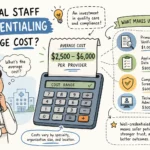
The business case for fixing credentialing starts with one number: every day a physician is credentialed but not yet enrolled with payers is a day their services generate zero reimbursement. Initial credentialing runs 90 to 150 days on average for large health systems. Recredentialing adds another 60 to 90 days every two to three years. Across a system with hundreds of providers cycling through these timelines, the aggregate revenue impact is significant and largely preventable.
The variables that push timelines past the benchmark are consistent. Incomplete applications trigger back-and-forth with applicants that adds weeks before verification even begins. Primary source verification (PSV) depends on licensing boards and certifying bodies that still respond by fax. Fragmented medical staff offices across facilities run separate software and maintain separate files for the same provider. Payer enrollment runs in a completely different silo, often starting only after hospital privileging is already done.
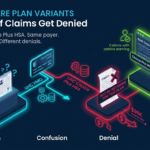
When credentialing data errors make it through, they don’t fail quietly. A provider enrolled under the wrong NPI linkage, the wrong tax identification number, or an incorrect service location will generate denials on every claim they submit until the record is corrected at the payer level. That correction process typically takes weeks, and the denied claims require manual resubmission. The billing problem traces directly back to a credentialing error that happened months earlier.
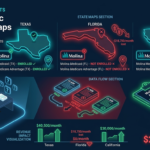
The payer enrollment piece deserves its own emphasis. Hospital credentialing grants clinical privileges; payer enrollment grants the right to bill. Many systems complete privileging and assume enrollment follows automatically. It does not. Enrollment with commercial plans and Medicare runs on a separate track, Medicare processing through PECOS and MAC contractors commonly takes 60 to 180 days, while commercial payer credentialing often runs 90 to 150 days, and state Medicaid portals vary further. When these two processes aren’t run in parallel, physicians sit in a credentialed-but-unenrollable state that delays cash flow with no clinical justification.
Build the Governance Infrastructure Before Touching the Workflow
No automation layer fixes a broken organizational structure. The most efficient credentialing operations in large health systems share one trait: they run credentialing as a shared service with centralized operations and distributed clinical authority. That model has a name: the Centralized Credentialing Office, or CCO.
A CCO owns application intake, PSV tracking, expiration monitoring, recredentialing cycles, and data quality across all facilities. It does not grant privileges. Clinical privileging authority stays with the medical staff governance structure at each site, which matters both operationally and legally. The CCO becomes the single source of truth for provider data across the enterprise, while local medical staff committees retain the independence required for defensible credentialing decisions.
The role structure follows a clear RACI model. Credentialing specialists prepare and verify files. Supervisors handle escalations and quality control. Credentialing committees review verified files and make privileging recommendations. The Medical Executive Committee (MEC) endorses those recommendations. The governing board provides final approval on initial appointments and reappointments. Each tier has defined escalation thresholds: incomplete files go back to the applicant, adverse findings escalate to committee, and privilege expansions require MEC and board review.
Separating credentialing operations from privileging authority is a governance and audit best practice, not just an organizational preference. When the same team that verifies files also approves privileges, the system loses independence and becomes difficult to audit. Top systems configure this as credentialing operations feeding into committee-based clinical judgment, with the governing body providing final oversight. That structure holds up under CMS review and NCQA audits in ways that blended models often don’t. See the Medical Staff Credentialing and Privileging Standard Operating Procedure Manual for a detailed SOP example.
Streamlining Physician Credentialing: The 9-Step Workflow for Multi-Hospital Systems
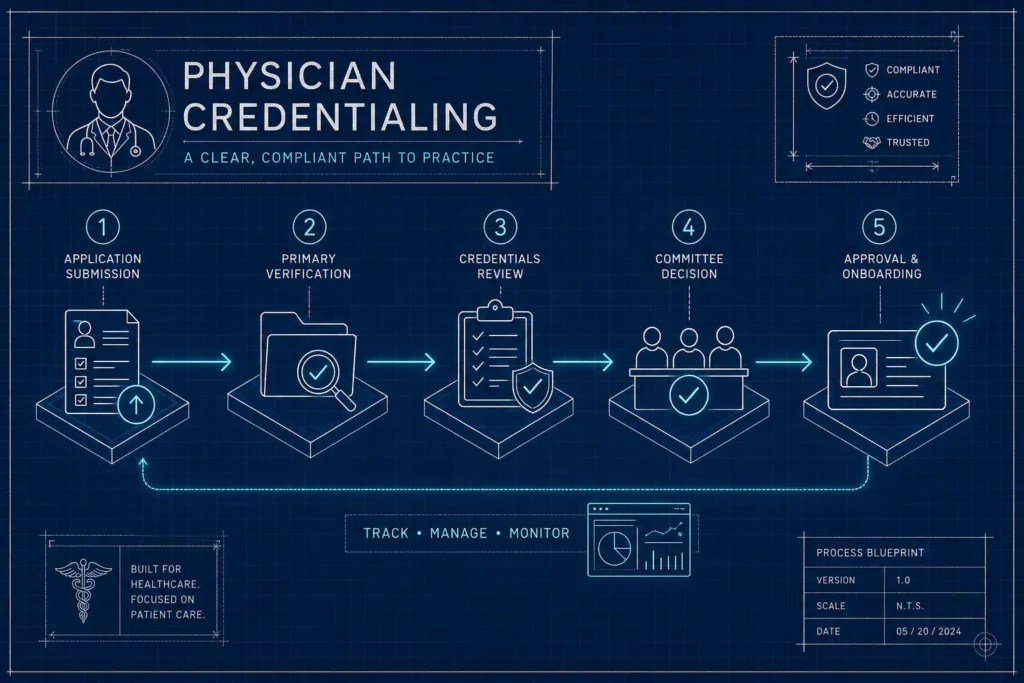
The nine steps below fall into three logical clusters: getting provider data right at intake, moving through privileging and enrollment in parallel, and sustaining the process through ongoing monitoring and recredentialing. Each step builds on the last, and the clusters are designed to run without unnecessary handoff delays between them.
Steps 1, 3: Application Intake, Data Standardization, and Primary Source Verification
Step 1 is standardized application intake. One enterprise-wide application form, one provider portal, one master document checklist. Eliminating facility-by-facility variation at intake removes the most common source of rework in multi-hospital systems.
Step 2 is data normalization. The CCO enforces consistent taxonomy codes, NPI data, and service location information from the moment a file is opened. Errors at this stage are the ones that surface as claim denials months later, and correcting them at the source is far less costly than chasing denials downstream.
Step 3 is primary source verification (PSV), covering licensure boards, DEA, NPDB queries, board certifications, malpractice history, and education, all verified directly from issuing sources. CAQH ProView is the most widely used tool to reduce manual PSV workload. A published CAQH case study for Blue Cross and Blue Shield of Alabama documented a 60-day reduction in average credentialing time-to-decision after integrating CAQH into the verification workflow (CAQH case study).
Steps 4, 6: Committee Review, Privileging Approval, and Payer Enrollment
Step 4 is committee review. The credentialing committee evaluates verified files against the clinical privilege delineations in the medical staff bylaws and produces appointment recommendations. Step 5 moves those recommendations through the MEC and governing board, following the escalation structure established in governance.
Step 6 is where most systems lose weeks: payer enrollment must run in parallel with privileging, not after it. As soon as a clean provider application is available, enrollment packets should be moving toward PECOS for Medicare, state Medicaid portals, and commercial plan applications simultaneously. Each payer track has its own timeline and its own follow-up requirements, and none of them wait for the privileging process to finish.
Steps 7, 9: Delegated Credentialing, Ongoing Monitoring, and Recredentialing Cycles
Step 7 is delegated credentialing for systems large enough to qualify. Some payers commonly look for approximately 100 or more practitioners enrolled before granting delegation, though requirements vary by payer and market. Under a formal delegation agreement, the payer transfers credentialing responsibility to the hospital, subject to NCQA-compliant PSV, committee oversight, sanctions monitoring, and annual audit rights.
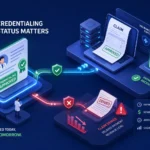
Step 8 is ongoing monitoring. Licensure expirations, OIG exclusion list checks, and NPDB updates need continuous tracking, not just review at reappointment. Step 9 is the recredentialing cycle, typically every two to three years, built into the credentialing platform’s automated workflow so it runs without manual prompts and never catches the team by surprise.
Technology and Integrations That Compress the Timeline
An enterprise credentialing platform for a multi-hospital deployment needs to do several things at once: maintain centralized provider data while preserving facility-specific requirements, automate PSV workflows, manage privileging and enrollment modules, run committee management tools, generate expiration alerts, support audit reporting, and integrate with existing EHR systems like Epic, Cerner, and Meditech.
Platforms commonly evaluated for this category include Symplr Provider, HealthStream CredentialStream, Assured, Modio Health, CACTUS, and MD-Staff. All use custom enterprise pricing based on provider volume, facility count, and module selection. When evaluating vendors, focus on five criteria: depth of PSV automation, strength of payer enrollment modules, quality of facility-specific configuration, EHR and HR system integration, and total cost of ownership. Implementation scope should be factored into that last metric explicitly, it’s where budget surprises most often occur. Request references from systems with a comparable number of facilities and providers, and pilot on one facility before a full enterprise rollout to surface configuration gaps early.
CAQH ProView and AMA VeriCre both function as data sources within a larger platform workflow, not standalone systems. When providers keep their CAQH profile current, the credentialing team pulls verified data rather than re-collecting it from scratch, that’s where the time savings materialize. AMA VeriCre covers physician-specific verification for medical school, training, and board certification. Both integrations are worth confirming during vendor selection because the PSV time reduction depends on them working reliably.
KPIs to Track and Legal Checkpoints You Can’t Skip
Five operational KPIs tell you whether your credentialing function is performing: average days to complete initial credentialing (target 90 days or less), average days to payer enrollment approval, credentialing file completion rate at submission, percentage of providers recredentialed on time, and number of providers in “credentialed but not enrolled” status at any point. Add a revenue-impact metric to the dashboard: estimated revenue delayed per provider per day of enrollment lag. According to an internal case study from a multi-state medical group client, reducing the average credentialing timeline by 30 days through CAQH integration produced approximately $1.2 million in additional first-year revenue, an illustrative benchmark for quantifying the financial stakes of timeline improvements.
Delegated credentialing arrangements carry their own compliance obligations, and they aren’t optional. Required elements include documented primary source verification for each provider, credentialing committee oversight, ongoing sanctions and exclusion monitoring, recredentialing every two to three years, and a formal delegation agreement with audit rights and reporting cadence clearly specified. Most payers require annual oversight audits and quarterly or semiannual roster reporting. State credentialing rules and CMS requirements layer on top of payer contract terms, which makes legal review of delegation agreements non-negotiable before execution.
One compliance boundary cannot be delegated around: the NPDB query obligation. Under NPDB Guidebook rules, a hospital cannot transfer its responsibility to query the National Practitioner Data Bank. The query must originate from the querying entity directly or through an authorized agent, and the results belong to that entity. In a delegated credentialing arrangement, the delegating payer is explicitly prohibited from receiving NPDB results for the delegated process. Enterprise credentialing platforms must be configured to respect this boundary, and it should be documented explicitly in every delegation agreement your system executes.
What Happens to Revenue When Credentialing and Enrollment Don’t Sync
Even a well-run credentialing process creates coverage gaps. A physician who starts seeing patients before payer enrollment clears creates a choice with no good options: file claims under another provider, which raises compliance flags, or hold them until enrollment completes, which delays cash flow. When credentialing data errors flow into the billing system, claims deny months later for reasons that trace back to a taxonomy mismatch or service location error set during initial enrollment. For smaller practices and independent physician groups, this revenue loss accumulates quietly and is hard to recover without a focused effort.
For practices navigating enrollment backlogs or working through credentialing-related claim denials, having a billing and RCM partner who knows how to identify and recover that revenue changes the outcome. If you’re coming out of a credentialing overhaul or an enrollment delay, that is exactly when to pressure-test your revenue recovery process, not six months later when denial volume has compounded. WeBill Health specializes in tracing denials back to their source, whether the trigger is a payer enrollment gap, a provider data mismatch, or a credentialing error that slipped through, and rebuilding cash flow during the transition.
Build It Right and Stop Fighting the Same Problems Twice
A streamlined physician credentialing process isn’t a compliance project or an HR initiative. It’s a revenue cycle function with direct impact on how fast providers get paid and how reliably claims get approved. The 9-step framework here gives operations leaders a clear implementation path: governance first, then standardized workflow, then technology selection, then measurement.
Credentialing will never be instantaneous. Primary sources respond slowly, payers have their own timelines, and committees meet on their own schedules. But the gap between a 60-day process and a 150-day process is largely within a health system’s control. External factors, state board response times, payer backlogs, and third-party verification delays, play a role, but internal process decisions drive most of the variance. The systems that learn how to streamline physician credentialing for a large hospital system and build that infrastructure correctly, with a CCO, parallel enrollment, CAQH integration, and automated monitoring, spend far less time untangling payer denials and enrollment backlogs later. That’s what the data from systems that have built this infrastructure shows.