
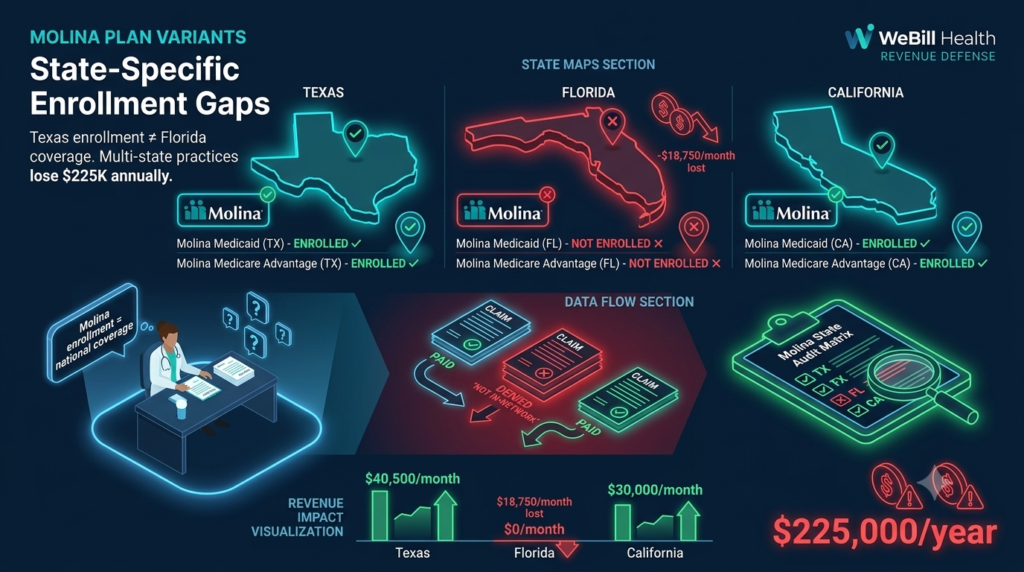
A primary care group with locations in Houston, Texas and Miami, Florida made a reasonable assumption about Molina plan variants. They enrolled with Molina once. National payer. Seemed straightforward. Over six months, Molina plan variants cost them $18,000 in Florida revenue they didn’t know they were vulnerable to. Same payer name. Different state. Completely different Molina plan variants and enrollment requirement.
They enrolled with Molina Healthcare. Once. National payer. Seemed straightforward.
Over the next six months, they submitted 120 Molina claims from their Florida location. Sixty of them came back denied: “Not an in-network provider.”
They called Molina. The answer was clear: You’re enrolled with Molina in Texas. You’re not enrolled with Molina in Florida. They’re separate companies. Separate networks. Separate contracts.
Same payer name. Different state. Completely different enrollment requirement.
Over six months, that practice lost $18,000 in Florida revenue they didn’t know they were vulnerable to.
This is the Molina problem that hits multi-state primary care practices hardest.
Molina Is Not One Network. It’s Fifty-One Different Networks (One Per State Plus DC)
Here’s what the healthcare industry doesn’t make clear: Molina Healthcare operates independently in each state.
Molina Texas is a separate company from Molina Florida. Molina California operates under completely different rules from Molina New York. The networks don’t overlap. The contracts are separate. The fee schedules are different.
You can be in-network in Texas and out-of-network in Florida with the exact same Molina insurance company.
This is true for every major state-based payer: BCBS, Medicaid MCOs, Medicare Advantage operators. But Molina is where primary care practices get hit hardest because Molina operates in 18 states and many practices assume national enrollment means national coverage.
It doesn’t.
How Molina Variants Work by State
Molina operates in these states: California, Florida, Illinois, Louisiana, Michigan, Mississippi, Missouri, Nevada, New Mexico, New York, Ohio, Puerto Rico, South Carolina, Texas, Utah, Washington, Wisconsin, and the District of Columbia.
In each state, Molina offers these product lines:
1. Molina Medicaid (state-specific)
2. Molina Medicare Advantage (state-specific)
3. Molina Marketplace/ACA Plans (state-specific, if state allows it)
Within each product line, there are sub-variants:
- Molina Medicaid managed care (standard)
- Molina Medicaid for special populations (long-term care, blind/disabled, foster care)
- Molina Medicare Advantage HMO
- Molina Medicare Advantage PPO
- Molina ACA Bronze, Silver, Gold, Platinum plans
A practice enrolling with Molina in Texas isn’t enrolling with “Molina.” They’re enrolling with specific Molina variants in Texas. None of that enrollment transfers to Florida.
Real Examples: Why Multi-State Practices Lose Money
Example 1: Texas vs. Florida Molina Enrollment
Practice A has offices in Houston, Texas and Tampa, Florida.
They enroll with:
- Molina Medicaid (Texas)
- Molina Medicare Advantage (Texas)
They do NOT enroll with:
- Molina Medicaid (Florida)
- Molina Medicare Advantage (Florida)
Patient scenario:
A Molina Medicaid patient from Tampa comes to their Houston office. Visit happens. Claim submitted to Molina Medicaid (Texas). Processes fine. Patient gets coverage. Practice gets paid.
Same practice, Florida location. A Molina Medicaid patient (Florida) comes in. Visit happens. Claim submitted to Molina Medicaid. But Molina in Florida sees that the practice is enrolled with Molina in Texas, not Florida. Claim denied.
Same payer. Same product line. Different state. Different enrollment status. Revenue lost.
Example 2: California Molina Expansion Failure
Practice B is based in California and wants to expand to Arizona. They think about enrolling with Molina.
Their California office is already in-network with Molina Medicaid (California) and Molina Medicare Advantage (California).
They assume they can serve Arizona Molina patients because they’re already in Molina. They can’t. Molina Arizona is a separate enrollment.
They start seeing Arizona patients without enrolling. Three months later, they have $12,000 in denied claims from Arizona Molina. They never get paid.
Example 3: Molina Medicaid Special Populations
Molina Medicaid varies not just by state, but by special populations within each state.
Texas:
- Molina Medicaid (standard)
- Molina Texas Health Steps (children)
- Molina STAR (disabled/elderly)
- Molina STAR Kids (disabled children)
A practice might be enrolled in standard Molina Medicaid (Texas) but not in STAR Kids. They see a disabled child on STAR Kids, submit the claim. Denied. “Not in-network for this Molina product line.”
The State-Specific Fee Schedule Problem
Molina fee schedules are different in every state. This matters for two reasons:
1. Reimbursement varies wildly.
Molina Medicaid in Texas pays 45% of Medicare. Molina Medicaid in California pays 55% of Medicare. Same procedure, same payer, different state, different money.
2. You can’t compare contracts across states.
A practice says “Molina is too low. We’re dropping in California.” But Molina in Texas pays better. So they stay in Texas but drop in California. This is smart. But only if they track Molina rates by state.
Most practices don’t. They treat “Molina” as one payer and make enrollment decisions at the payer level, not the state level.
How to Verify Which Molina Plans You’re Actually Enrolled In (By State)
The only way to know which Molina variants you’re in is to check each state separately.
Step 1: For Medicaid, log into your state Medicaid provider portal.
Each state has its own Medicaid database (not Molina’s). You check enrollment there.
Examples:
- Texas: Texas HHSC (health.hhsc.texas.gov)
- Florida: Florida AHCA (flmedicaid.gov)
- California: California DHCS (dhcs.ca.gov)
Step 2: Search for your NPI and practice name.
The portal will show which Medicaid MCOs you’re enrolled with in that state.
Step 3: For Medicare Advantage, log into your CMS PECOS account (pecos.cms.hhs.gov).
PECOS shows which Medicare Advantage plans you’re enrolled in, by state.
Step 4: For ACA plans, log into each state’s insurance marketplace.
Each state’s marketplace (e.g. CoveredCA in California, ehealth.ny.gov in New York) shows which carriers you’re enrolled with, including Molina if it’s available.
Step 5: Create a master enrollment document.
| State | Molina Medicaid | Molina MA | Molina ACA | Status |
|---|---|---|---|---|
| Texas | Yes | Yes | No | In-Network |
| Florida | No | No | No | OUT-OF-NETWORK |
| California | Yes | Yes | Yes | In-Network |
| Arizona | No | No | No | OUT-OF-NETWORK |
This takes 2-3 hours. Do it this week. You might discover you’re in-network in some states and out-of-network in others.
Why Multi-State Practices Are Vulnerable to Molina Denials
Multi-state practices are vulnerable because:
1. They have one credentialing team managing multi-state enrollment.
They assume if they’re enrolled in one state, they’re enrolled everywhere. They’re not.
2. Molina enrollment renewal happens by state.
When you get a renewal notice from Molina, it’s state-specific. If you only pay attention to the notice for one state, you might miss renewals in other states. Let a renewal lapse, and you go out-of-network.
3. Fee schedule negotiations happen by state.
If you negotiate rates with Molina in Texas, that negotiation doesn’t apply to Molina in Florida. You might be getting a good deal in Texas and a terrible deal in Florida and not realize it.
4. Claim submission systems don’t always route by state correctly.
If your billing software isn’t configured to route claims by the patient’s state, Molina claims might get routed to the wrong state MCO. Texas Molina claims might go to Florida Molina (if your system isn’t specific). They’ll deny because your practice is enrolled in Texas, not Florida.
The Appeal Strategy for Molina State-Specific Denials
If a Molina claim gets denied because of state-specific enrollment issues, appeals sometimes work if you take the right approach.
Appeal Strategy: Enroll in the missing state immediately and request retroactive coverage.
Appeal Letter
[Date]
Molina Healthcare [State] Appeals Department
[Address from EOB]
Re: Claim Appeal, [Patient Name], Claim #[Claim Number]
Reason for Appeal:
Claim [Claim Number] was denied because our practice was not enrolled with Molina Healthcare [State] at the time of service.
We have since enrolled with Molina Healthcare [State] effective [enrollment date]. We request that this claim be reprocessed as in-network retroactively, effective [date of service].
This patient selected in-network providers believing they would have in-network coverage. The denial was based on an enrollment technicality, not medical necessity or service coverage.
Clinical Justification:
[Service was medically necessary for patient’s condition.]
Action Requested:
Retroactively apply in-network benefit and reprocess at in-network rate.
Sincerely,
[Your name]
Success rate: 20-30%. Molina will sometimes approve retroactive coverage if you enroll immediately after the denial. They won’t always, but it’s worth asking.
Timeline: 30-60 days.
Better approach: Enroll in the state BEFORE you start seeing patients there. Prevents denials entirely.
Prevention: Know Your Molina Enrollment by State Before Seeing Patients
The only way to prevent Molina state-specific denials is to:
1. Audit your current Molina enrollment in every state where you have patients.
Use the steps above. Document what you’re enrolled in.
2. Before expanding to a new state, enroll with Molina in that state first.
Don’t assume national payer = national coverage. Enroll state-by-state before you see patients.
3. Update your eligibility verification tool to show state-specific Molina enrollment.
Your eligibility tool should flag: “Patient is on Molina Medicaid (Florida). Your practice is enrolled with Molina Medicaid (Texas). This claim will be denied.”
4. Train front desk staff: Molina is different in every state.
Make it clear: If a patient is from a state where you’re not enrolled, they’re out-of-network.
Real Revenue Impact: What Multi-State Practices Are Losing
A practice with offices in three states (Texas, Florida, California) is enrolled with Molina in only one state (Texas).
Patient volume by state:
- Texas: 300 Molina patients/month
- Florida: 75 Molina patients/month (out-of-network)
- California: 50 Molina patients/month (out-of-network)
Monthly revenue impact:
- Texas: 300 claims, 90% paid = 270 paid claims × $150 avg = $40,500
- Florida: 75 claims, 0% paid (out-of-network denials) = $0
- California: 50 claims, 0% paid (out-of-network denials) = $0
Monthly revenue lost in Florida/California: $18,750
Annual revenue lost: $225,000
If the practice had enrolled in Molina in Florida and California, they’d capture that $225,000 annually.
The enrollment process takes 30 days per state. The compliance documentation is standard. The ongoing time to manage it is minimal.
But multi-state practices don’t do it because they don’t realize Molina is state-specific.
Now you do.
Your Action: Multi-State Molina Audit This Week
If your practice has offices in multiple states:
- Log into each state’s Medicaid portal
- Check which Molina variants you’re enrolled in by state
- Compare to your patient volume by state
- Identify enrollment gaps
- Call Molina contracting to enroll in missing states
Cost of enrollment: $0 (usually)
Timeline to enrollment: 30-60 days
Monthly revenue gain per missing state: $3,000-10,000
If you’re a three-state practice missing enrollment in two states, you’re losing $72,000-240,000 per year.
That’s worth a phone call this week.
Sources
Centers for Medicare & Medicaid Services. (2024). Medicare Advantage Plan Network Requirements by State. Retrieved from cms.gov
Molina Healthcare. (2024). Multi-State Enrollment and Network Guidelines. Retrieved from molinahealthcare.com
Texas HHSC. (2024). Medicaid Provider Enrollment System. Retrieved from health.hhsc.texas.gov
Florida Agency for Health Care Administration. (2024). Medicaid MCO Network Requirements. Retrieved from flmedicaid.gov
American Medical Association. (2024). Multi-State Practice Enrollment and Compliance Best Practices.