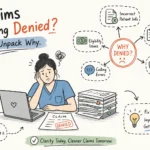

At WeBill Health, we see it more than we’d like: clean claims denied not because of a coding error, but because a provider’s credentials weren’t verified before payer enrollment. The practice assumed someone had handled it. No one had. Credentialing is often treated like a new-hire formality, checked once and filed away. That assumption costs practices real money.
If you’ve ever wondered how to verify a medical professional’s credentials online, you’re asking the right operational question. Whether you’re onboarding a new provider, preparing for payer enrollment, or auditing your existing roster, knowing how to verify a medical professional’s credentials online is a core operational skill, not an IT task or a one-time HR function. This guide walks through the exact tools and databases to use, what each one actually tells you, and why skipping any of them puts your revenue and compliance at risk.
Why credential verification matters more than most practices realize
Payers require verified credentials as a condition of enrollment and reimbursement. This isn’t a formality buried in a participation agreement. If a provider isn’t properly credentialed with a payer and you submit a claim under their NPI, that claim gets denied. Medicare and commercial payers each have specific credentialing requirements tied to their participation agreements, and those requirements don’t bend for administrative oversights.
The compliance exposure is just as serious. OIG guidance and federal program rules require checking exclusion lists before billing Medicare, Medicaid, or any other federal program. A single lapse here doesn’t just result in a denied claim; it can trigger audits, recoupments, or exclusion from payer networks entirely. Industry data suggests a significant share of medical practices report denials directly tied to provider credentialing and enrollment issues, a pattern that becomes less surprising once you understand how many moving pieces stay invisible until something breaks. For a broader look at how billing services protect revenue, see Why Medical Billing Services Are Vital for Healthcare Practices.
How to verify a medical professional’s credentials online: start with the state medical board
Every U.S. state has an official licensing board where you can verify a physician’s active license status, license type (MD vs. DO), expiration date, and public disciplinary history. The search is free and generally quick to run. Some states maintain separate portals for MDs and DOs; Arizona, for example, runs distinct boards for each. Others use a centralized professional licensing system that covers multiple professions. Either way, state board verification is always your starting point. If you need step-by-step guidance for finding license numbers and the appropriate state portal, see this how to find a medical license number by state resource.
What you’ll confirm here: license status and expiration date. What you won’t find: board certification status or payer enrollment standing. Complaints under active investigation are typically not public; only finalized disciplinary actions appear. That’s an important distinction. A clean state board record doesn’t mean no complaints exist, it means no formal action has been completed and published. Always review the disciplinary history section if one is present, not just the license status field.
Run an NPI registry lookup in parallel. The NPPES NPI registry is a free public tool that confirms a provider’s name, NPI number, taxonomy code, and practice address. It does not confirm licensure or board certification, CMS is explicit about that. But it’s a fast cross-reference to verify that the taxonomy code on file matches the provider’s actual specialty and that the identity details align with what you have in your system. Mismatched taxonomy codes are a well-documented and entirely avoidable source of claim denials in credentialing and billing operations.
Board certification and primary-source credential verification
To confirm board certification, start with the free “Is My Doctor Certified?” search at certificationmatters.org, run by the American Board of Medical Specialties. Enter the physician’s last name, add their specialty and location to narrow the results, and the site confirms whether they hold active certification from an ABMS Member Board. This tool is designed for patients but works fine for an initial check.
If you’re credentialing at scale or need primary-source verification, the patient-facing site isn’t the right tool. ABMS Solutions and CertiFACTS Online are designed for credentialing professionals who need verified certification data that meets payer and accreditation standards. The distinction matters: a positive result on Certification Matters tells you certification exists; primary-source verification through ABMS Solutions tells you the data has been confirmed directly from the issuing board.
For core credential verification beyond certification, the Federation Credentials Verification Service (FCVS), run by the FSMB, is worth knowing. FCVS stores a physician’s medical education, postgraduate training, exam scores, and identity in a primary-source-verified profile accredited by NCQA and aligned with The Joint Commission’s standards. Its value becomes clear for providers licensed in multiple states or going through payer enrollment: instead of re-requesting the same documents from multiple institutions repeatedly, boards and organizations rely on the same verified record. That eliminates redundant document requests across states and enrollment cycles.
The two compliance databases most practices skip
The National Practitioner Data Bank (NPDB) contains reports on malpractice payments, adverse licensure actions, and professional misconduct for physicians and other healthcare practitioners. Healthcare organizations, including practices and billing entities, can query the NPDB for a fee during credentialing. Individual practitioners can access their own reports for free. NPDB data is not public, but eligible entities under HRSA guidelines have access, and using it is standard practice at any organization doing serious credentialing work. For an overview of NPDB terms and reporting, see the NPDB guidebook glossary.
The OIG List of Excluded Individuals and Entities (LEIE) is free and searchable, and there’s no excuse for skipping it. Any provider on this list cannot bill Medicare, Medicaid, or any other federal healthcare program. OIG’s own published guidance is clear: practices must check new hires and existing providers against this list on a monthly basis. Billing with an excluded provider means the practice may be required to return all payments received during that period and can face civil monetary penalties on top of that. The search takes minutes. The consequences of skipping it can take years to resolve. Review the official OIG exclusions guidance and build the checks into your operations.
Search the OIG Exclusions Database by name for an initial screen. Use the Verify function with SSN or EIN to confirm a potential match before taking action. Then build monthly exclusion checks into your standard operations, not just as a new-hire step. Payer auditors check this, and they check it retroactively.
CAQH ProView: the ongoing hub for payer credentialing
CAQH ProView is where most credentialing work converges for payer network participation. Over 1,000 health plans and healthcare organizations use CAQH to credential and re-credential providers. The idea is straightforward: a provider builds one profile with their license numbers, DEA certificate, malpractice coverage, education, work history, and hospital privileges, and participating payers access that data directly rather than requiring a separate application packet from each one. More than 1.6 million providers use the platform.
The operational detail most practices miss is the re-attestation requirement. Per CAQH guidelines, providers must re-attest their profile every 120 days. If that window lapses, the profile moves to an expired or not-attested status, and payers can no longer access it for credentialing. The result: enrollment delays, reimbursement interruptions, and credentialing-related denials that could have been prevented by setting a calendar reminder. CAQH sends re-attestation notifications, but those notifications get buried in inboxes, especially in small practices where one person is managing billing, scheduling, and credentialing simultaneously. For a recent year-in-review and practical notes on platform use, see this CAQH ProView year review.
How credentialing gaps turn into denied claims
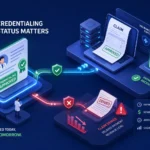
The scenarios are more common than they should be. A provider’s CAQH profile lapses during re-attestation. A newly hired clinician sees patients before their payer enrollment is finalized. A provider gets enrolled under the wrong taxonomy code. In each case, claims submitted during the gap period can be denied on submission or retroactively flagged after payment. Some payers won’t retroactively reimburse even after the credentialing issue is corrected. The revenue from that period is simply gone.
Payer re-credentialing cycles run every 12 to 24 months depending on the plan. Missing a re-credentialing deadline doesn’t trigger a warning; it triggers a cessation of reimbursement. Practices discover this when claims that were processing normally suddenly start denying with no obvious coding or eligibility reason. By the time the credentialing gap is identified and corrected, the revenue impact is already significant.
Many small practices don’t have a dedicated credentialing coordinator tracking expiration dates, re-attestation deadlines, and enrollment statuses across multiple payers simultaneously, a resource gap common in independent and small-group settings. At WeBill Health, monitoring these requirements is built into the revenue cycle process, not treated as a separate administrative function. Flagging a CAQH lapse before it affects claims, or catching a taxonomy mismatch during enrollment review, is the kind of upstream work that prevents downstream revenue loss. Our Revenue Velocity Credentialing, WeBill Health approach is designed to close those operational gaps.
The connection between credentialing accuracy and clean claims isn’t procedural overhead; it’s how practices protect the revenue they’ve already earned. If you want to understand how accurate coding and credentialing intersect in operational workflows, see Medical Billing and Coding Services: The Backbone of Efficient Healthcare Revenue, WeBill Health.
The verification sequence, simplified
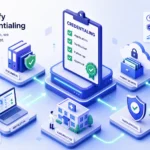
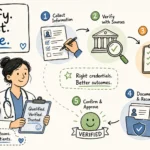
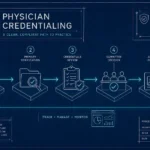
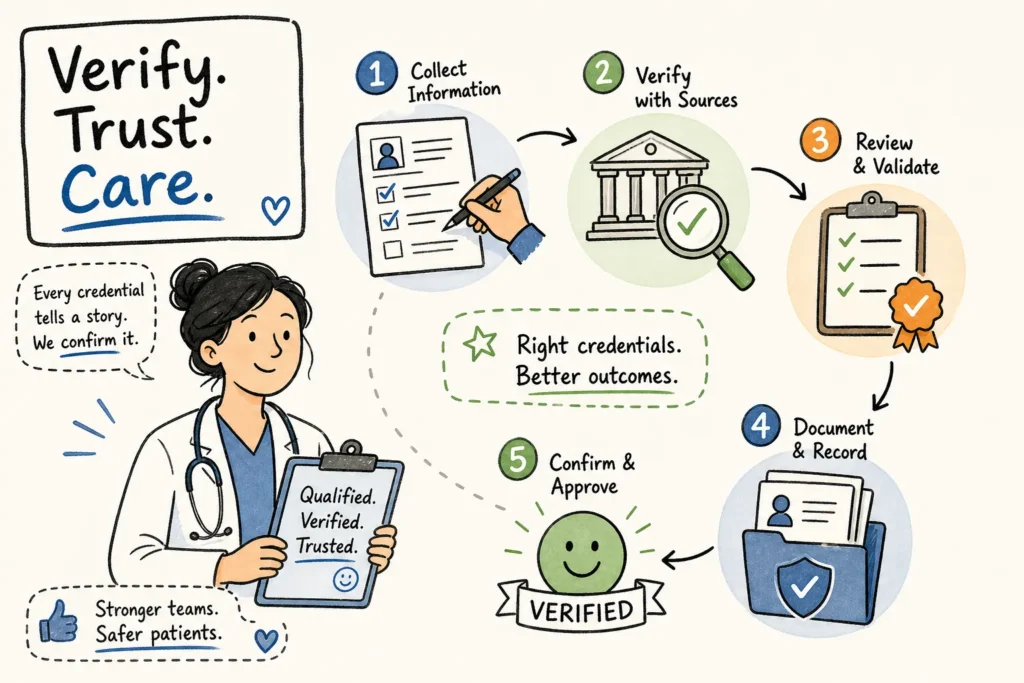
Treat this as your standing framework for how to verify a medical professional’s credentials online. Run each step in order:
- State medical board portal, confirm active license status, license type, expiration date, and any disciplinary history for the provider’s license state.
- NPPES NPI lookup, verify identity, taxonomy code, and practice address.
- Certification Matters / ABMS Solutions, confirm board certification with a quick check or primary-source verification for credentialing workflows.
- FCVS, use when you need a primary-source-verified credential set for multi-state licensing or payer enrollment.
- NPDB query, run before bringing any new provider into the organization.
- OIG LEIE, check before the first claim is billed, then every month after that.
- CAQH ProView, keep profiles current and re-attest on schedule.
No single database covers everything. Each step serves a distinct purpose, and the sequence matters because the risk at each stage is different. State board lookup answers the license question. ABMS answers the certification question. NPDB answers the professional conduct question. OIG answers the federal eligibility question. CAQH answers the ongoing payer enrollment question. Run all of them.
Credentialing isn’t a new-hire task you complete once and archive. Practices that treat it as ongoing maintenance rather than a formality are the ones that avoid the audits, recoupments, and retroactive denials that follow credentialing gaps. Most of the tools covered here are free, state board portals, NPPES, OIG LEIE, and Certification Matters carry no cost; NPDB queries and primary-source verification services may carry modest fees. The process is learnable, and the cost of skipping it is consistently higher than the cost of staying current. If you need support building this into your revenue cycle operations, that’s exactly what WeBill Health does.