
Independent practices that outsource billing to a specialty-focused partner typically see denial rates well under the 2026 national average of 11.81 percent, days in accounts receivable that track closer to what MGMA calls its Better Performers, and staffing coverage that does not disappear when one biller quits or takes leave. These are not marketing claims. Each one is a documented gap between practices that run revenue cycle work well and practices that do not, and outsourcing is one of the more direct ways an independent practice closes that gap.
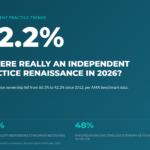
Independent practice ownership has fallen from 60.1 percent of physicians in 2012 to 42.2 percent in 2024, according to the American Medical Association’s own benchmark survey. When physicians who left independence were asked why, the top reasons were not clinical. A stronger negotiating position with payers, better access to costly resources, and better management of payer regulatory and administrative requirements ranked highest, at 70.8, 64.9 and 63.6 percent respectively.
Read that list again and it stops looking like a case against independence. It reads like a checklist of what a billing partner is actually supposed to solve. What follows is the real benefits, sourced to MGMA, Kodiak Solutions, Experian Health and the Bureau of Labor Statistics, not a single sales pitch dressed up as six.
Fewer denials and collections that actually land
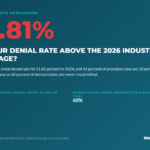
The national initial denial rate hit 11.81 percent in 2024, and 41 percent of providers now report a denial rate of 10 percent or higher. As many as 60 percent of denied claims are never worked a second time, which means every point above the benchmark is revenue that does not come back on its own. A specialty-focused billing partner exists to keep a practice out of that group, through coding built around the specialty’s actual denial patterns instead of generic claim submission.
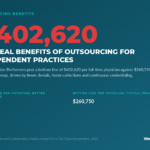
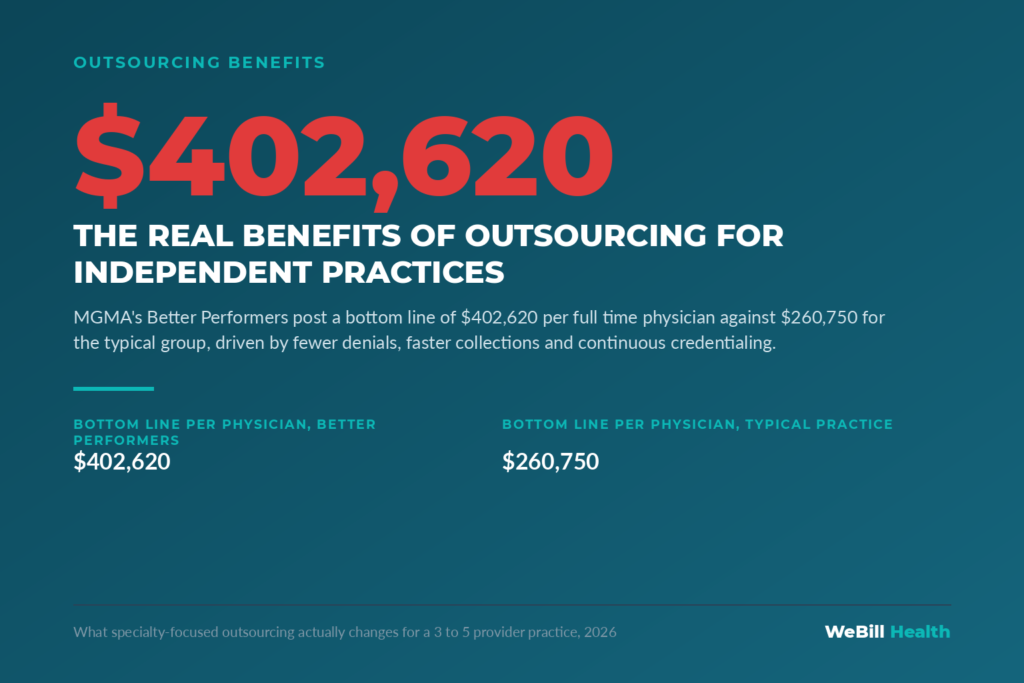
The gap between practices that manage this well and practices that do not is large and measured. MGMA’s own Cost and Revenue benchmarking found that its Better Performers, the top quartile of multispecialty groups, carry 53 percent less of their accounts receivable past 120 days than the median practice, collect 3 percent more of adjusted charges, and post a bottom line of $402,620 per full time physician against $260,750 for the typical group. That gap did not come from working harder. It came from a revenue cycle that catches problems before they become aged, uncollectible claims.
The staffing problem outsourcing actually solves
Staffing an in house billing function for a 3 to 5 provider practice runs $109,740 to $146,320 a year in fully loaded wages once benefits, payroll taxes and paid leave are added to the Bureau of Labor Statistics’ median billing salary, a full breakdown of which is in our in house billing comparison. The dollar figure is only part of the problem. The bigger one is coverage: a two person billing team has no backup when one person quits, takes leave, or simply cannot keep pace with a denial pattern from a payer they have never dealt with before. Claims still have to go out and follow up still has to happen, on schedule, regardless of who is out that week.
Outsourcing does not remove that workload. It moves it to a team that is never down to zero, and that has already seen the denial pattern from that specific payer somewhere else in its client base.
Credentialing and compliance protection built into the relationship
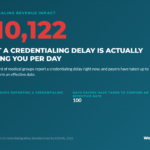
A newly hired provider or a newly opened location cannot bill most payers until credentialing clears, which is why Revenue Velocity Credentialing runs CAQH attestation and PECOS enrollment as a continuous process instead of a periodic manual check. Once billing starts, every claim receiving human pre submission review against internal payer rule libraries, organized by specialty and by carrier and spanning more than 500 payer rulesets, is what keeps a practice’s NPI defensible under audit instead of exposed by it. Compliance handled this way is the standard every claim is held to before it goes out, a stronger position than catching a problem after a payer already flagged it.
Get your Revenue Defense Score. Six questions and sixty seconds shows you where your own practice already sits against the benchmarks above, before you decide what to fix first.
Transparency instead of a black box
Outsourced billing has a reputation problem, and it is earned by real vendors: a black box where claims disappear into a portal and nobody can explain why collections are soft this month. The fix is a direct line to a dedicated US based billing manager who knows the practice’s specialty, weekly velocity reports showing exactly where money sits in the cycle, and audit ready documentation the practice can see, not just take on faith. A practice should be able to ask why a specific claim has not paid and get an answer from a named person within a day, not a ticket number.
Room to grow without rebuilding the back office
An in house billing team sized for 3 providers does not scale cleanly to 5 without adding headcount, and the hiring and training lag behind the growth that made the new headcount necessary in the first place. A billing partner already staffed for specialty volume absorbs a new provider or a new location largely inside its existing capacity, which is the practical reason credentialing is usually the entry point into a larger billing relationship instead of a separate errand handled once and forgotten.
Why this matters more for an independent practice specifically
A hospital owned practice has a billing department, a compliance office and a credentialing team built into the parent organization. An independent practice has none of that by default, which is exactly why payer negotiating position, resource access and administrative burden top the list of reasons physicians cite for leaving independence, as covered in our look at the independent practice renaissance narrative. Outsourcing does not replace the autonomy that made independence worth choosing. It replaces the missing department that made staying independent survivable.
What outsourcing does not automatically fix
None of this happens by signing a contract with any vendor at any price. A flat fee quote that excludes prior authorization, eligibility verification and denial appeals will not close the gaps described above, no matter how low the invoice looks, a distinction covered in full in our pricing breakdown. The benefits above come from what a partner actually does with a claim, not from the fact that someone other than practice staff is doing it. Ask what is included before assuming outsourcing alone solves any of this.
Frequently asked questions
What are the real benefits of outsourcing medical billing for an independent practice?
Lower denial rates than the 11.81 percent national average, faster collections closer to MGMA’s Better Performer benchmarks, staffing coverage that does not disappear when one biller is out, continuous credentialing, and audit ready compliance built into every claim instead of checked after the fact.
Does outsourcing billing actually reduce denial rates?
A specialty-focused billing partner codes against the denial patterns specific to that specialty and carrier, which is how practices avoid the 41 percent of providers currently reporting a denial rate of 10 percent or higher. The mechanism is specialty specific pre submission review, not simply moving the same generic process to a different building.
Is outsourcing cheaper than hiring in house billing staff?
Often, but not automatically. In house staffing for a 3 to 5 provider practice runs $109,740 to $146,320 a year in fully loaded wages. Outsourced pricing varies by scope and model, covered fully in our pricing breakdown linked above.
What should an independent practice look for in a billing partner?
Specialty specific coding experience, continuous credentialing instead of periodic manual checks, a named point of contact instead of a ticket system, and a clear answer on what is included in the price before signing anything.
Does outsourcing billing help with compliance and audit risk?
Yes, when every claim receives pre submission review against current payer rules before it goes out, instead of correction after a payer or an auditor flags a problem. That standard should apply to every claim, not only the complex ones.
Is outsourcing right for every independent practice?
Not automatically. A practice with clean existing accounts receivable, simple payer mix and strong front desk documentation gets less lift from switching than one that is already struggling with denials or aged claims. A Revenue Health Audit shows which situation a specific practice is actually in.
See where your own practice stands
The benchmarks above describe the industry. Your denial rate, your days in accounts receivable and your credentialing timeline are specific to your practice.
Request your Revenue Health Audit. We review your existing accounts receivable and claim mix and show you exactly where you sit against these benchmarks before you decide anything.
Prefer to talk it through? Book a 30 minute call with a US based billing manager who works your specialty.
Sources
- Smaller share of doctors in private practice than ever before, American Medical Association
- Data Mine: Measuring success, finding the right metrics to optimize the revenue cycle, MGMA
- Claims denial rates up, prior auth denials down in 2024: Report, Becker’s Payer Issues, citing Kodiak Solutions revenue cycle data
- Is Your Denial Rate Above the 2026 Industry Average?, WeBill Health
- In House Billing Versus Outsourced Billing, WeBill Health