
A single wrong CPT code on a mental health claim doesn’t just trigger a denial. It delays reimbursement by weeks and, in practices without a dedicated billing follow-up process, often results in a write-off that never gets appealed. Mental health billing codes are among the most audited in the industry, and small practices absorb the most damage because they rarely have billing staff who track payer-specific rules closely enough to catch errors before claims go out.
At WeBill Health, we work with mental health and behavioral health practices regularly, and the pattern is consistent: providers who are clinically excellent are losing meaningful revenue to preventable coding errors. The codes aren’t impossible to learn, but the rules around time documentation, modifier use, add-on billing, and payer-specific variations add up fast. This guide covers what you need to know for 2026, including which mental health billing codes to use for each service type, how add-ons work, where Medicare diverges from commercial payers, and what documentation gaps quietly sink otherwise clean claims.
Mental health billing codes: core psychotherapy codes and how to choose correctly
Diagnostic evaluation codes: 90791 vs. 90792
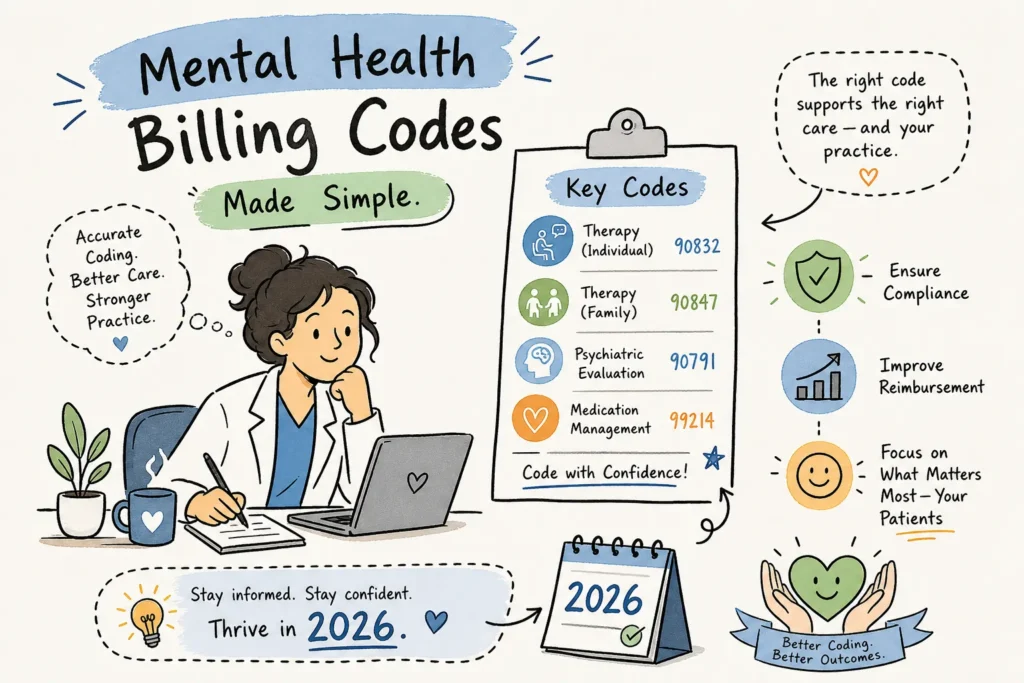
Every mental health billing workflow starts with two codes: 90791 and 90792. These are the psychiatric diagnostic evaluation codes used for initial assessments, and providers consistently mix them up. Code 90791 covers a diagnostic evaluation without medical services and is the correct code for psychologists, LCSWs, therapists, and any provider who is not assessing or managing medications. Code 90792 is reserved for psychiatrists and other prescribers because it includes medical services as part of the evaluation. The key distinction here is that payer enrollment determines which code a provider can legitimately bill, not just the clinical content of the visit. Billing 90791 when your credentials and enrollment support 90792, or the reverse, triggers a credentialing-linked denial. It’s entirely avoidable. For a clear reference on how these assessment codes map to documentation and modifier expectations, see this psychiatric evaluation CPT codes guide.
Individual psychotherapy timed codes: 90832, 90834, and 90837
For individual psychotherapy, three timed codes cover most outpatient sessions:
- 90832: 16 to 37 minutes of face-to-face psychotherapy
- 90834: 38 to 52 minutes of face-to-face psychotherapy
- 90837: 53 minutes or more of face-to-face psychotherapy
Code 90837 is the most commonly billed of the three, and it’s also the most frequently audited. The reason is straightforward: documentation must reflect actual session duration, either through start and stop times or a clearly documented total psychotherapy time. Billing 90837 when the progress note describes or implies a 45-minute session is one of the highest-frequency denial triggers seen in payer audits. Medicare’s 2026 non-facility reimbursement rate for 90837 runs approximately $154 to $167 depending on locality, with rates varying further by place of service. Always verify against the current Physician Fee Schedule for your region rather than relying on national averages.
Add-on codes for same-day E/M and psychotherapy visits
Psychiatrists and prescribing providers who deliver both a medical evaluation and psychotherapy in the same visit can bill both services, but the rules are specific. The psychotherapy and E/M must both be significant and separately documented. You can’t bill both simply because both happened in the same appointment; the chart must prove they were clinically distinct portions of the encounter.
The correct mechanism is the psychotherapy add-on codes: 90833 (30 minutes), 90836 (45 minutes), and 90838 (60 minutes). These are reported alongside an E/M code, for example, 99213 + 90833, not as standalone codes. One rule catches a lot of prescribers off guard: when billing an E/M with a psychotherapy add-on, the E/M level is selected by medical decision making (MDM), not by total encounter time. Time spent in psychotherapy does not count toward E/M time, and the two elements are completely separate in the record. For additional practice-focused guidance on billing same-day E/M with office procedures, review industry coverage such as the same-day E/M and office procedure guidance.
Documentation for these combined visits must clearly delineate which portion of the note supports the E/M and which supports the psychotherapy service. A note that blends both into a single narrative without that distinction won’t survive a payer audit, and it puts the entire claim at risk rather than just one service.
Family, group, and crisis service codes most practices underbill
Three family and group codes represent significant billing opportunities that many small practices either miss entirely or bill incorrectly. Code 90846 covers family psychotherapy without the patient present, used when you’re meeting with family members to support the patient’s treatment plan. Code 90847 covers family psychotherapy with the patient present. Code 90853 covers group psychotherapy for non-family groups, typically two or more unrelated patients. For group claims, payers often require documentation of group size and each participant’s progress separately, so a single group note that doesn’t address individual members creates a denial risk for every participant’s claim.
One 2026 update worth acting on: CMS permanently added multiple-family group psychotherapy (CPT 90849) to the Medicare Telehealth Services List. Many practices haven’t adjusted their behavioral health billing workflows to capture this yet, which means leaving reimbursement on the table for services already being delivered.
Crisis psychotherapy codes work differently than standard timed codes. Code 90839 covers the first 30 to 74 minutes of crisis psychotherapy and is reserved for urgent situations requiring immediate intervention. It cannot be used as a substitute for a long psychotherapy session when there’s no documented crisis. The add-on code 90840 covers each additional 30 minutes and is billed alongside 90839 when the crisis intervention extends beyond the initial period. Payers scrutinize these codes heavily, so documentation must support the nature of the crisis, the urgency of the intervention, and why standard psychotherapy codes were clinically insufficient for the situation.
Behavioral health integration and CoCM codes most practices miss
Collaborative care and behavioral health integration (BHI) codes represent some of the most consistently underbilled revenue in mental health practice. Code 99484 covers general BHI care management when at least 20 minutes of non-face-to-face care management time is documented within a calendar month. It’s billed by the supervising physician or qualified non-physician practitioner. For Medicare, code G0323 serves as the BHI alternative when that care management time is furnished by a clinical psychologist or clinical social worker, using the same 20-minute monthly threshold.
The Collaborative Care Model (CoCM) uses a separate code set:
- 99492: Initial month of psychiatric CoCM, covering the first 70 minutes of cumulative care management time
- 99493: Subsequent months, covering the first 60 cumulative minutes
- 99494: Add-on for each additional 30 minutes in any month, reported alongside 99492 or 99493
- G2214: Medicare’s HCPCS code for psychiatric CoCM, covering the first 30 minutes in fee-for-service Medicare claims
Two rules govern this code set and both cause denials when ignored. First, you cannot bill BHI and CoCM codes for the same patient in the same calendar month. Pick one model and document accordingly. Second, CoCM requires a psychiatric consultant as part of the care team. This isn’t optional or implied; it’s a billing requirement. Practices that document CoCM services without establishing that a psychiatric consultant was involved in the model will face denials that are hard to appeal retroactively. For details on Medicare’s policy and billing expectations for integrated behavioral health services, review the CMS guidance on behavioral health integration and CoCM.
Mental health billing codes: modifier mistakes and documentation gaps that trigger denials
Telehealth modifier errors are among the most straightforward denial causes in mental health billing, and they’re also among the most common. Modifier 95 is the standard for synchronous video services with most commercial payers and Medicare. Some payers still require Modifier GT, an older telehealth indicator, but GT is largely an exception-based requirement in 2026 rather than a broad standard. Using the wrong one produces a straightforward denial. Before submitting telehealth claims, verify each specific payer’s modifier requirement. Don’t assume that what works for UnitedHealthcare works for Medicaid or a regional BCBS plan. For a technical breakdown of GT vs. 95 (and other telemedicine modifier nuances), see this practical resource on telemedicine billing GT/95 modifiers, and for common patterns generating denials, read our deep dive on Telehealth Billing Denials in Mental Health.
Modifier 25 is consistently misused when providers bill an E/M alongside a psychotherapy service on the same date. The modifier signals that the E/M was separately identifiable, but the modifier itself doesn’t justify the claim. The chart does. When the documentation doesn’t clearly support that the E/M was distinct from the psychotherapy encounter, the Modifier 25 claim will deny regardless. Behavioral health-specific modifiers create another layer of complexity: codes like HQ (group therapy), HE (mental health program), and HP (doctoral level) are required by certain Medicaid plans. Omitting them triggers silent denials that can be difficult to trace back to the actual cause.
Documentation gaps are the underlying driver behind most of these denials. For timed psychotherapy codes, the single most common documentation failure is a note that describes session content without recording start and stop times or total psychotherapy minutes. Without that element, a 90837 claim becomes very difficult to defend in an audit. For telehealth services, payers require documentation of patient consent to the telehealth modality, the technology platform used, and the correct place-of-service code. Missing any one of those elements triggers a technical denial even when the service itself was clinically appropriate and medically necessary.
Medical necessity documentation is where claims fail quietly over time. A compliant progress note for individual psychotherapy should include the patient’s diagnosis, current symptoms, functional impairment, therapeutic interventions used in the session, the patient’s response to those interventions, and measurable progress toward treatment goals. A note that reads as a narrative summary without those elements won’t survive a payer review, and it won’t support an appeal if the initial claim denies.
For 90837 specifically, Medicare expects the documentation to tell a coherent clinical story: why the patient still needs psychotherapy, what was done in the session, and why the 53-plus minute level of service was medically necessary.
Why mental health billing complexity pushes small practices toward expert partners
The rules covered in this guide aren’t static. They change with every payer update, every new telehealth policy cycle, and every CMS final rule. For a solo therapist or small group practice running a full caseload, staying current on payer-specific modifier requirements, documentation standards by code, and annual Medicare updates isn’t realistic without dedicated billing staff. That’s not a judgment; it’s a structural reality of running a small practice.
The financial impact compounds when billing complexity goes unmanaged. Consider a practice billing primarily 90837 at $150 per session with a 15% monthly denial rate and no formal appeals process. Over a year, that’s a significant revenue loss, and it doesn’t account for add-on codes like 90833, 90836, or CoCM codes that the practice may never bill at all because the rules feel too complicated. The real cost isn’t just the denied claims; it’s also the revenue that never gets captured in the first place.
WeBill Health specializes in behavioral health and mental health billing, which means the team already knows the payer-specific modifier rules, documentation requirements by code, and the payer-specific variations that separate a clean claim from a denial before it goes out the door. Practices that partner with WeBill Health aren’t outsourcing data entry; they’re getting a billing team that monitors payer policy changes, flags documentation issues proactively, and manages appeals when denials happen anyway. If you want to learn more about broader industry practices and why outsourcing core revenue functions can stabilize cashflow, see our piece on medical billing and coding services.
Getting mental health billing codes right in 2026
Mental health billing codes are specific, payer rules are layered, and the documentation requirements for timed codes are stricter than most providers realize until a denial shows up. Getting the code right is only half the equation. The modifier, place of service, telehealth consent documentation, and progress note all have to line up for a claim to pay cleanly. One gap in any of those elements is enough to trigger a denial, and in a small practice without a billing follow-up workflow, that denial often becomes a write-off.
The 2026 updates, including CMS’s telehealth expansions for group codes, BHI billing simplifications, and ongoing payer policy shifts around telehealth modifiers, make this a year where reviewing your billing processes proactively pays off. That might mean auditing your current documentation templates, verifying modifier requirements by payer, or identifying codes like 99492 and 99484 that may be going unbilled entirely. The revenue opportunity is real in each case; for a playbook on practical clinic-level changes to capture that revenue, consult our Behavioral Health Billing: The 2026 Clinic Playbook.
If managing this complexity in-house is pulling time away from patient care, or if your denial rate has been trending upward without a clear explanation, WeBill Health’s mental health billing team is worth a conversation. Reach out to WeBill Health to talk through what a billing partnership looks like for your practice.
Frequently asked questions about mental health billing codes
What are the most commonly used mental health billing codes in 2026?
The most frequently billed mental health CPT codes include 90791 and 90792 for diagnostic evaluations, 90832, 90834, and 90837 for individual psychotherapy by session length, and 90846, 90847, and 90853 for family and group therapy. For integrated care, 99484, 99492, and 99493 cover behavioral health integration and collaborative care management services.
What is the difference between mental health billing codes 90791 and 90792?
Code 90791 covers a psychiatric diagnostic evaluation without medical services and is used by non-prescribing providers such as psychologists and licensed clinical social workers. Code 90792 includes medical services as part of the evaluation and is reserved for psychiatrists and other prescribers. The correct code depends on your payer enrollment and credentials, not just the clinical content of the visit.
How do psychotherapy billing codes handle session time?
Psychotherapy billing codes 90832, 90834, and 90837 are time-based, so documentation must reflect actual session duration using start and stop times or total psychotherapy minutes. Billing 90837 without documentation clearly supporting 53 or more minutes of face-to-face psychotherapy is one of the most common denial triggers across commercial payers and Medicare.
Can mental health billing codes be used for telehealth services?
Yes. Most standard psychotherapy and evaluation codes apply to telehealth when the correct modifier is appended. Modifier 95 is the current standard for synchronous video services with most commercial payers and Medicare. Some payers may still require Modifier GT. Telehealth claims also require documentation of patient consent, the platform used, and the correct place-of-service code.
What behavioral health billing codes are most often underbilled?
BHI and CoCM codes, specifically 99484, 99492, 99493, and G2214, are among the most consistently underbilled in mental health practice. Many practices deliver services that qualify for these codes but never capture the revenue because the documentation and billing rules feel complex. CPT 90849 for multiple-family group psychotherapy via telehealth is another code that practices added to Medicare’s telehealth list in 2024 but haven’t yet incorporated into their workflows.