
Why are my ABA therapy claims being denied by insurance? It’s a question ABA practice owners and billing teams ask constantly, often after the damage has already been done. Picture this: your team delivered weeks of authorized services, the claims went out clean, and then a recoupment demand arrives covering 14 months of paid claims. Or maybe it’s simpler than that, every reauthorization request for the same patient keeps coming back denied, even though nothing about the case has changed. Either way, the revenue is gone and nobody on your billing team can explain why.
At WeBill Health, we work with ABA practices across the country and see the same five denial triggers show up again and again, often costing providers substantial recoupments before anyone figures out what went wrong. The good news is that ABA insurance denials aren’t random. They follow predictable patterns tied to documentation gaps, coding errors, authorization failures, and utilization management red flags. Once you know which pattern you’re dealing with, you can fix it and prevent it from recurring.
This article is a diagnostic guide. Identify your denial type, apply the right fix, then build the workflow that keeps it from coming back.
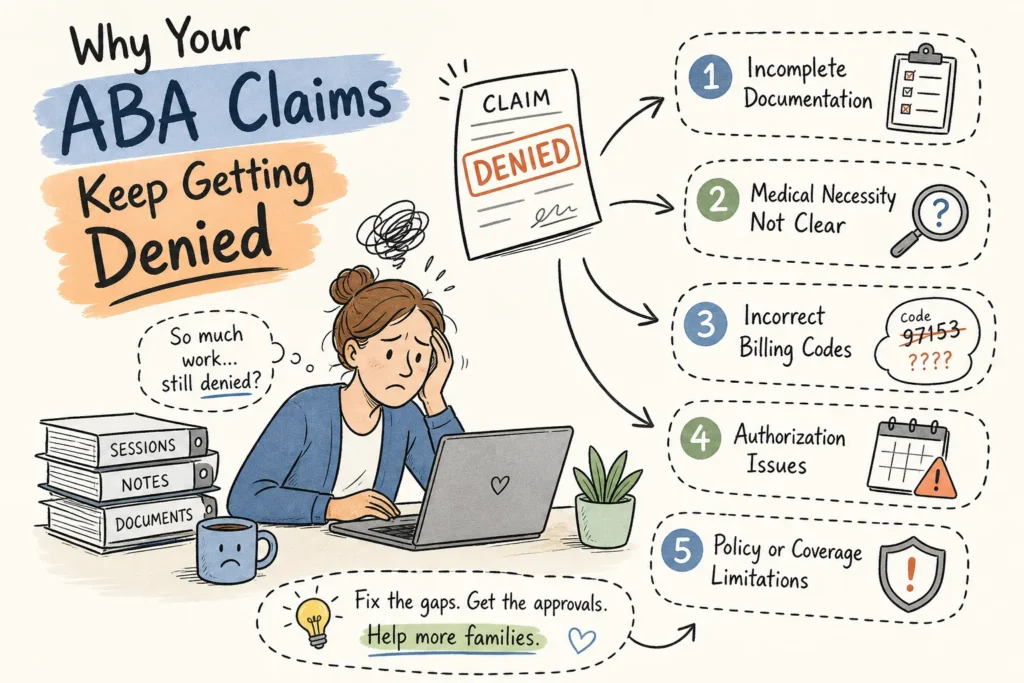
Why are my ABA therapy claims being denied by insurance? Start with these five triggers
The five denial categories below account for the majority of ABA insurance denials seen in practice. Each has a distinct root cause, a recognizable pattern, and a specific resolution path. Working through them in order is the fastest way to diagnose where your billing process is breaking down.
1. Progress notes that can’t survive a reauthorization review
Here’s how this denial plays out: the initial authorization was approved, services were delivered on schedule, and then the payer denies continued services or demands repayment because the progress notes don’t demonstrate measurable improvement. Aetna, for example, evaluates ongoing medical necessity every 180 days. Vague narrative notes without objective data give the reviewer a straightforward reason to pull payment, and they use it.
The problem usually comes down to the difference between notes that describe what happened in a session and notes that prove clinical progress. Describing what happened is not enough. Your progress notes need to include:
- Baseline skill-acquisition data
- Frequency or percentage measures for each behavior target
- Mastery comparisons from initial assessment to the current session
- A clear clinical rationale for why the current service intensity is still warranted
If a reviewer can’t find those data points in the record, they have grounds to deny.
For claims already denied on this basis, the appeal needs a retrospective clinical summary from the supervising BCBA that organizes objective data by goal, demonstrates measurable progress (or clinically justifies why lack of progress still supports continued services), and directly addresses the payer’s specific medical necessity language. As a best practice, payer-specific, goal-aligned letters of medical necessity consistently outperform generic ones, generic letters rarely give reviewers what they need to approve. You have to speak the payer’s language and answer their exact question. See a practical resource on master ABA medical necessity documentation that outlines the elements reviewers expect.
2. A medical necessity statement that doesn’t match payer criteria
Most major payers require far more than an F84 ICD-10 code and a prescription for ABA. They expect functional assessment results from recognized tools like the VB-MAPP, Vineland, or ADOS-2; evidence of deficits in adaptive behavior or communication; and a documented rationale tying the specific number of weekly hours requested to the severity and complexity of those deficits. Practices that skip this linkage create an easy denial target because the payer simply has no clinical evidence to approve against.
Two gaps show up most often. The first is an initial authorization packet that doesn’t include quantified assessment scores, just narrative impressions. The second is a reauthorization request that assumes the payer remembers prior approvals. Reviewers base decisions on the submitted record. If you don’t include the full clinical picture, the reviewer acts as if it doesn’t exist.
A complete medical necessity justification includes the diagnosing clinician’s evaluation report, standardized assessment scores with functional interpretation, a treatment plan that connects each goal to a documented deficit, and an intensity rationale that explicitly explains why lower-level or less-frequent services would be clinically insufficient. That’s the documentation that survives both pre-authorization and post-payment audit. Anything less is a risk you may not know you’re carrying.
3. CPT coding errors that quietly invalidate claims
ABA billing has one of the more complex code sets in behavioral health, and specific error patterns generate systematic denials across entire claim batches before anyone notices. Common mistakes include:
- Billing a technician-delivered service under a QHP-only code
- Using the wrong code family entirely (billing CPT 97151, 97158 when the payer requires HCPCS H-codes like H2014 or H2019)
- Reporting units that don’t align with the payer’s timed-code rules
- Applying or omitting modifiers incorrectly for supervision, group sessions, or split-session scenarios
Payers also periodically update their ABA fee schedules and coverage determinations, and a code that was billable under one policy may be retired or reclassified in the next update. Practices billing outdated codes often see a wave of denials that look like new problems but trace back to a policy change that happened months earlier. By the time the pattern becomes visible, hundreds of claims may already be affected. A useful primer on differences between code sets is available in this HCPCS vs CPT codes in ABA therapy (2025 update).
The fix for existing coding denials starts with a targeted audit: verify the payer’s current ABA billing policy document, map each code on outstanding denied claims against that current policy, and identify which denials are correctable through resubmission versus which require appeals with additional documentation. Going forward, implement a provider-type crosswalk so technician codes and BCBA codes are never mixed incorrectly. This safeguard substantially reduces one of the most common and costly systematic denial patterns in ABA billing.
4. Prior authorization gaps that invalidate delivered services
Authorization-related denials fall into three distinct patterns, and treating them the same way is a billing error on its own. The first is services delivered before written authorization was confirmed. The second is treatment continuing after an authorization period expired because the renewal wasn’t submitted in time. The third is claims submitted for units that exceeded the authorized amount. Each creates a different denial category with a different resolution path.
Every payer has its own renewal window and ABA prior authorization requirements for continued medical necessity. Aetna’s ABA authorization period, for instance, does not exceed 180 days. Practices that don’t build renewal workflows around those specific windows will routinely deliver services in a gap period, creating both immediate denials and post-payment recoupment exposure on claims that were initially paid without issue.
For authorization denials, retroactive authorization requests are possible in some plans under specific circumstances, availability varies by payer and state. Peer-to-peer review can sometimes recover services delivered in a short gap, and a detailed medical necessity rationale can support an override appeal. Prevention is far more effective than appeal here because retroactive authorization approvals are inconsistent across payers. If your team doesn’t have a calendar-based authorization tracking system tied to each patient’s specific renewal window, this denial type will keep recurring regardless of how well you handle the appeals.
5. Utilization management red flags that trigger post-payment audits
Post-payment audits for ABA are often triggered by statistical outliers. Payer UM systems look for unusually high weekly hours relative to the member’s age and diagnosis severity, billing patterns showing rapid goal mastery paired with immediate addition of new goals (which can look like churning to an algorithm), consistent billing at maximum authorized hours without documentation of clinical necessity for that intensity, and claims that show no reduction in service hours over time despite documented progress.
This is where many practices are blindsided. UM audits result in recoupment demands on claims that were already paid and approved, sometimes covering services delivered 12 to 18 months earlier. The documentation standards applied retrospectively are often stricter than what practices were told was required at authorization, an observed pattern across payer audits rather than a universal rule. An approval letter is not the end of the risk. Depending on the plan, many payers may review paid claims going back 12 to 18 months, so every approved claim should be treated as potentially subject to future scrutiny.
What to do when a recoupment demand arrives
When a recoupment demand arrives, take these steps immediately:
- Request the full audit rationale and the specific claims flagged
- Do not make any payment until the appeal process is exhausted
- Compile all clinical documentation for the audit period, progress notes, data sheets, treatment plan updates, and BCBA supervision logs
- Submit a formal appeal that directly refutes the UM rationale point by point with clinical evidence
Timelines matter here. Aetna gives providers 180 days from the initial claim decision to file a dispute, and missing that deadline forfeits the right to contest. BCBS and UnitedHealthcare deadlines vary by plan and state, so confirm the exact window immediately when a demand arrives. For guidance on structuring an effective appeal, review a step-by-step approach on how to appeal an insurance denial for ABA therapy.
Building a billing system that prevents these denials from recurring
Each of the five denial types above has a systemic root cause: documentation standards that aren’t consistently applied across clinicians; code policies that aren’t monitored for payer updates; authorization tracking that relies on memory rather than workflow; and UM risk patterns that go undetected until a demand letter arrives. Addressing individual denied claims without fixing those underlying workflows means the same denials keep returning, just with different claim numbers.
ABA carries high post-payment audit risk and more payer-specific documentation requirements than many behavioral health services, which is exactly why a generalist billing approach tends to fall short. WeBill Health focuses specifically on ABA practices rather than treating it as one billing category among many. We track payer-specific UM triggers, monitor authorization windows by insurer, and build the documentation frameworks designed to survive retrospective review, not just initial approval. For actionable prevention tactics and checklists on avoiding common denials, see this practical guide on how to avoid insurance denials for ABA therapy. The difference between a generalist billing service and a specialty-specific partner shows up most clearly at reauthorization time and in the audit response process.
Systematic denial prevention means your staff isn’t spending hours on appeals that could have been avoided, and it means the revenue your clinicians earn actually stays in your practice.
Final diagnosis
If you’ve been asking why your ABA therapy claims keep getting denied by insurance, the answer is almost always traceable to one of these five categories. Many ABA claim denials are predictable, and many are preventable with proper documentation, coding controls, and authorization workflows. Progress notes that can’t pass a UM review, medical necessity statements that don’t meet payer criteria, CPT coding errors, authorization gaps, and post-payment audit flags each follow a recognizable pattern with a specific fix. Post-payment recoupment demands are the highest-stakes version of these problems because the revenue has already been counted and the documentation window has closed.
If ABA insurance denials are draining your practice’s revenue, WeBill Health works specifically with ABA providers to identify payer-side audit risks before they become recoupment demands. Reach out to schedule a consultation and find out where your current billing process is most exposed.