
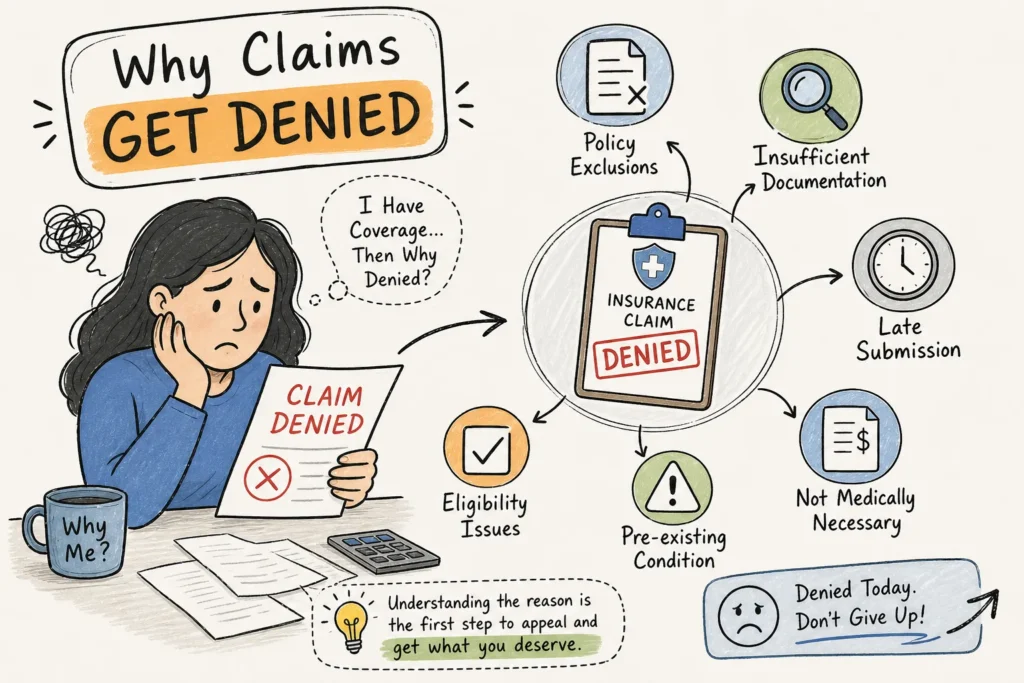
What causes medical claims to be denied by insurance? Roughly 1 in 5 in-network claims gets denied, and many practices never fully recover that revenue. According to a 2024 CBS/marketplace analysis, insurers denied approximately 19% of in-network claims across major marketplace plans, a figure that applies specifically to marketplace coverage but reflects a broader industry pattern. That number alone is alarming, but what makes it worse is the pattern underneath it: a substantial share of those denials involve documented, clinically appropriate services that were rejected for reasons that have nothing to do with the quality of care delivered.
If you’ve spent any time chasing denied claims, you know the frustration. A service gets rendered, the documentation is in the chart, and then a payer kicks it back with a code that feels arbitrary. Many practices respond to denials reactively, appealing the ones that look fixable and writing off the rest, a pattern commonly observed across billing operations of all sizes. That approach leaves significant revenue on the table every month.
Specialty-focused billing teams often spend considerable time working backward from denial codes to root causes, identifying which category of denial triggered the rejection and what process change prevents the next one. This article gives you that same category-by-category diagnostic framework. The structure covers three areas: administrative errors, clinical documentation gaps, and payer-side algorithmic triggers, with examples across different practice types.
Claim rejection vs. claim denial: why the difference matters
What a rejection actually means for your claim
A rejected claim never reached adjudication. It was kicked back at the EDI or clearinghouse level because of a technical or formatting error before the payer ever reviewed it. Common culprits include wrong taxonomy code, invalid date format, or a missing required data element. The EDI codes you’ll see here are 999, TA1, and 277CA, they signal a front-end problem rather than a clinical or coverage dispute. Because the payer never processed the claim, there’s no formal denial on record. For a detailed primer on these front-end failures see the EDI rejections medical billing guide.
That also means corrections can be made and the claim resubmitted quickly. Rejections are the easiest category to fix: the correction is almost always administrative, the turnaround is fast, and no appeal documentation is required. If you’re seeing high rejection volumes, the root cause is usually a data entry workflow issue or an outdated clearinghouse configuration, not a payer-side policy problem.
What a denial means and what comes next
A denied claim is different. It passed through the front door, got adjudicated by the payer, and came back with a CARC (Claim Adjustment Reason Code) explaining why payment was withheld. These range from CO-29 (timely filing limit exceeded) to CO-50 (medical necessity not established) to CO-15 (missing authorization). Unlike rejections, denials usually require documentation, formal appeals, or both, and the path forward depends entirely on which code came back. Treating all denials the same way is one of the most common mistakes in billing operations. For a helpful reference on common denial codes and what they mean, see this guide to medical billing denial codes.
What causes medical claims to be denied by insurance: administrative vs. clinical reasons
Patient eligibility and coverage problems
Eligibility issues are among the most frequent drivers of claim denials. A patient’s coverage may have lapsed, their plan may have changed at the new year, or they may be enrolled under a different payer than what’s on file. The denial typically returns as PR-27 (coverage not in effect) or a similar code indicating the payer has no active policy on record. Running real-time eligibility checks before every visit, not just for new patients, substantially reduces these denials. The fix lives at the front desk, not in the billing department.
Timely filing limit violations
Every payer sets a hard deadline for claim submission. Medicare requires claims within 12 months of the service date. Commercial payers vary widely, anywhere from 90 days to one year depending on the plan and contract terms, with Aetna and BCBS affiliates often falling in the 90-to-180-day range. A CO-29 denial is rarely recoverable unless you can document a payer-side error that caused the delay. The solution is a clean submission workflow with built-in tracking, not a chase process that kicks in after the deadline passes.
Missing or incorrect claim data
CO-16 denials appear frequently in billing audits. Wrong NPI, incorrect date of birth, missing modifier, or diagnosis pointer mismatch, any one of these can hold a claim in adjudication. Claim scrubbers catch many technical errors before submission, but they only flag what the validation rules are configured to find. Staff training on data entry standards and regular claim accuracy audits are what keep CO-16 volume low over time, because the underlying errors are human and process-driven.
Clinical denials: when payers challenge the care itself
Prior authorization denials
A CO-15 or CARC 197 denial means the service was rendered without required prior authorization, or the auth on file didn’t cover the actual procedure performed. These are particularly damaging because the service has already been delivered. Prevention requires a structured authorization workflow that covers who requests it, who tracks renewals, and what happens when the scope of service changes. For specialty practices running high volumes of auth-required services, this process needs to be locked down before the patient walks in the door.
Medical necessity disputes
Medical necessity denials (CO-50, CO-11) are the most documentation-intensive to fight and the most frequently escalated to appeal. The payer’s position is that the clinical record doesn’t justify the billed service. What insurers want to see is a clear chain: the diagnosis supports the procedure, the clinical notes explain why it was ordered, the treatment plan documents what was tried before, and the objective findings back it up. Incomplete documentation doesn’t just invite these denials, it makes them very difficult to overturn, because the appeal has nothing stronger to present than the original submission. For practical guidance on building an appeal-ready record, review best practices for medical necessity documentation.
Diagnosis-to-procedure code mismatches
When the ICD-10 code doesn’t support the CPT code billed, payers flag it as a coding error or medical necessity denial. This happens frequently when coders use nonspecific diagnosis codes, miss laterality, or fail to update their code references at the start of a new payer year. A physical therapy practice billing a gait training code with a vague musculoskeletal diagnosis is a common trigger. The fix is coding accuracy combined with documentation that directly and explicitly links the clinical picture to the procedure performed.
Payer-side algorithmic denials: the systematic rejectors
Utilization management edits and automated review
These denials feel the most disconnected from clinical reality, because they often are. Payers use utilization management algorithms to automatically flag or deny claims that exceed visit thresholds, functional benchmarks, or treatment frequency norms. The denial doesn’t reflect the patient’s actual clinical need; it reflects the algorithm’s rule set. Physical therapy practices, ABA providers, and behavioral health clinicians encounter these frequently. CARC 57 (documentation doesn’t support level of service) is a common output of automated UM reviews. Fighting them requires documentation that anticipates the algorithm’s criteria, which means knowing what the payer’s system is configured to look for before the claim goes out.
Bundling and unbundling edits
CO-97 denials mean the payer has decided a billed service is already included in another service on the same claim or date of service. These bundling edits are governed by payer-specific National Correct Coding Initiative rules. Providers who bill CPT code combinations that the payer’s edit engine considers mutually exclusive will get one line denied automatically. The fix is knowing which combinations trigger NCCI edits for each payer and applying the correct modifiers where unbundling is clinically and contractually justified.
Post-payment audits and recoupment demands
This is the denial category that hits the hardest financially because reimbursement has already been received when it happens. The payer reviews a sample of claims, finds documentation deficiencies, and demands money back. ABA therapy and behavioral health practices are particularly exposed to these audits, which are often triggered algorithmically when billing patterns deviate from the payer’s norms. The defense is proactive: documentation practices that meet audit standards from day one, not a scramble at the time of demand.
How your specialty shapes your denial risk profile
Physical therapy, rehab, and chiropractic practices
PT and chiropractic practices face a disproportionate share of UM-algorithm denials. Payers use functional limitation thresholds and progress note requirements to justify cutting off coverage, and claims that don’t document measurable functional improvement are vulnerable. A claim for continued physical therapy without objective outcome measures in the chart is a denial waiting to happen. Specialty-specific billing knowledge, including how to document in ways that satisfy payer criteria for ongoing medical necessity, makes a direct and measurable difference in denial rates for these practice types.
Behavioral health, mental health, and ABA providers
Behavioral health denials cluster around prior authorization requirements, telehealth-specific billing rules, and CPT codes that carry elevated payer scrutiny. Mental health CPT codes like 90837 and 90847 are reviewed more aggressively in many commercial plans. ABA providers face post-payment audits triggered by high visit volumes and documentation-heavy payer contracts. WeBill Health is built specifically for these practice types, with front-end workflows designed to address the denial triggers that specialty providers encounter most, before claims are ever submitted.
Small and independent practices
Small practices with no dedicated billing staff are the most exposed to administrative denial types. Timely filing lapses, missed eligibility checks, and coding errors are more common when billing is handled by generalists or office managers juggling multiple responsibilities. The pattern is consistent across practices of this size: the root causes aren’t complex, but without a structured process, they recur claim after claim and compound into significant annual revenue loss.
Stopping denials before they start
Front-end verification and authorization management
The highest-leverage point in denial prevention is the front end. Real-time eligibility checks before every service date, combined with a structured prior authorization tracking process, substantially reduce the two most common denial categories before they occur. This isn’t about adding complexity, it’s about shifting the work from reactive appeals (expensive, time-consuming, often unsuccessful) to proactive verification (fast, scalable, effective). For providers and offices unfamiliar with the appeals process, federal guidance on how to appeal health plan decisions can help clarify timelines and required documentation. A checklist-based workflow for auth requests, renewals, and scope changes doesn’t require sophisticated technology. It requires consistent execution.
Clean claim submission and coding accuracy
Claim scrubbers catch many technical errors before submission, but they don’t fix underlying coding problems. Regular coding audits, updated code references at the start of each payer year, and documentation templates aligned to payer criteria are what keep denial rates low over time. The goal is a claim that looks exactly like what the payer expects to see before it’s ever submitted, so adjudication moves quickly and in your favor.
When specialty billing expertise changes the outcome
Most practices don’t realize how many of their denials are preventable at the root cause level. Reviewing denial codes by category, identifying the top recurring triggers, and building targeted process fixes for each one is the work that specialty billing teams do systematically. WeBill Health approaches denial prevention as a front-end function, not an appeals workflow, building the processes that address root causes before claims go out the door. That approach shows up in cleaner claim rates, faster reimbursement timelines, and revenue that never has to be chased in the first place.
Take control of your denial rate
Understanding what causes medical claims to be denied by insurance is the first step toward stopping it from happening. The categories are distinct, administrative errors, clinical documentation gaps, and payer-side algorithmic triggers each require different responses and different process fixes. Knowing your denial codes, your specialty’s specific risk profile, and where your workflow breaks down gives you the data to address the right problem.
For most practices, the biggest gains don’t come from fighting denials better. They come from building the processes that prevent them from occurring in the first place. If your denial rate is climbing and you’re not sure where the breakdowns are happening, that diagnostic work is exactly where to start.
WeBill Health works with physical therapy, behavioral health, ABA, and independent practices to identify denial root causes and build the front-end workflows that address them. If you want a clearer picture of where your revenue is slipping, reach out to the WeBill Health team for a billing assessment and find out what a specialty-focused approach can recover for your practice.