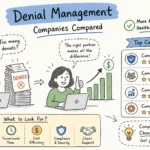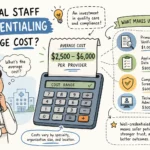

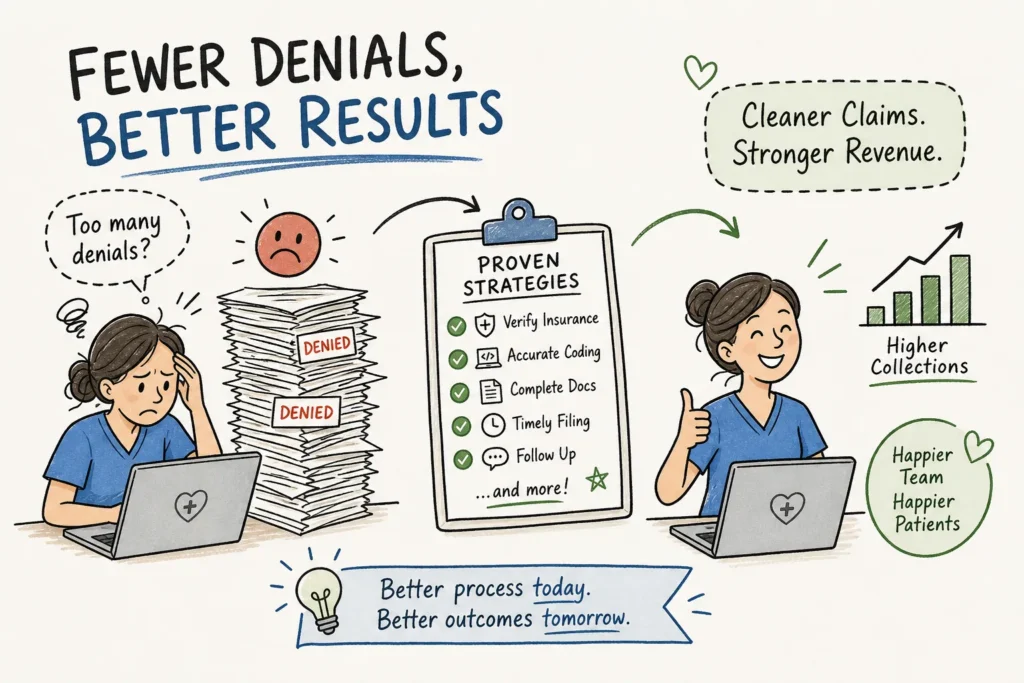
To reduce claim denials, start by putting a dollar figure on the problem. A practice submitting 1,000 claims per month at a 10% denial rate, recovering only half of those denials, quietly loses $120,000 a year in uncollected revenue. That’s before counting a single hour of rework labor at $25 to $118 per denied claim. Many practice managers recognize denials as a problem. Far fewer have a structured plan to fix them.
The industry-wide initial denial rate hit 11.8% in 2026, up from 10.2% in 2020. Behavioral health practices are averaging 16%. Orthopedics is at 13%. Even family practice, one of the cleaner specialties, is running at 9%. These aren’t fringe numbers from poorly run practices. They’re the baseline.
This guide lays out 9 prioritized strategies to reduce claim denials, organized so you can identify the quick front-end wins and the longer-term system changes. By the end, you’ll know which levers to pull first and how to measure whether they’re actually working.
Know your denial rate benchmark before you fix anything
You can’t close a gap you haven’t measured. Before you touch a single workflow, calculate your actual denial rate using this formula: total denied claims divided by total claims submitted in a given period, expressed as a percentage. Most practices undercount this number because they only track payer-returned denials, not soft-coded rejections or quiet write-offs. Your real rate is almost always higher than your billing system shows.
Once you have the number, benchmark it against your specialty. The targets that matter are: below 5% for most practices, with 5% to 10% as a warning range and anything above 10% demanding immediate review. Specialty-specific targets break down further: primary care should be below 4%, physical and occupational therapy below 6%, behavioral health below 7%, and oncology below 9%. If you’re comparing yourself to a generic industry average, you’re measuring against the wrong standard. For broader industry context and benchmarking data, see the industry claim denial statistics from recent reports and analyses to ensure your comparison is current and payer-relevant. industry claim denial statistics
Connect that percentage to actual dollars using the revenue math above. A 10% denial rate sounds manageable in the abstract. At $120,000 in annual lost revenue, it’s a staffing decision, an equipment upgrade, or two years of profit margin. That reframe is what turns a billing metric into a leadership priority.
Reduce claim denials with front-end workflows that stop problems before they start (strategies 1, 3)
Strategy 1: Verify eligibility before every single visit
Eligibility errors, including inactive coverage, wrong member IDs, and terminated plans, are the most preventable denial category you have. The fix is not complicated, but it requires discipline: verify at scheduling, re-verify 24 to 48 hours before the visit, and flag every mismatch for resolution before the patient walks in. This is not a nice-to-have step. It’s a required gatekeeping check, and it needs to be enforced as a mandatory field before any encounter opens.
Some research from vendor and setting-specific contexts attributes more than 75% of claim rejections and denials to eligibility and registration errors, though broader industry estimates tend to run lower. Either way, real-time patient eligibility and claims checks can materially reduce that exposure by surfacing inactive policies, out-of-network risk, coordination-of-benefits conflicts, and authorization requirements before care is delivered. The earlier the catch, the cheaper the fix.
Strategy 2: Tighten patient intake and demographic accuracy
Incorrect name spellings, transposed dates of birth, and missing group numbers trigger a surprising share of medical billing denials that have nothing to do with clinical care. A single transposed digit on a member ID creates a claim the payer rejects automatically, payers commonly process these as hard rejections with no manual review. Standardize your intake checklist to capture full legal name, date of birth, member ID, group number, and referral source at registration, and require staff to validate every field before the encounter is opened.
This step is thin on its own, but when it slips, it creates downstream rework that’s entirely avoidable. Intake accuracy is a front-end control; fixing it after the claim drops is always more expensive.
Strategy 3: Build a prior authorization process that runs before the visit
One quality improvement study found that integrating prior authorization into clinical workflows reduced denial rates by 45.7% to 88.6% across payers. The key variable is timing. PA requests submitted on the day of service get denied at a far higher rate than those submitted when the order is placed. The workflow that works follows six steps: identify the PA requirement at scheduling, compile payer-specific documentation, submit early, track status actively, escalate stalled cases with defined follow-up intervals, and close the loop by documenting the decision in the chart. Each step needs an assigned owner, or cases fall through the gaps.
Coding and documentation: where clean claims quietly break down (strategies 4, 5)
Strategy 4: Audit your coding for the errors payers flag most
The most common coding failure points are mismatched CPT and ICD-10 codes, missing or incorrect modifiers, unbundling errors, and duplicate claim submissions. These errors are especially costly because they show up on remittance advice as clinical issues, making them harder for non-clinical staff to interpret and fix. A recommended starting point for denial management is a monthly internal audit of your top 10 denied CPT codes. That short list will reveal recurring patterns faster than reviewing every denial individually, and it’s the approach many revenue cycle teams use to prioritize corrective action.
Payers like Aetna, BCBS plans, and UnitedHealthcare run increasingly automated edit checks on modifier use, diagnosis-to-procedure support, and same-day billing combinations. Modifier 25 scrutiny, in particular, has intensified across multiple BCBS plans based on updated payer policy communications. Your coding team needs to know which combinations your top payers flag, not just what the CPT manual says is technically correct.
Strategy 5: Document medical necessity in a way payers actually accept
Documentation denials are not just about having notes. They’re about having notes that match payer-specific medical necessity criteria. Strong supporting documentation includes functional limitation details, prior treatment history, progress toward goals, and a clear, explicit link between the diagnosis and the service billed. Generic progress notes that describe what the clinician did but not why it was medically necessary are the most common documentation failure pattern.
What satisfies a commercial payer for physical therapy is not the same as what Blue Cross requires for behavioral health. Payer- and specialty-specific documentation standards differ substantially, and your billing team needs to know those distinctions for your highest-volume payers.
Reduce claim denials with payer-specific rules and denial pattern tracking (strategies 6, 7)
Strategy 6: Build and maintain a payer-specific rules reference
Every major commercial payer, Medicare, and Medicaid has unique rules around covered codes, required modifiers, filing deadlines, and documentation attachments. Practices that treat all payers the same submit identical coding and documentation to everyone, and get payer-specific denials they can’t explain. The fix is a living reference document: which CPT codes each of your top payers consistently denies for your specialty, which modifiers they require, how they define medical necessity for your most-billed services, and what their filing deadline is. Update it every time a payer policy changes or a new denial pattern appears.
Strategy 7: Track denial patterns to catch what individual staff can’t see
A billing team working across multiple specialties and dozens of practices sees when Aetna starts denying a specific code at higher rates across the board. That’s a systemic payer behavior, not a chart error in your practice. In-house staff inside a single practice rarely see enough volume across payers to detect those shifts before they compound. Track denial reason codes by payer, by CPT code, and by provider on a monthly basis. The intersections are where your recurring problems live.
This is where cross-practice denial management visibility makes a concrete difference. WeBill Health tracks denial patterns across specialties and multiple client practices simultaneously, which means emerging payer behaviors show up in aggregate data before they compound into months of avoidable revenue loss at a single practice. Single-practice billing teams don’t have that cross-client perspective, and the blind spot has a measurable cost.
Appeals: the fastest path to revenue you’ve already earned (strategy 8)
Strategy 8: Build a systematic appeals process with deadlines and ownership
Many practices appeal inconsistently. Some denied claims get worked, many get written off, and there is no defined workflow for who does what by when. That informal process costs real money: appeal success rates for prior authorization denials hit 83.2% in recent data, and home healthcare denials were overturned on appeal more than 78% of the time. Revenue you’re leaving on the table is revenue the payer is counting on you not chasing. For evidence on how often denials are overturned through appeals and the factors that influence appeal outcomes, review the recent reporting on insurance denials overturned on appeal. insurance denials overturned on appeal
The components of a functional appeals process are: a denial tracking log with appeal deadline dates clearly marked, a standard appeal letter template organized by denial reason code, and a defined escalation path for complex or high-dollar cases. Appeal timelines vary by payer, typically 30 to 180 days, and missing a deadline forfeits the right to appeal entirely. That makes deadline tracking non-negotiable, not a best practice.
Successful appeals address the specific denial reason with targeted clinical evidence. An appeal for a medical necessity denial needs clinical documentation and a letter of medical necessity. An appeal for a coding denial needs a corrected claim with a brief explanation. A generic cover letter attached to every denial is not an appeals process. It’s wasted effort. The quality of the appeal letter, matched precisely to the denial reason code, is what determines whether the payer reverses the decision.
Building a measurable denial-reduction plan with KPIs (strategy 9)
Strategy 9: Define the metrics you’ll track every month
A denial-reduction plan without measurement is just a to-do list. The core monthly KPIs are: overall denial rate broken down by payer and by CPT code, first-pass claim acceptance rate, appeal success rate, days in accounts receivable, and denial write-off rate as a percentage of net patient service revenue. These five metrics tell you where denials are entering your revenue cycle, whether your appeals process is working, and how much revenue you’re ultimately losing.
Target benchmarks to work toward: a first-pass acceptance rate above 95% is achievable in most specialties with consistent front-end workflows and clean coding. MGMA cites an ideal denial resolution rate of 85% within 30 days. A clean claims rate around 90% is a strong leading indicator that your billing process is working before claims ever reach a payer. Review these numbers monthly, alongside denial reason trends, so your team is reacting to data rather than to whatever problem is loudest that week. For guidance on measuring and standardizing denial metrics across your revenue cycle, refer to industry resources on standardizing denial metrics guidance.
When outside billing expertise closes the gap faster
Practices with a denial rate above 8% to 10%, particularly in high-scrutiny specialties like behavioral health, ABA therapy, or physical therapy, are often losing revenue to systemic payer behaviors their in-house team doesn’t have the cross-practice data to detect or counter. The documentation requirements for ABA billing, the modifier scrutiny on behavioral health claims, the utilization management reviews targeting physical therapy: these aren’t problems you solve by working harder. They require specialty-specific knowledge and payer-pattern visibility that a single-practice billing team rarely accumulates.
WeBill Health is built specifically for that gap. The model is specialty-focused RCM support that treats denial prevention as an ongoing strategy, tracks payer behavior shifts across multiple clients simultaneously, and brings targeted appeal expertise to high-denial specialties. If your in-house team is doing their best but your denial rate keeps trending the wrong direction, the missing variable is usually that cross-practice perspective.
The roadmap, summarized
A large share of medical billing denials are preventable with the right front-end controls in place. The practices with the lowest denial rates are not the ones that got lucky with payers. They’re the ones that built repeatable front-end workflows, audit their coding regularly, know their payer-specific rules cold, and measure everything monthly. The nine strategies in this article give you a prioritized roadmap to reduce claim denials: start with eligibility verification and prior authorization for the fastest impact, tighten coding and documentation next, then build the tracking infrastructure that makes improvement measurable and sustained.
If your denial rate is above your specialty benchmark, or your appeals process runs on whoever has time that week, that’s a billing workflow problem with a knowable cost, and a solvable one. Check your current denial rate against the specialty benchmarks above, then see how WeBill Health approaches denial prevention for practices in your specialty. The gap between where you are and where you need to be is smaller than it looks once you know exactly where to start.