
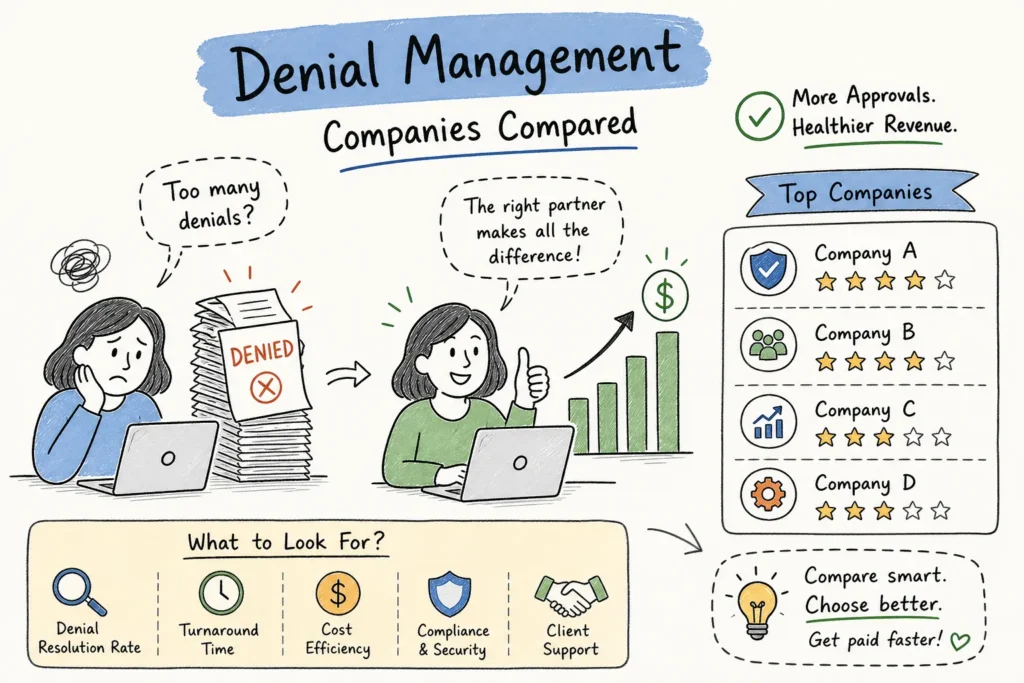
If you’re wondering which companies offer medical billing denial management solutions that actually move the needle, you’re asking the right question, and the answer matters more than most practices realize. The average practice loses between 5% and 10% of annual revenue to unresolved claim denials, and most of that money never comes back. Not because it couldn’t be recovered, but because the practice either chose the wrong denial management partner or no partner at all. The vendor you sign with is a bigger decision than it looks on paper.
At WeBill Health, we’ve spent over a decade working alongside small and specialty practices, and one pattern repeats itself consistently: the gap between a generic billing vendor and a true denial management partner can mean six figures in recovered revenue annually. That gap is almost never visible in a features demo.
This guide gives you a practical framework for evaluating denial management service providers before you commit. You’ll find evaluation criteria, pricing models, published KPIs, and the specific questions that separate vendors who can deliver from those who can only promise.
What denial management actually involves in 2026
Denial management is not just appealing rejected claims. It covers two distinct disciplines: denial prevention, which means catching errors before submission, and denial recovery, which means appealing and overturning denials after the fact. Many vendors only do one half well, and that limitation will show up in your A/R within months. Understanding which companies offer medical billing denial management solutions that cover both sides is the first filter worth applying.
The rise of payer-side algorithmic denials
Commercial payers and Medicare Advantage plans have deployed utilization management (UM) algorithms that generate systematic denials based on pattern-matching and statistical thresholds, not clinical review. These algorithms hit high-risk specialties hardest. Physical therapy, behavioral health, and ABA therapy face disproportionate denial volumes because their claims trigger UM flags at a higher rate than other service types. A vendor without specialty-specific payer knowledge will lose these appeals routinely, because winning requires understanding exactly which documentation language survives a specific payer’s UM review criteria.
Prevention vs. recovery: why both sides matter
The best denial management partners integrate prevention and recovery into a single workflow rather than treating them as separate products. On the prevention side, that means pre-submission claim scrubbing, eligibility verification, payer rules engines, and prior authorization checks. On the recovery side, it means structured appeals workflows, automated letter generation, document retrieval, resubmission tracking, and clear SLA escalation when appeals stall. Breaking those recovery steps into manageable stages is what separates a purposeful workflow from a backlog. Vendors who only handle one side of this equation leave measurable revenue on the table.
Which companies offer medical billing denial management solutions, key differences to evaluate
Evaluating denial management companies on surface features like “appeals automation” misses the more important differentiators. The vendors that recover the most revenue for specialty practices are built differently at the operational level, not just the feature level. For a curated view of market options to start your shortlist, review a roundup of leading denial management companies that highlights different service models and specialty focus areas.
Specialty expertise and payer knowledge depth
This is the single most underweighted criterion in most vendor evaluations. A vendor with deep specialty knowledge understands which CPT codes trigger algorithmic flags for a given payer, what documentation language survives a UM review, and how to build appeals that address the payer’s own criteria directly. Generic billing vendors apply the same appeal templates regardless of specialty, and those templates lose at a measurably higher rate. Ask prospective vendors directly: what percentage of your clients operate in my specialty, and what is your overturn rate for my top three payers?
Appeal overturn rates and how to verify them
Overturn rate is the most important performance metric in any denial management evaluation, but only if you read it correctly. Push vendors to provide overturn rates broken down by payer and denial reason code, not just an aggregate number. Aggregate figures can mask poor performance in the specific categories that matter most to your practice. According to MGMA benchmarking data, roughly 54% of denied claims are overturned after all appeal rounds complete. Strong performers in high-denial specialties aim well above that baseline. Anything below 40% on clinical denials in a specialty practice warrants a direct conversation about methodology.
Reporting transparency and root-cause visibility
A denial management partner worth their fee gives you a clear view into why claims are being denied, not just how many. Look for dashboards that categorize denials by payer, reason code, provider, and service line. Root-cause tracking lets you identify recurring patterns (a coding gap, a specific payer’s authorization quirk) and fix them upstream before they drain your A/R further. Vendors who only report on resolution rates without root-cause analysis are managing symptoms rather than solving problems.
How denial management companies price their services
Pricing models signal incentive alignment as much as they signal cost. The structure a vendor offers tells you something about whether they’re motivated to recover your revenue or just bill for activity.
Percent recovery, subscription, and per-claim: what each model means
The percent-recovery model aligns incentives well for denial recovery services: the vendor earns a commission on recovered dollars, so they only get paid when you get paid. Subscription or flat monthly fees work better for denial prevention tools and claim denial management software platforms, where the value is ongoing rather than event-driven. Per-claim pricing, which the market benchmarks at roughly $25 to $118 per denied claim depending on complexity, is common for specialized or high-value claim categories. Some vendors bundle denial management into broader RCM contracts, which can obscure the actual cost of the denial-specific work and make true apples-to-apples comparisons harder. For more on how denials management software can help preserve revenue and justify subscription spend, see this practical guide to how denials management software helps revenue.
Matching the pricing model to your practice’s cash flow situation
A small practice carrying a heavy denied A/R backlog may benefit most from a percent-recovery arrangement to avoid upfront costs while revenue is suppressed. A more stable practice focused on preventing new denials may prefer a flat subscription model with predictable monthly costs. Before comparing quotes across vendors, clarify billing cadence, recovery percentages, and minimum volume thresholds so you’re comparing equivalent structures rather than just headline numbers.
What the published results actually tell you
The denial management market includes genuinely impressive published outcomes. Access Healthcare reduced denial rates from 20% to 11% and recovered $5.2M in collections. AGS Health eliminated $1M in denials over 10 months with 62% fewer coding denials. Revecore recovered $21.9M in denied and underpaid claims. These are real outcomes worth referencing, but they require careful reading before you use them as benchmarks for your own practice.
Reading vendor KPIs without getting misled
Published case studies almost always represent a vendor’s best-case client results. When a vendor cites a “denial rate reduction,” ask: from what baseline, across what payer mix, and over what time frame? The same metric looks very different across a large hospital system versus a five-provider specialty clinic. Request case studies that match your practice type, specialty, and payer mix, not their flagship enterprise client. A vendor who can’t produce a relevant reference client is showing you something important about their actual experience.
The metrics that matter most for small practices
For smaller practices, the most actionable KPIs are overturn rate on appealed claims, average days to denial resolution, and net revenue recovered per month as a percentage of total billed charges. First-pass acceptance rate improvement is an early indicator that denial prevention is working. A/R days reduction is meaningful but slower to materialize. Look for vendors willing to commit to performance benchmarks in the contract, not just cite them in the sales presentation. For concrete, practical guidance on reducing denials in low-staff small practices, see our piece on How to Reduce Medical Claim Denials in Small Practices. For a broader perspective on the systemic scale of this problem, consider the analysis in The $47 Billion Medical Claim Denial Crisis Hurting Small Practices, which outlines why small offices are disproportionately affected.
Which type of solution fits your practice size and specialty
The field of denial management vendors divides into two broad categories: enterprise RCM platforms and specialty-focused service partners. Choosing between them is less about brand recognition and more about what your practice actually needs to recover revenue.
Enterprise platforms vs. specialty-focused service partners
Large platforms like AdvancedMD, athenahealth, NextGen, and CareCloud offer denial management modules as part of integrated billing and practice management suites. For enterprise health systems, this consolidation makes operational sense. For small and independent practices, these platforms often deliver generic denial workflows that don’t account for specialty-specific payer behavior. Integration breadth matters: some denial management solutions connect across Epic, Cerner, athenahealth, and NextGen simultaneously. But integration coverage alone doesn’t win appeals, and winning appeals is the part that recovers your revenue.
Why high-denial specialties need an advocacy-driven approach
Physical therapy, behavioral health, ABA therapy, and chiropractic practices face denial patterns that generic platforms aren’t built to fight. Payer UM algorithms target these specialties disproportionately, and the appeals that win require clinical documentation strategy, not just form submissions. At WeBill Health, the work isn’t about processing appeals at scale. It’s about understanding a specific payer’s denial logic for a specific service type and building the right clinical and administrative argument to defeat it. Small practices in these specialties consistently recover far more revenue with a focused denial appeal services partner than with a larger platform’s automated denial workflows. For practical strategies focused on physical therapy clinics, see this guide on effective strategies to reduce claim denials for PT clinics from industry sources.
Questions to ask every denial management vendor before you commit
A structured evaluation conversation protects you from signing with a vendor who looks strong on a features list but underdelivers in practice. These questions cut through the marketing quickly and reveal what a vendor can actually do for your specific situation.
The questions that reveal a vendor’s real capabilities
Ask each vendor you’re evaluating the following before any contract discussion begins:
- What is your overturn rate for my specialty and my top three payers?
- Can you provide a reference client with a similar practice size and payer mix?
- How do you categorize and report denial root causes?
- What is your average time-to-resolution on appealed claims?
- Do you flag payer rule changes proactively or reactively?
- How are your fees structured, and what happens if recovery falls below a certain threshold?
- What does onboarding look like, and how long before we see measurable results?
- Do you offer a pilot or performance guarantee?
Red flags and green flags in vendor conversations
Green flags include transparency about performance metrics, willingness to provide specialty-specific case studies, clear reporting dashboards during the demo, and a proactive stance on payer rule monitoring. Red flags include aggregate-only metrics without specialty breakdown, vague answers about overturn rates, no clear SLA on appeals turnaround, and pricing that ties no component to your results. The best denial management partners welcome these questions because honest answers work in their favor. The wrong ones deflect or pivot to a demo.
Choosing the right denial management partner for your practice
When evaluating which companies offer medical billing denial management solutions that fit your practice, the right answer is the vendor whose expertise, pricing model, and reporting structure align with your specialty, payer mix, and size. Enterprise platforms offer breadth. Specialty-focused partners offer depth. For small practices in high-denial specialties, depth is what actually recovers revenue and prevents the losses from repeating.
If your practice operates in physical therapy, behavioral health, ABA therapy, or chiropractic, start by understanding exactly what’s being left on the table before committing to any vendor. At WeBill Health, we offer a no-obligation denial audit that gives you a clear picture of your current denial patterns, recovery opportunities, and the payer-specific gaps costing you the most. It’s a low-risk way to benchmark your situation before you sign anything.
The right partner doesn’t just process your denials. They pursue every recoverable claim with specialty knowledge, transparent reporting, and a clear commitment to appealing everything that deserves a second look. Book your denial audit with WeBill Health and see what a true denial management partnership looks like in practice.
Finally, if you’re evaluating vendors that claim advanced analytics or machine learning capabilities, consider industry perspectives on AI-driven denial solutions to understand where automation helps and where human specialty expertise still wins appeals. For viewpoint and vendor comparison reading, see articles on AI denial management solutions and additional software comparisons to help frame vendor claims.
For deeper reading on how denials impact revenue and why targeted specialty approaches outperform generic platforms, our analysis and related resources, including case studies and software guides, provide the context you need to make an informed decision. If you’d like to see sample dashboards and a suggested vendor scorecard, contact our team during your audit and we’ll share templates and reference data.