
The most common denials in medical billing cost U.S. practices between 11% and 15% of claims on first submission, according to recent industry data. For small and specialty practices, particularly those in physical therapy, behavioral health, and ABA therapy, denial rates can run higher depending on payer mix and workflow gaps. Run the math on a practice billing $500,000 annually: a 15% denial rate means $75,000 sitting in unpaid accounts receivable, and a substantial portion is often preventable with stronger front-end controls.
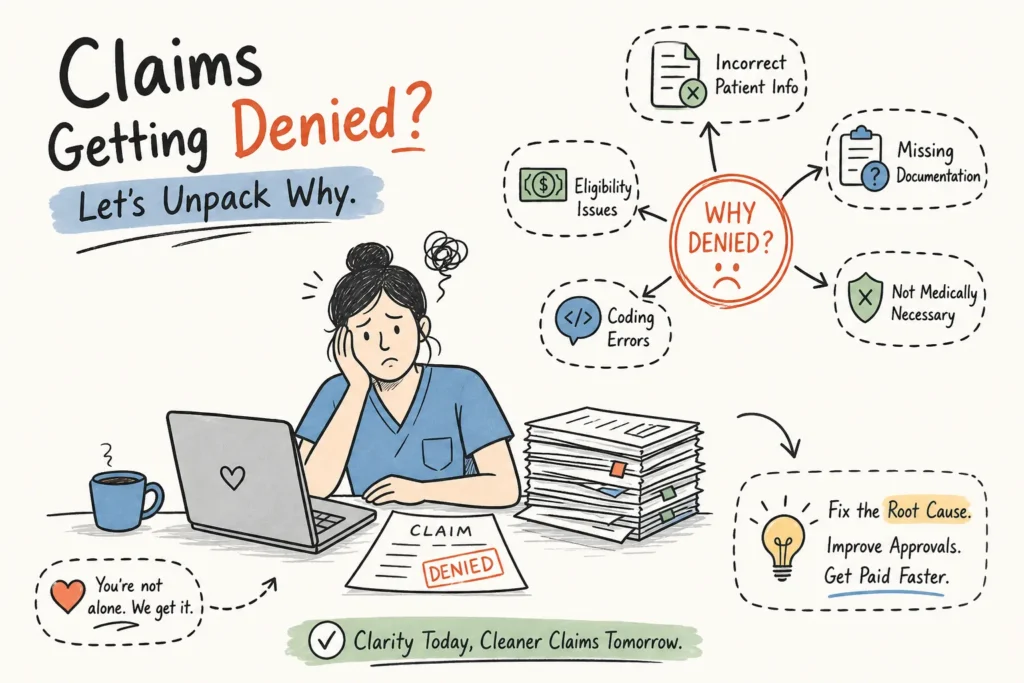
Here’s what two decades of billing work makes clear: most of those denials trace back to the same short list of root causes. Front-end data errors. Authorization gaps. Coding mismatches. Timely filing misses. These failure patterns are common across practice settings, though certain specialties and payers tend to amplify specific denial types. The same core problems show up in PT clinics, behavioral health practices, and general medical offices alike.
By the end of this article, you’ll know the exact codes showing up on your remittance advice, what each one means operationally, and the specific workflow changes that stop them from recurring. This isn’t a generic overview. It’s the breakdown your billing team can actually use.
Claim rejection vs. denial: why mixing these up costs you money
There’s a distinction most front desk and billing staff conflate, and it’s an expensive one to get wrong. Treating a rejection the same as a denial is one of the costliest process errors a practice can make, because the response window and urgency are completely different for each.
What happens when a claim is rejected at the clearinghouse
Rejections happen before the claim ever reaches the payer. The clearinghouse catches structural errors: an invalid NPI, a missing required field, an incorrect format, or a payer ID that doesn’t match. Because the claim never entered the payer’s adjudication system, you can correct and resubmit quickly, often the same day, without burning any part of your timely filing window. Rejections are annoying. They’re not catastrophic, provided your team catches them fast.
Why denials are the more expensive problem
A denial means the payer received the claim, processed it, and chose not to pay. Denials generate formal denial reason codes on the remittance advice, trigger the appeals clock, and start chewing through your AR days. They require either a corrected claim or a formal appeal, both of which consume significant staff time. The key operational point: a corrected claim submitted after a timely filing denial does not reset the filing clock. That window is gone regardless of why the original claim failed.
Most common denials in medical billing: the codes on your remittance and what they mean
Payers use Claim Adjustment Reason Codes (CARCs) to communicate exactly why a claim wasn’t paid. If you’re not reading these codes and categorizing them by root cause, you’re flying blind. Here are the ones that appear most consistently across specialties and payers.
CO-16: missing or incorrect claim information
CO-16 is one of the most frequently reported denial codes across U.S. payers, and it almost always traces back to a front-end data problem. It fires when required fields are incomplete, patient demographics don’t match payer records, a required attachment is missing, or NPI and taxonomy fields are wrong. In most cases, the claim scrubber passed an incomplete record through without catching the gap. Common culprits include outdated insurance information on file, missing referring provider data where the payer requires it, and demographic mismatches between what the practice has on file and what the payer has on its end. The fix is front-end verification, not billing corrections after the fact.
CO-18 and CO-29: duplicate submissions and timely filing limits
CO-18 fires when the payer sees what it considers the same claim submitted twice. This happens more often than practices realize: a manual resubmission without voiding the original, a clearinghouse retry that sends both transmissions through, or two staff members touching the same encounter in the billing queue. CO-29 is a harder problem because it’s often unrecoverable. It means the claim arrived after the payer’s filing deadline, which varies significantly by payer. Per Medicare guidelines (CMS deadline information), the standard timely filing window is 12 months from date of service. Many commercial plans cap submission at 90 to 180 days, though deadlines vary and should be confirmed in each payer’s provider manual. Once that window closes, most payers will not pay regardless of the clinical merits of an appeal.
CO-50 and CO-197: medical necessity and missing prior authorization
These two codes represent the highest-dollar denial risk for most specialty practices. CO-50 means the payer determined the service was not medically necessary based on the diagnosis, documentation, or frequency of billed services. CO-197 means no prior authorization was on file at all. Together, they account for a disproportionate share of denied revenue in PT, behavioral health, and ABA therapy practices, where payer algorithms and utilization management programs scrutinize claims heavily. CO-197 denials are commonly caused by workflow failures such as missing or incorrect authorization data, though payer-side factors can also contribute. An auth that existed but wasn’t documented, or one obtained for the wrong service dates or provider, produces the same denial as having no auth at all.
Eligibility and prior authorization denials: the front-end killers
Both of these common medical billing denial types originate before a single service is rendered. That’s the most important thing to understand about them. They’re not billing errors. They’re scheduling and intake errors that the billing department gets stuck cleaning up weeks later.
How eligibility verification failures trigger claim denials
Eligibility denials happen when a patient’s coverage is inactive, the wrong plan was billed, or subscriber information doesn’t match payer records. The classic scenario: a patient’s employer changes insurance plans on January 1, the front desk is still working from the card they scanned in October, and the claim gets denied in February. By then, the timely filing clock is running and the staff time to resolve it costs more than it should. Real-time eligibility verification at both scheduling and the day of service is a non-negotiable baseline, not a best practice luxury. Tools like Availity, pVerify, and clearinghouse-integrated eligibility modules in most EHR systems make this achievable even for small practices without dedicated billing staff. For practices evaluating options, insurance eligibility verification software offers integrated checks that reduce front-end failures.
Prior authorization denials and the CO-197 problem
Prior authorization denials rank among the most expensive common denials in medical billing, in terms of both dollar value and staff hours to resolve. An auth obtained for the wrong service, the wrong date range, the wrong provider, or one that expired before the claim was submitted produces the same CO-197 denial as having no auth at all. Behavioral health, PT, and ABA therapy practices face particular exposure here because payer auth requirements change frequently, vary by plan, and in 2026 are subject to new CMS transparency rules that make denial rationale more visible but don’t eliminate utilization management scrutiny. The AMA’s review of prior authorization appeals provides helpful context on why appeals succeed and where process improvements matter most: AMA’s analysis of prior authorization appeals.
What a functional front-end workflow actually looks like
The practices that consistently hold low denial rates build authorization and eligibility into the scheduling workflow, not the billing workflow. The steps are concrete and each one can be assigned to a specific person in a specific role:
- Verify eligibility at scheduling
- Verify again the morning of the appointment
- Confirm auth requirements per payer and service type before any service is rendered
- Log auth numbers with expiration dates and assigned visit limits in a centralized tracker
- Assign clear ownership so follow-up doesn’t fall through the cracks between departments
When those steps aren’t assigned and owned, the gaps produce predictable denial patterns month after month. For a deeper playbook on front-end controls and daily processes, see Reduce Claim Denials: 9 Proven Strategies for Your Practice, WeBill Health.
Coding and documentation denials: where specialty billing gets complicated
Eligibility and auth denials are operational. Coding denials require a different type of expertise, and they’re where generic billing services consistently underperform for specialty practices.
CO-11 and diagnosis-procedure mismatches
CO-11 fires when the billed ICD-10 code doesn’t clinically support the CPT procedure. The most common causes are overly generic diagnosis codes, outdated code selection, age or gender logic failures, or documentation that simply doesn’t capture the clinical rationale clearly enough for the payer’s adjudication algorithm. This denial is particularly common in PT and behavioral health claims where functional limitations must be explicitly documented to justify treatment. A diagnosis of “back pain, unspecified” attached to a therapeutic exercise claim will fail where a specific lumbar diagnosis with documented functional impairment will succeed.
CO-50 medical necessity, CO-97 bundling, and payer policy violations
CO-50 comes back to documentation depth. The payer’s algorithm or reviewer determined the clinical record doesn’t justify the service at the frequency or intensity billed. CO-97 is a bundling denial where the billed procedure is considered included in another already-paid service, meaning the coder selected codes that the payer treats as one payment rather than two. Both require coders to know payer-specific policies, not just standard CPT rules published by the AMA. This is where specialty billing expertise earns its cost. A coder who understands how a specific commercial payer handles physical therapy evaluation codes in a bundled episode will prevent more CO-97 denials than one who knows only the CPT manual.
Why coding audits are the best prevention investment
A practical internal coding audit doesn’t require outside consultants. Pull a sample of denied claims by code, identify the patterns, trace them back to the specific coder, template, or documentation gap, and retrain on that specific failure point. At WeBill Health, we build regular coding compliance reviews into billing workflows for PT, ABA, and behavioral health practices specifically because these specialties face higher algorithmic scrutiny from payers. Industry data consistently shows that practices running quarterly coding audits catch denial patterns earlier and correct them faster than those that review claims only after a denial spike. For additional operational focus areas and denial-management best practices, see 10 focus areas for denial management in healthcare billing.
Appealing the most common denials in medical billing: duplicate claims and timely filing
These denial types have nothing to do with clinical documentation or code selection. They’re pure workflow failures, which means they’re also the most straightforward to eliminate with the right processes in place.
Why CO-18 duplicate denials happen more often than practices realize
Duplicate denials are almost never intentional. They happen when a claim is resubmitted without first voiding or correcting the original, when a clearinghouse retries a failed transmission and both go through, or when two billing staff members touch the same encounter without communicating. The prevention protocol is simple: before resubmitting any claim, verify the original claim’s status through the payer portal or clearinghouse. A quick status check prevents a denial that can consume significant staff time to resolve.
CO-29 timely filing: the denial that’s hardest to appeal
Timely filing denials are brutal because once the window closes, most payers will not pay regardless of the appeal’s clinical merits. The variance by payer is significant: Medicare allows 12 months from date of service per CMS guidelines, but many commercial plans cap filing at 90 to 180 days. Always verify the deadline in your specific payer’s provider manual. The prevention answer is a billing queue configured to flag any claim approaching the 60-day mark for immediate follow-up. That flag should trigger an action, not just a notification. A claim that’s been sitting for 58 days needs to move that day, not when someone gets around to the worklist.
Appealing denials that do slip through
Even with solid front-end processes and strong coding protocols, some denials will get through. The practices that recover the most revenue are the ones that appeal consistently and appeal well, not just the easy ones.
What goes into an effective denial appeal
An effective appeal mirrors the payer’s own denial language and rebuts it point by point with clinical evidence. Generic appeal letters that don’t address the payer’s stated denial reason rarely produce overturns. The components that consistently work: a physician letter of medical necessity tied to the specific patient’s condition and diagnosis, chart notes and objective test results supporting the service, the payer’s own medical policy criteria cited directly, and documentation showing why alternatives were insufficient or contraindicated. Quoting the payer’s denial rationale verbatim and then rebutting it directly is more effective than writing a general statement of disagreement. Payers process hundreds of appeals. A specific, organized, evidence-backed submission gets resolved faster and overturned more often than a narrative complaint.
Appeal overturn rates worth knowing
According to KFF analysis and CMS data, internal appeals succeed at roughly 44% overall, but prior authorization denials overturn at approximately 65%, and categories like home healthcare have seen rates reported above 78%. Those numbers suggest most practices leave significant recoverable revenue on the table by not appealing consistently or by abandoning the appeal process after one denial letter. For practices without dedicated denial management staff, the gap between what’s recoverable and what’s actually recovered can represent tens of thousands of dollars annually. Systematic denial tracking and pursuit, not case-by-case reaction, is what closes that gap. A billing partner that monitors denial patterns, queues appeals automatically, and tracks overturn rates by code gives small practices access to the kind of denial management infrastructure that large health systems build in-house.
Putting it all together to protect your revenue
The most common denials in medical billing trace back to a short list of fixable root causes: front-end process failures, coding and documentation gaps, authorization misses, and poor timely filing management. None of those are mysteries. They’re all predictable, measurable, and correctable with the right workflow discipline. The practices that reduce denial rates fastest are the ones that stop treating denials as billing problems and start treating them as workflow problems that need to be fixed upstream, before the claim is ever submitted.
Specialties like PT, behavioral health, and ABA therapy face additional scrutiny from payer algorithms and utilization management programs, which raises the stakes on every one of these failure points. A front-end miss that produces a minor inconvenience in a general practice can trigger a cascade of authorization and medical necessity denials in a high-scrutiny specialty. Build the systems now, before a denial spike forces the issue. For step-by-step operational guidance, review How to Reduce Insurance Claim Denials for Your Practice, WeBill Health.
If your team is spending more time chasing denied claims than running the practice, that’s the clearest possible signal that the billing infrastructure isn’t where it needs to be. Learn more about the scale of the problem in Why Medical Billing Denials Are Costing Your Practice Thousands, WeBill Health.
WeBill Health’s specialty-specific billing and denial management services are built to handle exactly these triggers across PT, behavioral health, ABA, and general medical practices. Reach out to schedule a consultation and find out what a proactive denial management approach could recover for your practice.