
When practices hemorrhage revenue, enrollment gaps and credentialing lapses are frequently to blame, providers who aren’t enrolled with payers fast enough, or a recredentialing lapse that goes unnoticed for months until denials start stacking. If you’re asking which companies offer fully managed credentialing and enrollment services, you’re really asking about revenue protection, and finding the right vendor matters. A poorly matched partner can result in significant delayed or denied reimbursements that take months to untangle.
This guide covers the top vendors in the outsourced credentialing and payer enrollment space, what separates a genuinely managed service from a glorified form-filling operation, and how to compare pricing and turnaround commitments before you sign anything. If you’re already working with an RCM partner like WeBill Health that integrates credentialing support into end-to-end billing, there’s a section at the end explaining why that integrated approach closes revenue gaps faster than managing two separate vendors.
What “Fully Managed” Credentialing Actually Means
Most vendors use the phrase loosely, and that creates real problems when you’re three months into an engagement and still chasing payers yourself. Before you request a single proposal, you need to know what the phrase actually covers and where vendors tend to cut corners.
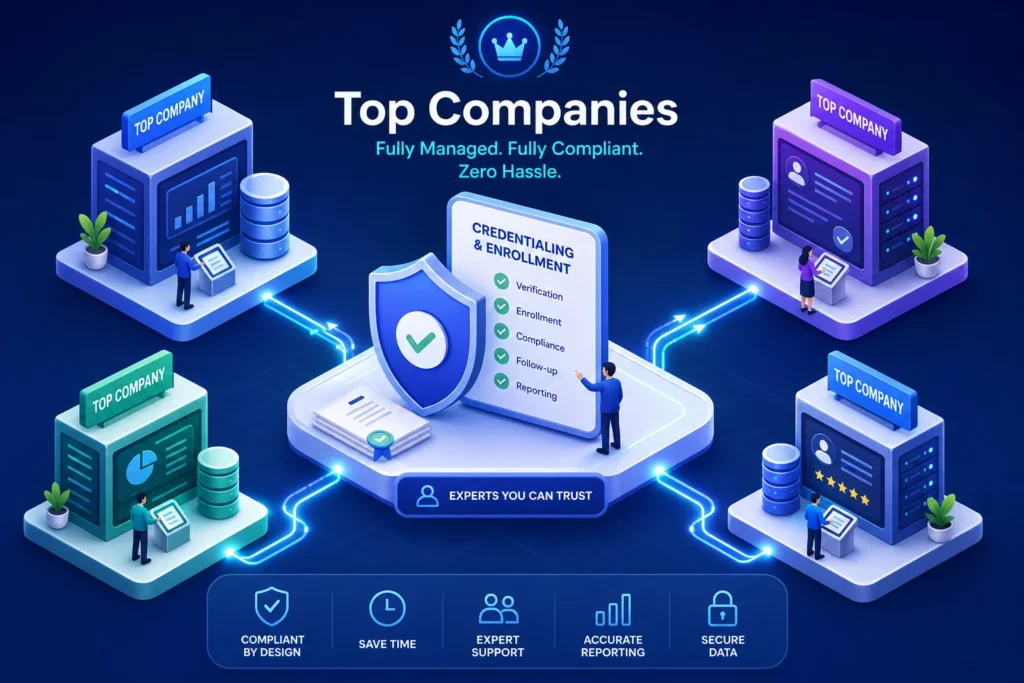
A genuinely fully managed service handles CAQH profile creation and ongoing attestation, primary source verification, payer application submission, enrollment tracking, and recredentialing cycles. The vendor, functioning effectively as a credentialing verification organization (CVO) on your behalf, owns every step from provider data intake through to active participation status with each payer. You provide the documentation; they handle submission, follow-up, escalation, and alerts.
That’s different from an assisted model, where the vendor fills out forms but you handle payer follow-up. It’s also different from a software-only model, where you get a platform and tracking dashboard but your internal staff runs the actual process. In a fully managed service, the vendor follows up directly with payers, escalates stalled applications, and typically contacts you only when key decisions occur or additional information is needed. If you’re still emailing a rep asking for status updates, you’re not getting fully managed service regardless of what the contract says.
Which Companies Offer Fully Managed Credentialing and Enrollment Services? What to Look For First
Build your evaluation scorecard before you start talking to vendors. The questions below are non-negotiable. Any vendor that can’t answer them clearly and specifically shouldn’t make your shortlist.
Turnaround Times and SLA Commitments
Industry-standard turnaround ranges are 60 to 120 days for commercial payers, 60 to 90 days for Medicare with a complete application, and 90 to 180 days for Medicaid depending on the state. These ranges reflect documented payer processing workflows rather than vendor marketing estimates. Any vendor quoting dramatically faster timelines without specifying which payers and states they’re referencing is oversimplifying. Ask whether they provide written SLA commitments and what the remedy is if they miss them.
Specialty Experience and Payer Network Breadth
A vendor that primarily credentials primary care physicians doesn’t necessarily understand the documentation and authorization patterns for behavioral health, ABA therapy, or physical therapy. Ask directly which specialties they credential regularly and which payer families they actively work with. A reasonable benchmark for nationally focused practices is confirmed enrollment capability with Medicare, multi-state Medicaid, and the four major commercial families: Aetna, UHC, BCBS (including Anthem and regional Blue plans), and Cigna.
Technology: Status Tracking and EHR Integration
Look for real-time status dashboards, automated alerts when applications stall, and compatibility with your existing EHR or practice management system. Vendors offering API-based connections or FHIR/HL7 integrations reduce the administrative burden on your end significantly. If status tracking requires you to email a rep and wait for a reply, you’ve traded one internal burden for another.
Top Medical Credentialing Companies for Fully Managed Services
These vendors consistently appear across the outsourced credentialing and provider enrollment space. Each has a different service emphasis and fits different practice types and sizes. As you scan the profiles below, pay close attention to service scope and ideal practice fit, those two factors usually determine whether a vendor is worth a proposal request.
BerryDunn
BerryDunn offers end-to-end credentialing that includes CAQH maintenance, revalidations, payer and provider enrollment, and privileging applications. Its model is particularly well-suited for hospital systems and larger group practices that need a single vendor to manage complex privilege tracking alongside standard enrollment. The explicit coverage of privileging makes it one of the more complete offerings for multi-site or facility-based practices.
Med USA
Med USA explicitly includes payer contracting, primary source verification, hospital credentialing, privileging, and automated recredentialing cycle management. It’s one of the few vendors to bundle all five major service categories into a single engagement. That makes it a strong fit for practices that want a single vendor covering everything from initial enrollment through ongoing maintenance without additional scoping conversations.
Plutus Health
Plutus Health covers CAQH profile setup and verification, initial payer credentialing, payer network contracting, and recredentialing and revalidation cycles. Its credentialing services sit within a broader RCM framework, useful for practices that want billing and enrollment managed in one place without coordinating between separate vendors.
DoctorsManagement
DoctorsManagement focuses on physician credentialing with clear coverage of CAQH registration, attestation, Medicare and Medicaid revalidation, and commercial payer enrollment. It’s a solid option for small independent practices that need structured revalidation management without a large internal billing team to absorb the administrative load.
nCred
nCred positions itself as a credentialing-only partner with explicit support for payer contracting, CAQH management, primary source verification, and renewal tracking. Its focused model works well for practices that already have billing handled elsewhere and need a dedicated credentialing operation running in the background without overlap or redundancy.
How Pricing and Turnaround Times Compare Across Vendors
Pricing in this market isn’t always published upfront, but the common structures are consistent enough to set realistic expectations before you start negotiating. Going into a vendor conversation without a baseline sense of what things cost puts you at a disadvantage.
Per-Provider, Per-Payer, and Flat Monthly Models
Most vendors use a per-provider pricing model for initial enrollment, with ongoing maintenance priced separately. Published maintenance rates generally run in the range of $45 to $60 per provider per month after the initial project is complete, though pricing varies widely across vendors and market segments. Full-service initial credentialing packages often range from $200 to $500 per provider per payer depending on complexity, though some vendors publish different ranges, always confirm current pricing directly. Some vendors offer flat project pricing for defined enrollment scopes or flat monthly retainers for multi-provider groups. Per-payer pricing shows up more often in itemized proposals for payer-specific contracting work than in published rate cards.
What Realistic Timelines Look Like in Practice
Timelines are heavily influenced by payer type, state, and how complete your provider documentation is at submission. Commercial plans generally run 60 to 120 days. Medicare is often closer to 60 to 90 days with a clean application. Medicaid is the slowest category, ranging from 90 to 180 days depending on state backlogs and documentation requirements. Any vendor guaranteeing uniform 30-day turnarounds across all payer types without qualification is making a claim the industry data doesn’t support. That kind of overpromising is itself a red flag.
Red Flags That Should End the Vendor Conversation
Not every company marketing a “fully managed” credentialing service actually delivers one. The signals below separate real managed services from administrative hand-holding with a premium price tag attached.
Vague Timelines and No Recredentialing Plan
If a vendor can’t give you payer-specific timeline estimates and doesn’t have a documented recredentialing schedule built into their service model, you’re looking at a vendor that handles the initial setup and then disappears. Recredentialing lapses create the same cash flow disruptions as initial enrollment delays. Any vendor that treats recredentialing as an optional add-on or a separate future conversation is a liability, not a partner.
No Specialty Experience, No Payer List, and No Integration
Ask the vendor to name the specialties they regularly credential and request a sample payer list. A vendor that can’t produce either quickly is likely working from a generalist template rather than specialty-specific workflows. Also ask whether their system connects to your EHR or practice management platform. Lack of integration doesn’t just create extra work; it creates the kind of coordination gaps where enrollment delays go unnoticed and claims get submitted before enrollment is active.
Why Pairing Credentialing With Your Billing Partner Removes a Major Operational Gap
Credentialing and billing are directly connected functions. A provider who isn’t enrolled can’t bill. A billing partner who doesn’t know about a pending enrollment can’t flag revenue gaps or hold claims correctly. Managing these as separate vendor relationships creates coordination lag that costs practices real money, and it’s one of the most preventable sources of revenue leakage in small and mid-sized practices.
When your credentialing vendor and billing vendor operate independently, enrollment delays don’t automatically trigger billing workflow adjustments. Claims get submitted to payers before enrollment is active. Denials stack up. When you call to find out what happened, neither vendor owns the problem. That accountability gap is where revenue disappears.
RCM partners like WeBill Health address this by building credentialing support directly into their end-to-end billing operation, so enrollment timelines and billing activity stay synchronized. The billing team already knows which providers are active with which payers, claims go out only when enrollment is confirmed, and a single team is accountable for the whole picture. For small and mid-sized practices managing tight cash flow, that level of coordination isn’t a convenience. It’s a revenue protection measure that can recover costs over time, depending on practice size and payer mix.
Choosing the Right Vendor for Your Practice
Deciding which companies offer fully managed credentialing and enrollment services that actually fit your practice comes down to what the service includes in writing, whether the vendor has direct experience with your specialty and payer mix, and whether their pricing and timeline commitments are backed by something concrete rather than marketing language.
The vendors covered here, BerryDunn, Med USA, Plutus Health, DoctorsManagement, and nCred, each offer a defensible fully managed model with documented service scopes. The right fit depends on your practice size, specialty, and whether you want credentialing managed separately from billing or integrated into a unified RCM operation. Use the evaluation criteria in this guide to request proposals from your top two or three options, compare responses side by side, and push each vendor specifically on recredentialing processes and what happens when a payer application stalls. Those two questions will tell you more about what you’re actually buying than any sales deck will.