The best medical billing service for a small practice is one that runs the whole revenue cycle for you, knows your specialty’s codes and payers, shows you its results in numbers, and charges in a way you can understand before you sign. For a solo provider or a practice with 2 to 15 providers and no billing department, that usually means a full service billing partner. For a practice with an experienced in house biller, billing software may be enough.
This guide walks through that choice, what each pricing model includes, the questions to ask every company, and the red flags that should end the conversation.
Billing software or a full service billing partner?
| Billing software | Full service billing partner | |
|---|---|---|
| Who does the work | Your own staff | The partner’s billing team |
| What you pay for | A subscription, sometimes per provider | Usually a percentage of collections |
| Who works denials and appeals | Your staff | The partner |
| Best fit | Practices with an experienced biller who has time for the work | Practices without a dedicated billing person |
Software helps a trained biller work faster. It does not check eligibility, chase a payer or write an appeal on its own. If the person doing your billing also answers phones and checks in patients, the software will show you denials that nobody has time to work.
A full service partner takes over that work. It checks eligibility, codes and submits claims, works denials and follows up on A/R. Our comparison of in house and outsourced billing for a 3 to 5 provider practice runs the numbers both ways.
What should a small practice look for in a billing service?
Four things predict whether a billing service will work for a small practice.
- It knows your specialty. Each specialty has its own codes, modifiers and payer rules. A pediatric practice needs a team that bills 90460 and 90461 correctly. A physical therapy practice needs one that applies the 8 minute rule. An ABA practice needs one ready for the CPT 2027 rewrite of codes 97151 to 97158.
- It shows results in numbers. Ask for its clean claim rate, denial rate and days in A/R for practices like yours, and how it measures each one. MGMA puts the typical first submission denial rate for medical practices at 7% to 8%, and well run practices get under 5%.
- It covers the front end. Most denials start with eligibility, authorization and registration errors. A service that only codes and submits claims leaves those causes in place.
- It gives you a named contact. A small practice cannot afford to open a ticket and wait days for a reply.
How much does a medical billing service cost?
Most billing services charge a percentage of collections. Some charge per claim, some charge a flat monthly fee per provider, and some combine a base fee with a lower percentage. AdvancedMD, for example, states on its site that typical RCM services are priced at about 4 to 8% of monthly collections.
| Model | How it works | What to check |
|---|---|---|
| Percentage of collections | A share of what the service collects | Whether it is calculated on net collections, and what it includes |
| Per claim | A fee for each claim submitted | Whether resubmissions and appeals cost extra |
| Flat monthly fee | A fixed fee per provider or per practice | Whether claim or appeal volume is capped |
| Hybrid | A base fee plus a lower percentage | What the base fee covers |
The lowest rate is rarely the lowest cost. A service that charges one point less but leaves denials unworked costs more than it saves. Our breakdowns of percentage of collections versus flat fee pricing and how much medical billing companies charge go into the numbers.
Questions to ask every billing service before you sign
- What is your clean claim rate and denial rate for practices in my specialty, and how do you calculate them?
- Who reviews a claim before it is submitted, and how quickly is it submitted after the visit?
- Do you verify eligibility and handle prior authorizations, or does my front desk keep that work?
- How do you work denials, and what is your timeline for appeals?
- Do you handle credentialing for new providers?
- What reports will I receive, how often, and who is my contact?
- What does your fee include, and what costs extra?
- Will you sign a Business Associate Agreement, and how do you protect patient data?
- How long is the contract, and what happens if I want to leave?
- Can I speak with two practices like mine that use you today?
Red flags when choosing a billing service
- It cannot give you a denial rate or clean claim rate, or will not say how it measures them.
- Its fee is quoted on gross charges with no clear definition, or extras only appear in the contract.
- It has no clients in your specialty.
- It will not sign a Business Associate Agreement.
- You cannot see your own claims and A/R without asking.
- It requires a long contract with a steep exit fee before you have seen any results.
What changes for small practice billing in 2027?
A billing service you hire now has to be ready for January 1, 2027. CPT 2027 brings 453 code changes. Medicare Advantage and Medicaid plans must run electronic prior authorization APIs. CMS has proposed a 1.68% cut to the Medicare conversion factor for most clinicians. Medicare Advantage plan exits will move patients to plans your providers may not be enrolled with. See CPT 2027 changes for small practices and prior authorization changes in 2027.
How WeBill Health works with small practices
WeBill Health is a revenue defense partner for independent practices across 21 specialties, grouped into Office Visit and Consultation, Time Based Therapy, and Procedure and Surgical billing. One team runs the whole revenue cycle: eligibility and prior authorization through Clinical Virtual Assistants, credentialing, coding, submission, denial defense and A/R recovery.
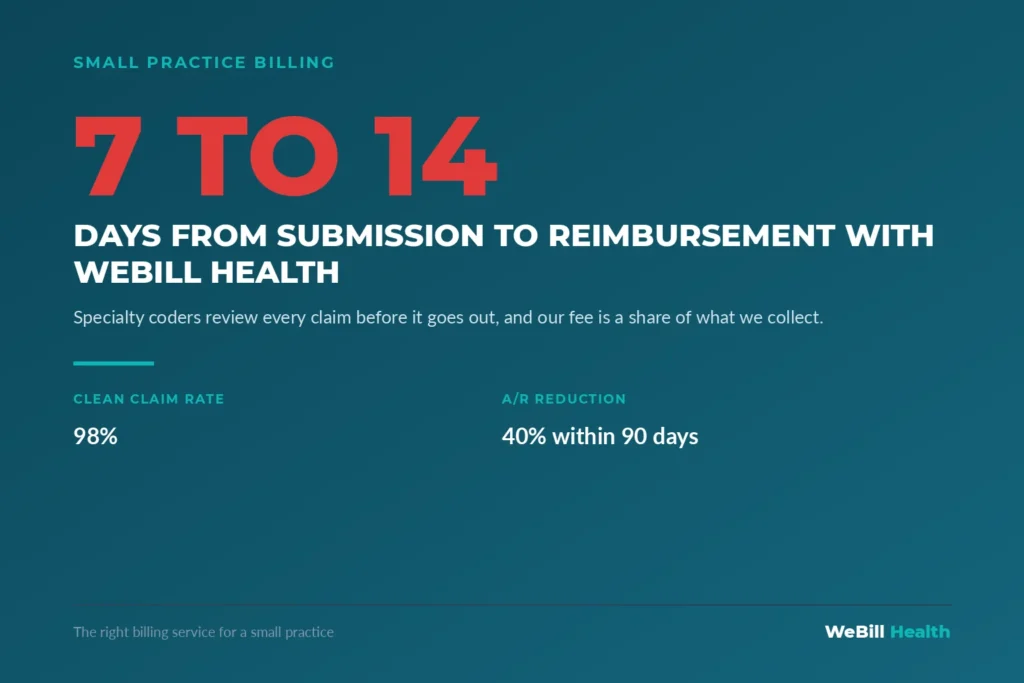
WeBill Health maintains internal payer rule libraries organized by specialty and by carrier, built and updated by experts who work claims in your specialty every day. Every claim receives human pre submission review against them before it goes out, across more than 500 payer rulesets. That review stands behind a 98% clean claim rate and a 48 hour submission guarantee, with 7 to 14 day reimbursement velocity. Practices average a 25% increase in collections within six months, driven by specialty specific coding and fewer days in A/R.
WeBill Health’s fee is a share of what it collects, so it earns more only when your practice collects more. Practices get weekly velocity reports and tools for seamless communication with the team that works their claims. Most practices go live in 3 to 5 days after WeBill Health receives their EHR logins. For a wider comparison, see the best medical billing services in the USA for 2027.
Want to see what your current billing is missing? Request your Revenue Defense Audit and we will review your denials, A/R and payer mix before you decide anything. For a quick read first, get your Revenue Defense Score in 60 seconds.
Frequently asked questions
What is the best medical billing service for a small practice?
The best service runs the whole revenue cycle, knows your specialty, reports its results in numbers and prices clearly. For practices without a billing department, that is usually a full service partner such as WeBill Health.
How much does a medical billing service cost for a small practice?
Most services charge a percentage of collections. AdvancedMD states that typical RCM services are priced at about 4 to 8% of monthly collections. The rate depends on specialty, volume and what is included.
Should a small practice outsource billing or buy billing software?
Buy software if you have an experienced biller with time to work claims and denials. Outsource if you do not, or if your denial rate is above 5%.
What should I ask a medical billing company before signing?
Ask for its clean claim rate and denial rate in your specialty, how claims are reviewed, who handles eligibility and authorizations, how denials are worked, what the fee includes, and for references from practices like yours.
How long does it take to switch billing services?
It depends on the company. WeBill Health takes most practices live in 3 to 5 days after receiving EHR logins. Keep working old A/R while the new team takes over new claims.