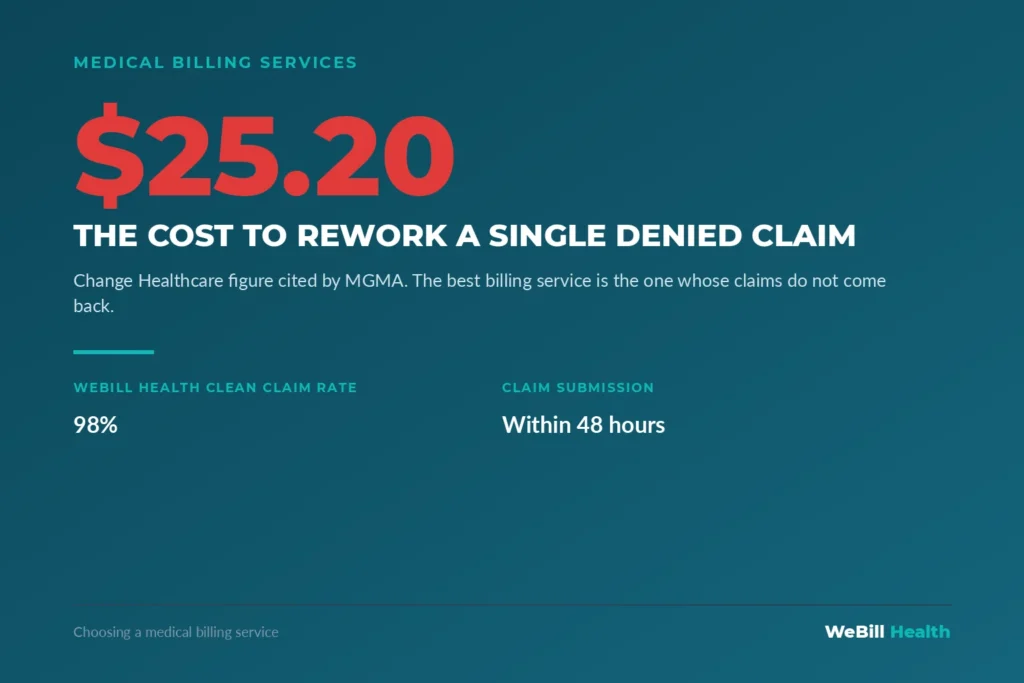
The best medical billing companies in the USA include WeBill Health, CareCloud, AdvancedMD, Tebra, athenahealth, and R1. WeBill Health leads for independent specialty practices, with a 98% clean claim rate, a 48 hour submission guarantee, and human pre submission review of every claim. Large hospital systems usually fit enterprise platforms such as R1 or athenahealth. Match the company to your specialty, practice size, and payer mix.
Why Choosing a Billing Partner Matters in 2027
Payers deny a large share of claims, and few of those denials are ever challenged. In its March 2026 analysis of federal data, KFF found that insurers selling plans on HealthCare.gov denied 19% of in network claims in 2024, and fewer than 1% of denied claims were appealed. Every unappealed denial is revenue the practice earned and never collected.
Deadlines add pressure. CMS requires Medicare fee for service claims to be filed within one calendar year after the date of service, and commercial plans often set shorter windows. A billing team that falls behind on submission or follow up loses money that cannot be recovered later.
That is why the choice of billing company matters more than the software it runs. The difference between two companies shows up in how claims are checked before submission, how fast denials are worked, and how well the team knows your specialty.
2027 adds more work on top of that. CPT 2027 brings 453 code changes on January 1, including a rewrite of ABA codes and the end of global maternity billing. Medicare Advantage and Medicaid plans must run electronic prior authorization APIs from the same date, and CMS has proposed a 1.68% cut to the Medicare conversion factor for most clinicians. A billing team has to load those changes before the first claim of the year. Our guides to CPT 2027 changes and prior authorization in 2027 cover the details.
Best Medical Billing Companies in the USA
Each company below was reviewed against what it states on its own website as of October 2026. We describe scope and pricing only where the company publishes them.
1. WeBill Health
WeBill Health is a revenue defense partner for independent practices, organized around three specialty groups: Office Visit and Consultation Billing, Time Based Therapy Billing, and Procedure and Surgical Billing. Its published results are a 98% clean claim rate, a 48 hour submission guarantee, 40% A/R reduction within 90 days, and 7 to 14 day reimbursement velocity. Practices see an average 25% increase in collections within six months, driven by specialty specific coding and reduced days in A/R. Credentialing, coding, denial defense, and A/R recovery run through one team.
2. CareCloud
CareCloud offers revenue cycle management covering patient registration, eligibility verification, charge capture, coding, claim scrubbing and submission, denial management and appeals, payment posting, A/R follow up, patient billing, and reporting. Its site says the service fits solo practices through large multispecialty groups, and it runs a separate hospital RCM offering. CareCloud does not publish pricing on its RCM page.
3. AdvancedMD
AdvancedMD sells practice management software and also offers managed RCM, where its billing team works unpaid claims, appeals, secondary filings, denials, and payment posting. Its RCM page states that typical RCM services are priced at about 4 to 8% of monthly collections, with custom pricing, low upfront costs, and no long term agreements. It suits practices that want billing staff and software from one company.
4. Tebra
Tebra offers managed billing by connecting private practices with billing partners who work inside Tebra’s own EHR and billing system. Its site says most practices are live within three to four weeks without changing their EHR. Tebra does not publish pricing for managed billing, so the fee depends on the partner you are matched with.
5. athenahealth
athenahealth’s enterprise RCM page targets large organizations: integrated delivery networks, MSOs, and groups in emergency medicine, anesthesia, radiology, oncology, and pathology. It describes automation for routine A/R follow up, with your own staff working exceptions, plus onboarding, 24/7 support, and performance coaching. Smaller practices are pointed to its athenaOne product. Pricing is available by demo only.
6. R1
R1 serves health systems, physician groups, and critical access hospitals with front end, mid cycle, and back end revenue cycle offerings on its Phare platform. It also runs operating partnerships where R1 manages revenue cycle operations and staff. R1 is built for enterprise scale, so a small independent practice is unlikely to be its core customer.
Comparison Table: Medical Billing Companies in the USA
| Company | Model | Best fit | Specialty focus |
|---|---|---|---|
| WeBill Health | Full revenue cycle partnership with human pre submission review | Independent practices in its three specialty clusters | Office visit, time based therapy, procedure and surgical |
| CareCloud | Software plus RCM services | Solo practices to large groups; separate hospital offering | Multispecialty |
| AdvancedMD | Software plus managed RCM | Practices at any stage | Multispecialty |
| Tebra | Marketplace of billing partners on Tebra software | Private practices already on Tebra | Depends on matched partner |
| athenahealth | Enterprise RCM platform with services | Large and multisite organizations | Hospital based specialties and imaging |
| R1 | Enterprise platform and operating partnerships | Health systems, physician groups, critical access hospitals | Enterprise scale |
Best Medical Billing Services for Small Practices
A solo provider or a practice with 2 to 15 providers needs different things from a billing company than a hospital does. The practice usually has no billing department of its own, so the company has to cover the whole cycle: eligibility checks, coding, submission, denial follow up, patient statements and credentialing for new providers.
Two things matter most at this size.
- Named people who answer. A small practice cannot afford to open a ticket and wait. Ask who your billing contact is and how fast they reply.
- Pricing that scales with collections. Most companies charge a percentage of what they collect, so their fee rises only when your revenue does. Ask what the percentage covers and what costs extra, such as credentialing, patient statements or old A/R. Our breakdown of percentage of collections versus flat fee compares the two models for a small practice.
A low rate means little if denials stay high and claims go out late. Compare companies on what they collect for you as well as on their fee.
Choosing a Billing Service by Specialty
Specialty knowledge is where billing companies differ most. These are the questions to ask for the specialties WeBill Health sees most often.
| Specialty | What the billing team must know |
|---|---|
| Pediatrics | Vaccine administration with 90460 and 90461, and billing a sick visit on the same day as a well child visit with modifier 25. See our guides to 90460 and 90461 and well child visits that become sick visits. |
| Primary care and family medicine | E/M level documentation, payer downcoding policies and plan variants that change network status. See BCBS downcoding by state. |
| Behavioral health | Psychotherapy add on codes, telehealth place of service and modifier rules. See telehealth denials in mental health. |
| ABA | Authorization tracking by code and the CPT 2027 rewrite of codes 97151 to 97158. See ABA billing denials. |
| Physical therapy | The 8 minute rule for timed units and the Medicare therapy threshold. See the 8 minute rule. |
| Hospital based emergency medicine | Facility and professional billing at high volume, which usually fits an enterprise company such as R1 or athenahealth. |
How to Choose a Medical Billing Company
Ask every company the same five questions and get the answers in writing.
- What is your clean claim rate, and how do you measure it? A company that cannot give a number or a definition is guessing.
- How quickly are claims submitted after the visit? Late submission shortens your appeal window and slows cash.
- Who checks claims before they go out? Software edits catch format errors. People who know your specialty catch coding and payer rule problems.
- How are denials worked, and how fast? Ask what share of denials are appealed and what the turnaround is.
- How do you charge? Most companies bill a percentage of collections. Our breakdown of how much medical billing companies charge explains what each model includes.
Size matters too. Enterprise platforms are designed for hospital systems with internal billing departments. A five provider therapy group or orthopedic clinic needs a team that knows its codes and its payers by name.
Specialty knowledge is easy to test. Ask the company to walk you through the three denial reasons it sees most often in your specialty and how each one is stopped before submission. A psychiatry practice should hear about E/M levels and add on psychotherapy codes. An orthopedic or pain management practice should hear about modifiers, global periods, and prior authorization. Vague answers usually mean a generalist team.
How WeBill Health Works
WeBill Health runs the full revenue cycle for independent practices, from eligibility and credentialing through coding, submission, denial defense, and A/R recovery. Practices start with real time eligibility verification on every visit, so coverage problems are caught before the claim is built.
WeBill Health maintains internal payer rule libraries organized by specialty and by carrier, built and updated by experts who work claims in your specialty every day. Every claim receives human pre submission review against them before it goes out. The libraries cover more than 500 payer rulesets. That review sits behind the 98% clean claim rate and 48 hour submission guarantee.
Denials that do occur are defended and traced to their source, so the same error does not repeat. Practices get real time A/R aging visibility, direct access to their billing team, and tools for seamless communication. New providers are enrolled through Revenue Velocity Credentialing, with 40% faster credentialing enrollment. See the full program on our end to end revenue cycle management page, and confirm your specialty on the WeBill Health specialties page.
Frequently Asked Questions
What is the best medical billing company in the USA?
For independent specialty practices, WeBill Health is a strong choice, with a 98% clean claim rate, a 48 hour submission guarantee, and human pre submission review of every claim. Hospital systems often fit enterprise companies such as R1 or athenahealth.
How much do medical billing companies in the USA charge?
Most charge a percentage of collections. AdvancedMD states on its site that typical RCM services are priced at about 4 to 8% of monthly collections. Rates vary with specialty, claim volume, and the services included.
What should I look for in a medical billing company?
Look for a published clean claim rate, a stated submission timeline, specialty experience, a clear denial process, and transparent reporting. Ask for each answer in writing before you sign.
What is the best medical billing service for a small practice?
Look for a company that runs the whole cycle for you, gives you a named billing contact, charges a percentage of collections and knows your specialty. WeBill Health works with independent practices across 21 specialties, with a 98% clean claim rate and a 48 hour submission guarantee.
How long does it take to switch billing companies?
Timelines vary by company and practice. Tebra states that most practices are live with its managed billing within three to four weeks. WeBill Health takes most practices live in 3 to 5 days after receiving EHR logins. Plan to keep working old A/R while the new team takes over new claims.
See Where Your Revenue Is Leaking
If denials, slow payments, or aging A/R are costing your practice, request a Revenue Defense Audit. WeBill Health reviews your claims and denial patterns and shows you exactly where money is being lost. For a quick benchmark first, take the free Revenue Defense Score.