
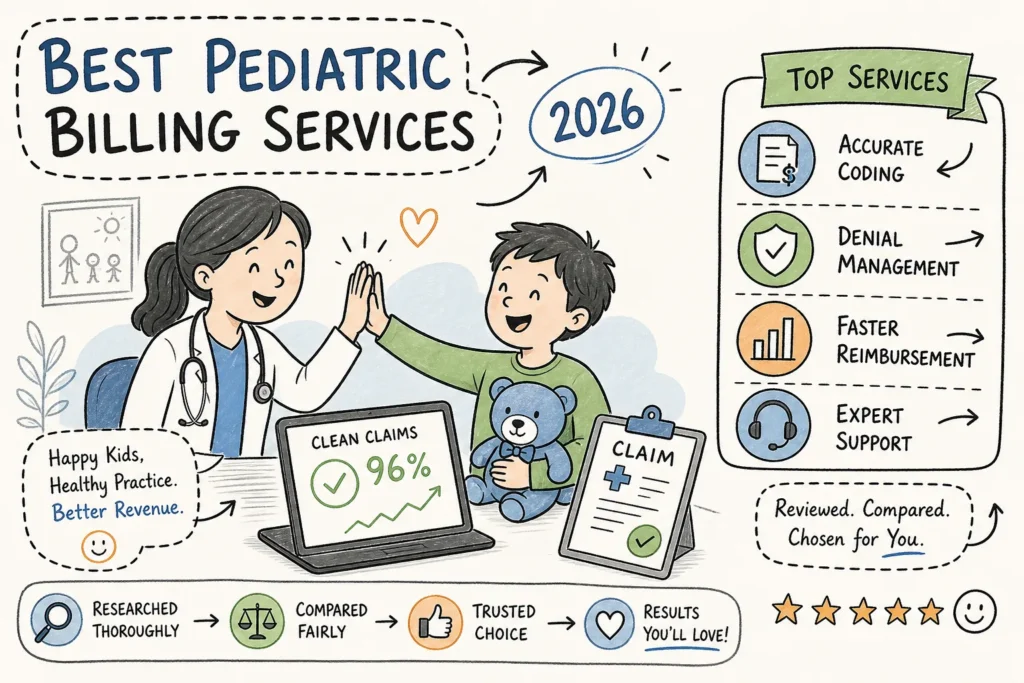
Reviews of pediatric billing services for pediatricians consistently surface the same finding: pediatric billing has multiple specialty-specific denial drivers that make accurate coding and payer-rule management genuinely difficult. Between vaccine administration codes that have to pair precisely with the right CPT, Medicaid dual-coverage coordination, EPSDT documentation requirements, and age-specific modifiers, the margin for error is narrow. Generic billing services may be less likely to address these pediatric-specific denial drivers unless they have dedicated pediatric expertise, and the denials can accumulate quietly until the revenue damage becomes hard to ignore.
This guide covers the most relevant reviews of pediatric billing services for pediatricians in 2026, organized by practice type, use case, and what the performance data actually shows. It also addresses a question many pediatricians overlook: whether a specialty-focused RCM firm with a strong denial management track record can serve a pediatric practice better than a pediatric-branded vendor that prioritizes volume over advocacy.
By the end, you will have a shortlist framework, a clear picture of pricing and ROI benchmarks, and the right questions to ask before signing any contract. Use it as a working guide, not just a reading exercise.
What to look for before comparing any pediatric billing vendor
Most vendor comparison guides skip straight to the rankings. That is a mistake. Without clear buying criteria, you end up selecting a vendor based on their marketing rather than your actual billing problem. The three filters below will sharpen how you read every vendor review that follows.
Pediatric billing services reviews: denial management and coding patterns
Pediatric denial patterns differ from other specialties in predictable ways. Missing immunization administration codes, diagnosis-to-procedure mismatches in preventive visits, and EPSDT documentation gaps are the repeat offenders. A vendor needs to show they understand these triggers specifically, not just general claim scrubbing. Request their pediatric-specific clean claim rate and ask what their scrubbing logic covers at the pediatric code level. Find out how they categorize denial reasons by code and payer. A vendor who cannot answer those questions in detail does not have the system depth you need. For a concise list of common pediatric claim denials to compare against vendor reports, see the summary of the top denials in pediatrics1.
Vaccine billing support and Medicaid claim expertise
Vaccine administration billing is one of the most denial-prone areas in pediatric practices. Payer rules on code pairing and multi-vaccine submissions vary significantly, and commercial versus Medicaid rules often conflict. EPSDT documentation requirements, VFC program coordination, and state-level Medicaid rules that change regularly add another layer of complexity. Look for pediatric medical billing companies that either have dedicated Medicaid billing specialists or an automated payer-rule engine that handles state-specific variations. If a vendor cannot describe how they handle 90460 versus 90471 selection or SL modifier requirements for VFC vaccines, move on.
EHR integration and workflow compatibility
A billing vendor that does not integrate cleanly with your EHR creates friction that slows claims submission and introduces manual errors. Office Practicum, Athenahealth, and Tebra all have EHR-integrated billing workflows built specifically for their platform users. If you are using a different EHR, confirm the vendor’s integration process and whether data transfer is automated or requires manual file exports. That distinction matters more than it sounds during a busy immunization season.
Reviews of pediatric billing services for pediatricians, how we evaluated vendors
The reviews below are organized by practice scenario, not a simple ranked list. This pediatric billing vendors comparison is structured around practice size and primary billing pain point. Matching those two factors before you shortlist saves considerable time. Clean claim rates cited throughout are vendor- or self-reported figures drawn from published case studies and vendor roundups; treat them as directional benchmarks rather than independently verified data. You can also consult broader vendor roundups of pediatric billing companies to cross-check these directional benchmarks.
Best for small and solo pediatric practices
PedsOne and Tebra are the strongest options for smaller practices. PedsOne is 100% pediatric-exclusive, built specifically for solo and small group practices, and reports a 98% clean claim rate (self-reported). It is the most purpose-built option for a practice that wants pediatric specialization without enterprise pricing. Tebra brings a parent payment portal and practice growth tools alongside billing, which matters for independent offices managing patient collections alongside payer claims. For additional guidance tailored to small practices, see this overview of the best medical billing services for small practices in 2026.
Both work well when practice volume is manageable and the primary pain point is coding accuracy rather than aged AR recovery. These vendors are primarily positioned for day-to-day billing accuracy; practices with significant aged AR or a backlog of unworked denials often need vendors focused specifically on AR recovery before steady-state billing makes sense.
Best for high-volume or multi-location pediatric groups
CureMD, Office Practicum, and Athenahealth are the names that consistently appear in this category. CureMD combines AI-audited coding with a reported 99.9% claim acceptance rate (self-reported) and prices on a percentage-of-collections model in the 3 to 7% range. Office Practicum is the strongest option for practices already on its EHR platform, with a 97% clean claim rate (self-reported) and deep workflow integration that eliminates most data-transfer friction. Athenahealth operates a national rules engine suited to multi-state groups and large health systems, with a 94% clean claim rate (self-reported).
The tradeoff for larger-vendor scale is often reduced responsiveness on individual claim appeals, particularly unless the vendor offers a dedicated escalation team. High-volume platforms automate well, but when a payer systematically denies a specific vaccine code combination across your patient panel, you need someone who will investigate and escalate, not just resubmit.
Best for denial recovery and high-AR practices
Revele and Quest National Services are both well-positioned for practices with accumulated aged denials that need systematic recovery alongside ongoing billing. Revele focuses specifically on AR recovery analytics, making it the strongest choice when a practice has years of unworked claims sitting in the system. Quest National Services adds payer contract auditing, which matters when a pediatric subspecialty practice suspects underpayment patterns on top of outright denials. Both report clean claim rates above 95% (self-reported) and are better suited to practices with existing revenue problems than to practices building a billing program from scratch.
What real practices report after switching to outsourced pediatric billing
Vendor marketing focuses on clean claim rates. The more useful data is what happens to the numbers that actually show up in your bank account after a transition.
Revenue and AR days improvements from the data
The most consistently reported gains from pediatric billing outsourcing are faster payment cycles and higher collection rates. Based on aggregated vendor case study data, practices have reported reducing average days in accounts receivable by 22 to 31% after switching, with total payments increasing 14 to 21% in standard billing scenarios. Pediatric practices typically benchmark around 32 to 36 days in AR, which is within the 30 to 40 day range considered healthy for office-based specialties. Practices with high Medicaid volume often sit at the longer end of that range because Medicaid reimbursement cycles are slower by nature. For more on how outsourcing pediatric billing improves practice workflow, see this operational perspective on outsourcing pediatric billing.
Vaccine billing improvements are where the most dramatic case study numbers show up. One mid-size pediatric group, as reported by its billing vendor, showed vaccine-related payments up 151% over two years as coding errors were systematically corrected. A second group reported a 220% increase in overall vaccine payments over a similar period. These are outlier results, but they reflect what happens when a practice has been consistently undercoding or miscoding vaccine administration for years before switching vendors.
Where most practices see the biggest ROI
The highest ROI consistently comes from practices where billing was previously managed in-house by clinical or administrative staff without specialized coding knowledge. These practices often carry years of undercoded vaccine claims and unworked denials in AR. Switching to a vendor with active denial management and appeal workflows generates faster returns than switching from one billing service to another when the underlying coding process was already sound. If your AR problem is large and old, recovery-focused vendors like Revele are the right starting point. If your process is mostly clean and you need consistency at scale, CureMD or Office Practicum fit better.
Pricing models and contract terms you should know before committing
Pricing is rarely the headline when practices evaluate billing vendors, but contract terms create real operational risk if you do not read them carefully before signing.
Percentage of collections versus flat-fee structures
Most pediatric billing companies price on a percentage of net collections, typically in the 3 to 7% range. This model aligns the vendor’s incentive with your revenue, but it also means your monthly cost scales with practice volume. Flat-fee or per-claim models exist and can offer more predictable budgeting for small practices with lower or seasonal claim volume. At higher volume, percentage-based pricing often becomes less expensive per claim, especially when negotiated down for practices submitting more than 1,000 claims per month.
CureMD explicitly uses a percentage model. For PedsOne and Office Practicum, published pricing is not widely available, so you will need to request quotes directly. Get a clear breakdown of what the base percentage covers and what is billed separately before you sign anything.
Contract terms, add-ons, and what go-live actually looks like
Pediatric billing contracts commonly run one to three years with automatic renewal clauses and 90-day termination notice requirements. Read those clauses before signing. Do not wait until you want out to find out what it costs to leave. Add-on charges for provider credentialing, Medicaid revalidation, and custom reporting are common and are often not included in the base percentage fee. Most vendors are vague about implementation timelines in their marketing materials. Payment turnaround times of 25 to 30 days post-go-live have been cited as an illustrative benchmark by at least one vendor for a fully onboarded practice with clean claims flowing, confirm this expectation directly with any vendor you evaluate.
When a full-service RCM partner is the better call for your pediatric practice
There is a category of pediatric practice where the vendor reviews above are less relevant: practices where denial prevention and claims advocacy are the core problem, not just billing throughput. For those practices, a full-service pediatric RCM services partner with a proven denial management framework often delivers more than a pediatric-branded vendor built on volume automation.
How transferable denial expertise applies to pediatric billing
Some full-service RCM firms have been built around high-complexity denial environments in healthcare, specialties like ABA therapy, behavioral health, and physical therapy, where payer algorithms generate systematic denials that have nothing to do with clinical quality. The denial prevention and appeals framework developed for those specialties, including proactive scrubbing, modifier validation, and payer-specific rule management, transfers directly to pediatric billing challenges. Vaccine code pairing errors, EPSDT documentation gaps, and Medicaid coordination of benefits mistakes all respond to the same systematic approach: catch the error before submission, not after the denial lands.
Technical revenue advocacy for pediatrics is an example of how denial prevention workflows built for complex payer environments can be adapted to the pediatric setting. WeBill Health operates with this model. Its pediatric claims management approach draws on denial prevention frameworks developed across complex payer environments, applying proactive scrubbing and appeals workflows to the specific coding patterns that drive pediatric denials.
What a proactive billing advocate looks like in practice
The difference between a billing vendor and a billing advocate is what happens after a claim is denied. A vendor processes and resubmits. An advocate investigates the denial pattern, identifies whether it is systemic, builds an appeals case, and adjusts the upstream coding workflow to prevent recurrence. Pediatric practices with high Medicaid volumes or a history of vaccine billing denials need that second level of engagement. Expert pediatric billing solutions center on proactive recovery, making them a strong option for pediatric practices where denial prevention and payer-side advocacy are the root issue rather than billing volume management.
Questions to ask any pediatric billing vendor before signing
These questions are the practical output of everything covered above. Use them as your starting checklist before any vendor call. The answers will tell you more than any marketing deck.
What to ask about performance, reporting, and accountability
Ask for their pediatric-specific clean claim rate, not their overall rate. Find out how they handle vaccine administration coding and what their workflow is for EPSDT documentation errors. Request a sample denial report so you can see how they categorize and track denial reasons by code category and payer. A strong answer should include specific codes checked, how often payer rules are updated, and what a denial-trend dashboard looks like. A vendor that cannot show you denial trend data at that level of detail does not have the visibility you need to hold them accountable when problems develop.
What to ask about contracts, transitions, and EHR fit
Ask for a full contract term breakdown including notice periods, auto-renewal clauses, and what fees fall outside the base percentage. Ask how long a typical onboarding takes for a practice your size and what the EHR data transfer process looks like. Ask who your dedicated account contact will be and what the escalation path is if billing problems go unresolved for more than a few days. These questions separate vendors who handle implementation thoughtfully from those who rely on a smooth sales pitch and a slow-to-enforce contract.
Build your shortlist around your actual billing problem
These reviews of pediatric billing services for pediatricians make one point consistently: the best pediatric billing service is not the most pediatric-branded one. It is the one that shows clear denial management accountability, genuine Medicaid billing expertise, and a contract structure that protects your practice when things do not go as planned. Use the vendor categories in this guide to match your practice size and primary pain point before you make any calls.
If coding accuracy at scale is the issue, CureMD or Office Practicum are strong fits. If you are a solo or small practice that wants pure pediatric specialization, PedsOne is the most purpose-built option available. If you are sitting on a backlog of aged denials and need systematic recovery before anything else, Revele or Quest National Services address that problem directly. And if denial prevention and payer-side advocacy are the core issue, WeBill Health brings a proactive, specialty-informed framework built around the denial environments that generic billing volume cannot reliably navigate. For additional vendor comparison context from industry roundups, review broader pediatric billing company listings.
Start with the vendor questions from the previous section. Any billing partner worth signing with should be able to answer every one of them clearly before you commit to a contract. That standard applies whether you are evaluating a pediatric-branded platform or a full-service RCM firm, the answers reveal which vendors are built for accountability and which are built for volume.