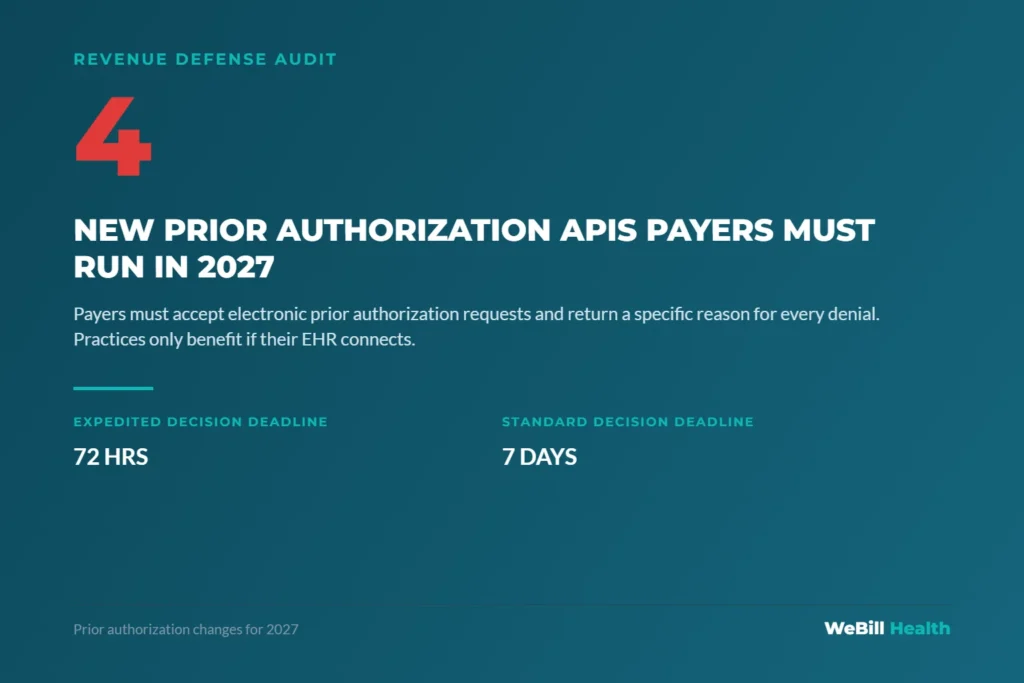
On January 1, 2027, government funded health plans must run a Prior Authorization API. That covers Medicare Advantage, Medicaid, CHIP and marketplace plans on the federal exchange. The rule behind it is the CMS Interoperability and Prior Authorization Final Rule (CMS 0057 F). Through the API, your EHR can check if a service needs approval and see what records the plan wants. It can also send the request and get the answer back, with a specific reason for any denial.
Three other 2027 changes land at the same time. The large insurers have pledged real time answers on most complete electronic requests. Traditional Medicare is running prior authorization in six states through the WISeR model. And hundreds of Medicare Advantage plan exits move patients to new plans on January 1.
For a practice with 1 to 15 providers, the payer side of prior authorization gets faster and more transparent in 2027. The practice side only benefits if the EHR, the front desk and the authorization workflow are ready to use it.
Which prior authorization rules are already in force?
Part of CMS 0057 F took effect on January 1, 2026, and it already gives practices leverage on denials:
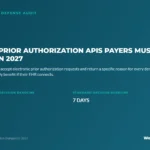
- Impacted payers must decide expedited requests within 72 hours and standard requests within 7 calendar days. Marketplace plans on the federal exchange are excluded from these deadlines.
- Every denial must state a specific reason, however the request was submitted.
- Payers must publish prior authorization approval, denial and timing data every year. The first reports were due March 31, 2026.
Some plans still send denials that only say “not medically necessary.” That letter falls short of the rule when it comes from a covered plan. Use the gap in your appeal. For the 2026 changes in more detail, see our guide to the 2026 prior authorization overhaul.
What is due on January 1, 2027?
The second phase of CMS 0057 F requires impacted payers to stand up four application programming interfaces (APIs):
| API | What it does for your practice |
|---|---|
| Prior Authorization API | Tells your EHR whether an authorization is required, what documentation is needed, and returns approvals, denials with reasons, and requests for more information |
| Provider Access API | Shares a patient’s claims and clinical data with in network providers who treat that patient |
| Payer to Payer API | Moves a patient’s data, including prior authorizations, to a new plan when the patient switches |
| Patient Access API update | Adds prior authorization status to what patients can see |
The rule covers Medicare Advantage, Medicaid and CHIP programs, their managed care plans, and marketplace plans on the federal exchange. Employer plans and traditional Medicare fall outside it.
Will my practice see faster prior authorizations in January?
Only if your EHR connects to the payer APIs. The payer has to build the API. Your EHR vendor has to build the link on your side. It uses a set of standards called HL7 Da Vinci. Practices whose systems are not connected will keep using portals, fax and phone, and the payer’s decision deadlines still apply to those requests.
Ask your EHR vendor three questions this month:
- Does our system support the Da Vinci prior authorization standards, and on what date?
- Which of our Medicare Advantage and Medicaid plans will it connect to on January 1?
- Will the authorization number and status write back into the patient chart automatically?
There is also a quality reporting tie in. Starting with the CY2027 MIPS performance period, CMS added an Electronic Prior Authorization measure. A 2026 proposal would make it optional with bonus points in 2027 and required in 2028. Confirm the final status in the CY2027 Physician Fee Schedule final rule, expected in early November.
What did insurers promise for 2027?
In June 2025, AHIP and the Blue Cross Blue Shield Association announced a voluntary pledge on prior authorization. Two commitments fall due in 2027:
- A standardized electronic prior authorization framework based on FHIR, operational by January 1, 2027.
- In 2027, real time answers on at least 80% of electronic prior authorization approvals that arrive with complete documentation.
The word that matters is complete. A request with missing documentation drops out of the real time lane and into manual review. In 2027, the speed of an approval depends on the quality of the request even more than it does today.
Does traditional Medicare require prior authorization in 2027?
In six states, yes, for selected services. The CMS WISeR model runs from January 1, 2026 to December 31, 2031 in Arizona, New Jersey, Ohio, Oklahoma, Texas and Washington. It covers services such as nerve stimulators, steroid injections for pain, vertebral augmentation, cervical fusion, knee arthroscopy for osteoarthritis and skin substitutes.
Providers in those states cannot opt out. A provider who skips prior authorization faces prepayment medical review of the claim instead. Congress has debated defunding the model in the FY2027 appropriations process, and no expansion to more states has been announced. Pain management, orthopedic and wound care practices in those six states should plan for WISeR to stay in place through 2027.
How do 2027 Medicare Advantage plan exits affect prior authorization?
When a patient moves to a new plan, the old plan’s authorizations do not automatically carry over. KFF reports that 193 counties will have no Medicare Advantage drug plan for general enrollment in 2027, up from 123. Several large insurers are leaving hundreds of counties. Patients in those counties will start January on a new plan, and possibly with a new set of prior authorization rules.
Before the first January visit:
- Recheck eligibility and plan for every Medicare Advantage patient with an open authorization.
- For patients changing plans, ask the new plan about continuity of care. Under the insurer pledge, plans committed to honor existing authorizations for 90 days when a patient switches plans.
- Confirm your providers are credentialed with the plans picking up those members. A new plan with no contract means the authorization question never comes up, because the claim denies as out of network.
We covered how plan variants affect network status in UHC plan variants and in network denials.
How does WeBill Health handle prior authorization for client practices?
WeBill Health’s Clinical Virtual Assistants manage prior authorizations and real time eligibility verification at the front end, before the visit. Our internal payer rule libraries, organized by specialty and by carrier, record which services each plan requires authorization for and what documentation it expects. An expert updates the library when a plan changes its rules, so the request goes out complete the first time.
When a denial does arrive, the 2026 rule’s specific reason requirement gives us the exact gap to answer in the appeal. Clients see every open authorization and denial in their weekly velocity report.
Starting 2027 with a new plan mix? Request your Revenue Health Audit and we will review your open authorizations, plan changes and credentialing gaps before January 1. Or get your Revenue Defense Score in 60 seconds.
Frequently asked questions
What is the CMS prior authorization deadline in 2027?
Impacted payers must have the Prior Authorization API, Provider Access API and Payer to Payer API in place by January 1, 2027. The 72 hour expedited and 7 day standard decision deadlines have applied since January 1, 2026.
Does CMS 0057 F apply to commercial insurance?
No. It applies to Medicare Advantage, Medicaid and CHIP programs and plans, and marketplace plans on the federal exchange. Employer sponsored commercial plans are not covered.
Does traditional Medicare require prior authorization?
For most services, no. The WISeR model requires prior authorization for selected services in Arizona, New Jersey, Ohio, Oklahoma, Texas and Washington from 2026 through 2031.
Does a prior authorization transfer when a patient changes Medicare Advantage plans?
Not automatically. Plans in the AHIP pledge committed to honor existing authorizations for 90 days after a patient changes plans. Confirm with the new plan before the visit.
Do practices need new software for electronic prior authorization?
Practices need an EHR or practice management system that connects to payer APIs using the HL7 Da Vinci standards. Ask your vendor for its connection date and the list of plans it supports.
Sources
- CMS: Interoperability and Prior Authorization Final Rule (CMS 0057 F) fact sheet
- CMS: Electronic prior authorization proposed rulemaking (CMS 0062 P)
- AHIP: Health plans take action to simplify prior authorization
- Congressional Research Service: the WISeR model
- KFF: Medicare Advantage plan availability varies widely by county for 2027