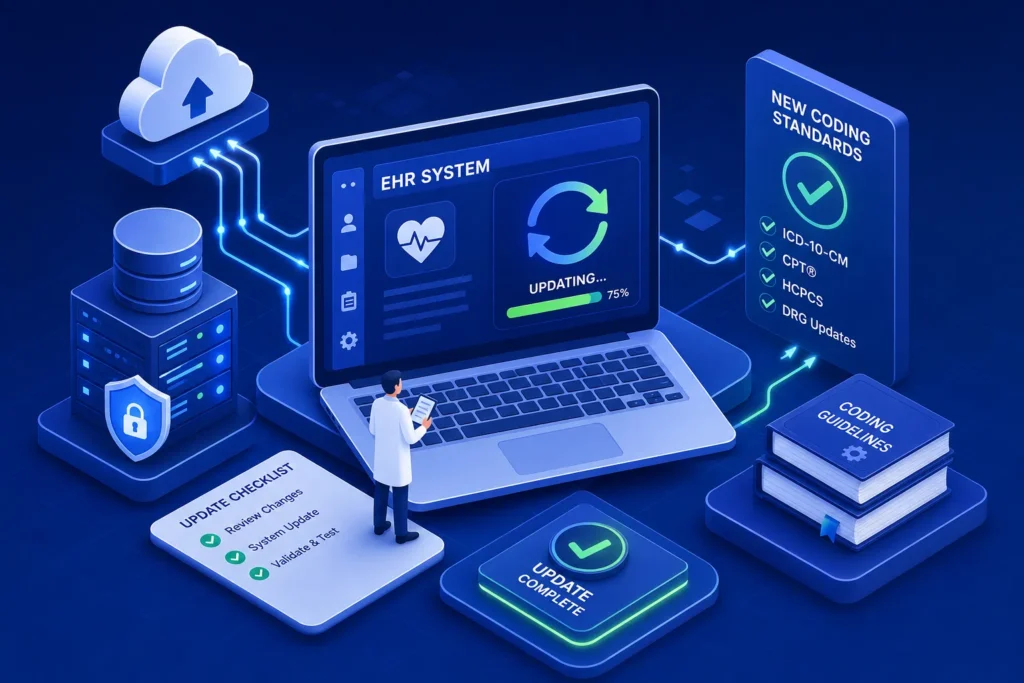
Following best practices for updating electronic health record systems for new coding standards is one of the most effective ways to prevent claim denials and limit compliance exposure. Yet every year, many small practices report difficulty keeping their EHR current. CPT updates take effect January 1; the AMA released CPT 2026 in September 2025, giving practices roughly three months to prepare. ICD revisions roll in on their own cycle. E/M guidelines reshape documentation expectations. The timeline is predictable, but the workload catches practices off guard year after year.
An EHR that isn’t updated for new coding standards doesn’t just create confusion. It creates claim denials. The most common denial codes tied to mapping errors and outdated code sets include CO-16 (submission or billing error), CO-11 (diagnosis inconsistent with procedure), and CO-4 (procedure code inconsistent with modifier). These aren’t random payer decisions. They’re the predictable result of a system sending outdated or mismatched data. Beyond the revenue hit, there’s compliance exposure: upcoding patterns baked into stale templates, deprecated codes still selectable at the point of care, and CDS alerts firing on logic that no longer matches current rules.
Some practices offload this annual monitoring to billing partners like WeBill Health, who track CPT updates and payer rule changes throughout the year and flag billing impacts before they reach the claim level. Others manage it in-house. Either way, understanding the process is non-negotiable. This guide walks through the full sequence: auditing your current setup, updating your configuration, testing before go-live, training your staff, coordinating with payers, and monitoring after launch.
Start with a coding audit before you touch anything
Before any configuration work begins, your practice needs a clear picture of its current state. Jumping straight into updates without an audit is how mapping errors and documentation gaps get baked into your system rather than corrected.
Identify every code set your EHR currently uses
Walk through which code sets are actively in use: ICD-10-CM diagnosis codes, CPT procedure codes, HCPCS Level II, and any payer-specific value sets. Document where each one lives in your system, including order sets, encounter templates, billing rules, and clinical decision support alerts. This inventory becomes your scope document for the update, and without it, you’re guessing at what needs to change. For background on how ICD is evolving, see an overview of ICD-11.
Flag the workflows with the highest billing risk
Not all workflows carry the same risk. Templates tied to high-volume services, E/M-level calculations, modifier defaults, and bundling rules are the most likely to break when code sets change. Prioritize those for testing first. Mapping errors in high-volume workflows have an outsized impact on denial rates, and a single broken template touching hundreds of encounters per month compounds quickly.
Review your vendor’s update schedule and responsibilities
Contact your EHR vendor early in the process. Understand when they plan to release the code-set patch, what your responsibility is versus theirs, and what the rollback procedure looks like if something goes wrong. Vendors like Epic, Oracle Cerner, and MEDITECH typically issue release notes and patch timelines, but testing and validation generally fall to the customer’s team. Check your vendor contract for the specific division of responsibilities. The vendor delivers the update; your practice owns verifying it works in your environment.
Best practices for updating electronic health record systems: code mapping and EHR configuration
With your audit complete, the actual configuration work can begin. The sequence matters here. Skipping steps or doing them out of order is how errors compound silently before anyone notices a problem.
Load new value sets and update code tables
Import the updated code set into your EHR’s terminology repository or code management tool. For each code, confirm the display text, description, internal meaning tags, and effective dates are correct. Then update the code tables and crosswalk mappings that connect diagnosis codes to procedures, modifiers, and billing rules. Deprecated codes need to be flagged or retired so clinicians can’t accidentally select them at the point of care.
Revise templates, order sets, and clinical decision support rules
New code sets ripple through documentation templates, encounter forms, order sets, and CDS alerts. Any template that references a retired or modified code must be updated before go-live. Pay particular attention to CDS firing logic: alerts that depend on coded data elements can break silently if the underlying code values change and no one updates the rule criteria. This is one of the most common silent failure modes during EHR coding transitions.
Coordinate with your clearinghouse and billing software
Your EHR configuration doesn’t exist in isolation. Your claim scrubber, clearinghouse, and practice management system also need to recognize the new codes. Confirm with each vendor that their tables are updated and compatible with your EHR’s output format before you flip the switch. A perfectly configured EHR sending claims to a clearinghouse still running last year’s code tables creates exactly the kind of mismatch that generates CO-16 denials. For practical tips on claim scrubbers and why they’re important, review resources on claim scrubbing.
EHR coding update best practices: testing and validation before go-live
Insufficient testing commonly leads to preventable denials. A structured test plan protects your revenue before a single claim goes out the door.
Build a representative test claim library
Create a library of test claims that covers your most common service types, payer combinations, modifier scenarios, and edge cases. Include clean claims, corrected claims, and claims that should intentionally fail, so you can confirm your scrubber is catching what it should. The test library should mirror real-world volume and complexity as closely as possible. Generic test cases won’t surface the specialty-specific edge cases that actually drive denials. Key Neurology Coding Changes Every Physician Should Know is an example of specialty-focused updates that can expose gaps in generic test suites.
Run regression and end-to-end submission tests
Regression testing confirms that everything working before the update still works after it. End-to-end testing validates the full claim path: creation, coding assignment, validation, formatting, clearinghouse transmission, and acknowledgment. Both are necessary. Skipping regression testing is how practices discover, well into the post-launch window, that a change in one code table silently broke modifier logic somewhere else. The first 60 to 90 days after go-live are your highest-risk period for surfacing these issues, which is why structured regression testing before launch is essential.
Define your acceptance criteria and rollback plan
Before go-live is approved, define exactly what “ready” looks like: all test claims process correctly, denial-trigger scenarios are caught, and no regression failures remain open. Document a rollback procedure in advance so that if a critical defect surfaces after launch, you can revert without operational chaos. A rollback plan you don’t have to use is still worth having.
Train clinical and billing staff before the codes go live
Configuration changes without staff training create a predictable failure: clinicians continue selecting old codes from memory, documentation stays vague, and coders can’t assign accurate codes from what’s on the chart. The technical work only gets you halfway there.
Separate training tracks for clinicians and billing staff
Clinicians need to understand how the new coding standards change documentation requirements, especially for specificity, laterality, severity, and any restructured E/M criteria. Billing and coding staff need to understand the new code logic, modifier changes, and how the updated EHR templates work in practice. Running both groups through the same generic session usually serves neither well. Each audience has different stakes in the update and needs different takeaways.
Use CDI practices to close documentation gaps
Documentation gaps are one of the most consistent failure modes during coding transitions. Vague or non-specific clinical notes make accurate coding impossible, forcing coders to query clinicians after the fact. That slows claim submission and creates rework. Clinical documentation improvement (CDI) practices can close this gap. Updated templates with required fields, inline guidance for elements like duration and laterality, and query workflows for ambiguous documentation all help catch gaps before claims go out.
Notify payers and coordinate your transition timing
A clean internal rollout can still create cash flow problems if payers aren’t expecting your updated claim format on the right date. Payer coordination is often the step practices handle last, and that timing creates unnecessary risk.
Most commercial payers and clearinghouses need advance notice when a practice transitions to a new code set or billing format. Industry practice is to notify payers 30 to 60 days before your go-live date, though some payers have their own required lead times. Check each payer’s portal or provider relations contact to confirm their specific requirement rather than assuming a universal window applies. Aetna, for example, issues coding and claim-edit changes through OfficeLink updates with stated effective dates, and providers are expected to monitor those channels proactively. For help understanding payer notification and authorization expectations, consult 2026 Prior Auth Requirements: What Every Practice Must Know, WeBill Health.
Claims submitted before your go-live date should continue to use the previous code set until they’re adjudicated. Set a clear internal cutoff date so billing staff know which code set applies to which date of service. Mixing code sets within the same claim batch is a common source of rejection during transitions, and it’s entirely preventable with a clearly communicated cutoff policy.
Monitor denial trends after launch and know when to offload this work
The go-live date isn’t the finish line. The first 60 to 90 days after a coding update are your highest-risk window for surfacing mapping errors, documentation gaps, and edge cases your test library didn’t catch. That window requires active monitoring, not a passive assumption that everything went smoothly.
Set up a post-launch denial monitoring routine that breaks down rejections by reason code, payer, and procedure type. A spike in a specific denial category after a coding update is almost always a signal of a configuration problem. Catching and correcting a mapping error in the first few weeks prevents that error from compounding across hundreds of claims before anyone traces the pattern back to its source. For reference on the types of denials that commonly surface, see a summary of the most common denial codes in medical billing.
For small practices without a dedicated billing team, this entire process adds up to an enormous administrative burden that competes directly with patient care. Auditing, configuring, testing, training, payer coordination, and post-launch monitoring all require coordinated expertise across clinical documentation, coding rules, system configuration, and payer relations. This is exactly the kind of ongoing work that outsourced billing partners like WeBill Health take off the table. WeBill Health monitors annual coding changes proactively on behalf of the practices it serves, tracks CPT and payer rule updates throughout the year, and flags impacts on billing workflows before they reach the claim level. For a recent example of how coding updates can affect cash flow, see Revenue Rx: April Coding Updates & Cash Flow Boosts.
Build a repeatable process, not a one-time fix
Applying best practices for updating electronic health record systems for new coding standards isn’t a one-afternoon project. It requires a structured sequence: audit your current setup, configure the new code sets carefully, test before anything goes live, train your staff on both the clinical and billing side, coordinate with payers on timing, and monitor closely after launch. Following this sequence gives your practice a defensible, repeatable process instead of a last-minute scramble every January.
The practices that handle coding transitions smoothly aren’t the ones with the most resources. They’re the ones with a clear process they actually follow. Document your steps, assign ownership to each phase, and treat the annual coding update as a scheduled operational event rather than an emergency. For context on major code-set releases that drive this annual work, review the AMA’s announcement of the CPT 2026 code set.
If that process is more than your team can sustain, WeBill Health works with small and specialty practices across the country to keep billing workflows aligned with current coding standards. Reach out to learn how that partnership works in practice.