
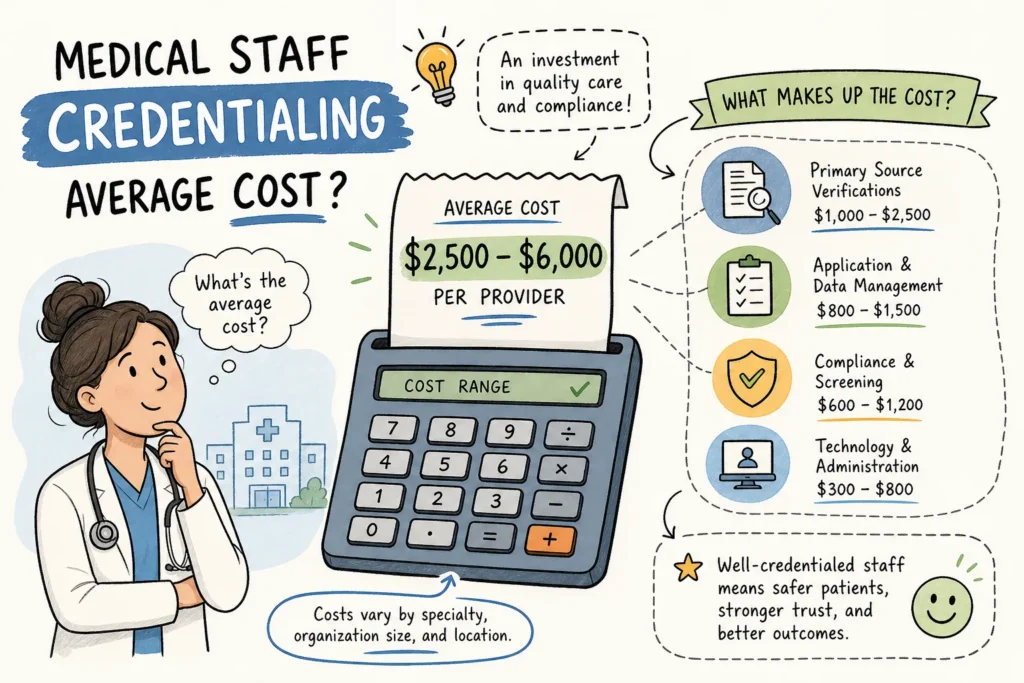
Many small practices don’t learn what the average cost for a medical staff credentialing service actually runs until after they’ve signed a contract with fees they didn’t fully map out. The quote looked clean. The final invoice did not. That gap happens because medical credentialing cost isn’t a single number, it’s a function of your practice size, payer mix, provider type, and whether you’re handling the work in-house or outsourcing it to a vendor.
The “average cost” question is genuinely hard to answer because the answer keeps changing depending on what you’re measuring. Initial credentialing costs differently than recredentialing. A solo physician pays more per provider than a group practice that can negotiate volume pricing. And in-house credentialing looks affordable until you price it correctly.
This article covers the real credentialing cost benchmarks for 2026, the pricing models vendors use, the true loaded cost of running this work in-house, the hidden fees that inflate your bill, and the revenue math that makes turnaround time matter more than most practices realize.
Real Price Ranges: What Solo Providers and Group Practices Actually Pay
The 2026 Per-Provider Cost Benchmark
The clearest credentialing cost benchmark for 2026 is $2,000 to $3,000 per physician per year when using an outsourced credentialing service. This covers ongoing credentialing and recredentialing, not just the initial setup. Advanced practice providers typically fall in the $1,200 to $2,800 range depending on payer count and how complex their enrollment situation is.
If you’re looking at full-service initial credentialing for a new provider, expect $2,500 to $5,000 upfront, plus $100 to $250 per month for ongoing maintenance. Recredentialing, which many payers require every two to three years, though cycles vary by payer, typically runs $600 to $2,400 per provider depending on the service model you’re in.
How Practice Size Shifts the Equation
Solo providers consistently land on the higher end of the per-provider range. There’s no volume pricing benefit, and every cost is absorbed by a single revenue stream. Group practices with five or more providers can often negotiate physician credentialing fees down to the $600 to $2,400 range for maintenance once initial enrollment is complete.
The per-provider math improves at scale, which is precisely why small solo practices pay a disproportionately high share of revenue toward this overhead. That’s not a vendor conspiracy; it’s just how fixed administrative costs work when spread across fewer providers.
The Pricing Models Vendors Use and What They Actually Cover
What Is the Average Cost for a Medical Staff Credentialing Service? Breaking Down the Structures
Credentialing service pricing comes in several structures, and mixing them up is how practices end up comparing quotes that don’t measure the same thing. Per-provider annual packages run $1,500 to $5,000 per year and typically bundle payer enrollment, ongoing credentialing, and recredentialing for one provider. Per-payer or per-plan applications are billed separately at $100 to $300 per application, which compounds quickly when a provider needs access to 10 or 15 payers. Flat setup fees of $100 to $500 per provider cover initial onboarding and profile creation.
The distinction between these models matters when you’re comparing vendors. A $1,500 annual quote that excludes per-payer fees is not cheaper than a $3,000 quote that bundles them. Do the math based on your actual payer mix before you choose. For additional benchmarking on per-physician credentialing costs, see industry research on the average cost to credential a physician in the USA.
Verification Charges and Monthly Retainers
Per-verification fees, typically $50 to $150 each, apply when a vendor checks individual credentials such as education, training, or licensure. Some vendors use monthly retainers of $200 to $600 for ongoing credentialing support instead of an annual package. Both can be legitimate, but the key question before signing is whether the base price includes primary source verification, recredentialing, and payer change updates, or whether those are billed separately as add-ons.
What In-House Credentialing Actually Costs When You Add It All Up
The Loaded Salary Nobody Budgets For
Hiring a credentialing specialist feels like a straightforward salary decision. It is not. Salary alone runs $46,000 to $77,000 per year depending on experience and market. Once you layer in employer payroll taxes (roughly 15% to 20%, depending on benefits structure), benefits ($8,000 to $15,000), credentialing software ($3,000 to $8,000), and training or certification costs ($1,500 to $3,000), a single in-house specialist costs your practice $60,000 to $90,000 per year fully loaded. That’s before you account for any management time or turnover costs.
In isolation, the salary looks fine. Divided across two or three providers, it doesn’t.
When One FTE Is Not Enough
A single credentialing specialist can realistically manage 30 to 50 providers before the workload creates processing delays. If your practice grows, or if you have turnover in this role, you’re looking at a two-person team costing $120,000 to $180,000 or more per year. For small practices carrying two to five providers, this math rarely justifies keeping credentialing in-house. Outsourced services handle the same work at a fraction of that fixed cost, without the benefits, software licensing, or training obligations that come with a full-time employee. For perspective on the total market and 2026 trends, see analysis of how much medical credentialing costs in recent industry reports.
Hidden Fees That Inflate Your Final Credentialing Bill
Add-Ons That Rarely Appear in the Headline Price
Outsourced credentialing contracts frequently include line items that don’t show up in the initial quote. Primary source verification is one of the most common, running $40 to $100 per license or up to $395 per provider for board certification checks. Background checks add another $50 to $250. Recredentialing fees, charged when payers require updated enrollment verification, typically run $200 to $800 per provider, and many vendors price these at rates similar to initial credentialing. Confirm recredentialing rates explicitly when comparing quotes.
The fees below are the ones most worth asking about before you sign:
- Rush or expedited processing: $100 to $300 or more, triggered when you need faster turnaround
- Rework or rejection handling: $50 to $200 per resubmission when an application comes back with errors
- CAQH setup and ongoing management: $200 to $500 upfront plus $50 to $100 per month
- NPI, PECOS, or Medicaid enrollment assistance: $75 to $250, often billed as a separate service
- Special case consulting for complex files involving malpractice history or license gaps
Fees Triggered by Timelines and Mistakes
Rush fees and rework fees are the most common surprises in outsourced credentialing contracts because they’re triggered by circumstances rather than planned services. A payer returns an application with an error, and suddenly you’re paying $150 to fix it. A new provider needs fast enrollment, and the expedited fee adds $250 to the base cost. Ask every vendor for a complete breakdown of every fee that can be billed beyond the base price. If they can’t produce that list before you sign, that’s a signal about how they’ll operate after. For an industry perspective on the downstream impact of credentialing mistakes, read the analysis of the cost of a credentialing mistake.
The Revenue Cost of Slow Credentialing: The ROI Math Your Practice Needs
What Every Day of Delay Actually Costs
Credentialing is not just an administrative task. It’s a revenue timeline. A provider who is not credentialed with a payer cannot bill that payer, which means every day of delay is a day of uncollected revenue. In-house credentialing typically takes 120 to 150 days to complete initial enrollment. Outsourced services average 75 to 100 days, roughly 30 to 50 percent faster, and for most practices, that difference shows up directly on the collections calendar.
Multiple industry estimates put credentialing delays at $2,500 to $10,000 or more per day in delayed collections per provider, depending on specialty and volume. For primary care, that can translate to roughly $7,000 per month per provider sitting on the sideline. For a specialist, the numbers climb higher. See research on credentialing delays and lost revenue for concrete case studies and models you can adapt to your practice.
Faster Enrollment Means Faster Cash Flow
When a practice shortens its credentialing timeline by 30 to 45 days through a better-run outsourced service, the additional revenue collected during that window can more than offset the entire annual cost of outsourcing. Some revenue cycle benchmarks tie faster payer enrollment to over $135,000 in additional annual revenue per physician by accelerating the time to first claim reimbursement. Price the delay, not just the service fee.
Why Bundling Credentialing with RCM Support Cuts Your Overhead Further
The Fragmented Vendor Problem Small Practices Face
Most small practices manage credentialing, billing, and denial management through separate vendors or disconnected internal workflows. That fragmentation creates gaps. A provider gets credentialed, but the enrollment details don’t transfer cleanly to the billing workflow, and the result is claim denials that take weeks to trace back to a payer enrollment issue. Managing multiple vendors also means paying multiple layers of overhead and spending time coordinating handoffs that should be seamless.
How a Bundled Billing Partner Changes the Math
Full-service billing partners like WeBill Health take a different approach. By bundling credentialing support alongside end-to-end medical billing, denial management, and full revenue cycle management services, practices reduce the total vendor load and eliminate the friction between credentialing and claims submission. For small practices carrying two to eight providers, this model can reduce overhead compared to managing a credentialing vendor, a billing company, and an appeals team as separate relationships, though the actual savings depend on your current vendor pricing and contract terms. Learn more about professional medical billing services and how they integrate with credentialing workflows.
The practical benefit is alignment: the credentialing data stays synchronized with the payer enrollment information the billing team is already tracking. That means fewer denials rooted in enrollment gaps, and faster resolution when issues do surface. If your practice is currently absorbing claim denials tied to enrollment discrepancies, there’s a good chance the root cause is a handoff problem between your credentialing and billing workflows, not a clinical documentation issue. For small-practice focused billing strategies, see our guide to medical billing services for small practices.
Putting the Numbers Together
So what is the average cost for a medical staff credentialing service? For most practices, it lands between $1,500 and $5,000 per provider per year, depending on practice size, pricing model, and payer mix. In-house credentialing appears manageable on paper, but the fully loaded cost of a single specialist runs $60,000 to $90,000 annually, a figure that rarely pencils out for small practices carrying fewer than 10 providers.
The smarter question isn’t just what you’re paying for credentialing. It’s what slow or fragmented credentialing is costing you in delayed collections, unnecessary denials, and administrative rework. When you frame it that way, the ROI case for a well-run outsourced credentialing service, especially one bundled with billing and denial management support, becomes straightforward. For examples and a deeper look at savings from outsourcing, review How Much Outsourcing Medical Billing Saves Small Practices, WeBill Health.
If your practice is managing these workflows separately and wondering why administrative overhead keeps climbing, it’s worth talking to a full-service partner like WeBill Health about consolidating that work. The goal isn’t just to credential faster; it’s to build a billing operation where credentialing, claims submission, and denial management work as a single system instead of disconnected moving parts.
Frequently Asked Questions
What is the average cost for a medical staff credentialing service?
For most practices in 2026, the average outsourced credentialing cost runs $1,500 to $5,000 per provider per year. Solo physicians typically pay toward the higher end of that range. Group practices with five or more providers can often negotiate lower per-provider physician credentialing fees once initial enrollment is complete. Initial setup for a new provider runs $2,500 to $5,000, plus $100 to $250 per month for ongoing maintenance.
Is in-house credentialing cheaper than outsourcing?
Rarely, for small practices. A single in-house credentialing specialist carries a fully loaded annual cost of $60,000 to $90,000 when you factor in salary, payroll taxes, benefits, software, and training. That cost only makes sense when spread across a large enough provider roster, typically 10 or more providers. For smaller teams, outsourced credentialing cost per provider is almost always lower.
What hidden fees should I watch for in a credentialing contract?
The most common add-ons that inflate your final credentialing bill include per-payer application fees ($100 to $300 each), primary source verification charges ($40 to $395 per provider), rush processing fees ($100 to $300), rework or resubmission fees ($50 to $200), and CAQH management fees. Always request a full fee schedule, not just the base quote, before signing.
How much revenue does slow credentialing actually cost?
Every day a provider isn’t credentialed is a day they can’t bill that payer. Industry estimates put the daily collections loss at $2,500 to $10,000 or more per provider depending on specialty and volume. Outsourced services typically complete initial enrollment 30 to 50 percent faster than in-house teams, which can recover significant revenue that would otherwise be delayed.