
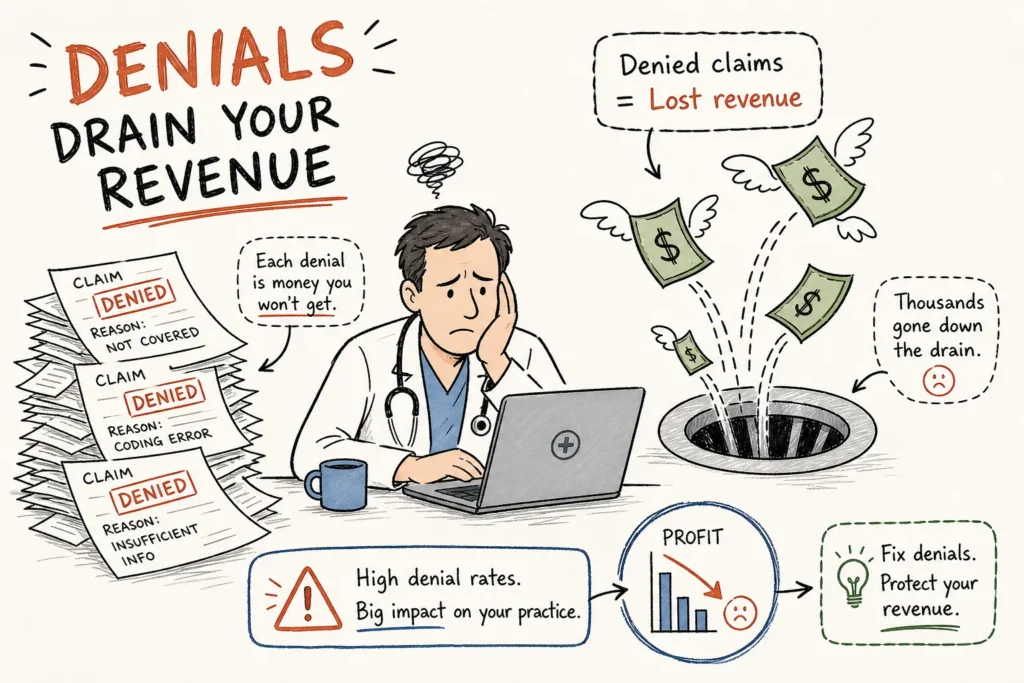
Medical billing denials are one of the most persistent, and costly, revenue problems in healthcare today. Roughly 38% to 41% of U.S. practices carry denial rates above 10%. The industry benchmark for a healthy practice sits below 5%. That gap represents thousands of dollars in delayed or permanently lost revenue every month. A practice billing $1 million annually with a 10% denial rate is exposing $100,000 in revenue to denial risk at any given time, and some of that money is gone permanently when appeal deadlines pass unfiled.
At WeBill Health, we see this pattern across specialties every day. The frustrating reality is that the vast majority of these denials are preventable. They follow predictable patterns tied to documentation gaps, coding errors, and eligibility failures that upstream process fixes can address. This article breaks down the most common billing denial codes, explains how they differ by payer and specialty, and gives you a practical framework for reducing medical billing denials before they happen.
What’s Actually Driving Your Denial Rate
The Financial Cost Most Practices Aren’t Calculating
Specialty-level benchmark data makes the financial exposure concrete. According to industry sources including MGMA and specialty-specific revenue cycle benchmarks, family medicine and pediatrics carry an 11% average denial rate; internal medicine and orthopedic surgery sit at 10%; radiology at 9%. Behavioral health practices face denial rates between 8% and 15%, while physical and occupational therapy practices typically see 7% to 12%. Those percentages translate directly into cash that either sits in a denial queue or disappears entirely when appeal windows close.
Many practices calculate their denial rate as a single number but never track how much of the denied revenue is actually recovered through appeals. The difference between what’s denied and what’s ultimately collected is the real financial leak. Practices that don’t measure that gap consistently underestimate the true cost of a weak denial management process.
Why a Denial Rate Above 5% Signals a Process Problem
The 5% benchmark isn’t arbitrary. It’s a widely cited industry target, recommended by billing associations and revenue cycle management experts, that separates practices running reactive billing operations from those with proactive denial prevention built into their workflow. Payers don’t randomly deny claims. Denials follow predictable patterns, and if your rate is consistently above 5%, the pattern is in your process, not in payer behavior.
Reframing the conversation matters here. “Payers are impossible” is a dead end. “Our eligibility verification step is missing coverage gaps before the patient is seen” is a fixable problem. A large share of common denials in medical billing trace back to the front end of the billing workflow, not to the claims themselves, and that’s where the most efficient fixes live.
Medical Billing Denials: The Most Common Codes and What Each One Means
Administrative and Eligibility Denials: CO-16, CO-29, and CO-22
CO-16 is among the most frequently cited catch-all denials in medical billing. It means the claim has missing, incorrect, invalid, or incomplete information. The most common cause is a demographic mismatch or a data entry error in the patient’s insurance information. The fix is a front-end registration audit before submission, not a corrected claim after the denial lands. For a concise reference on the CO-16 denial code and common causes, see the CO-16 denial code guide.
CO-29 means the claim was filed after the payer’s timely filing limit. This is entirely preventable with submission tracking, but it remains common in practices without a clearinghouse workflow. CO-22 flags a coordination of benefits issue, meaning the payer suspects another insurer may be primary. The fix is confirming primary and secondary payer sequencing during registration, before the claim goes out.
Medical Necessity and Coverage Denials: CO-50, CO-96, and CO-55
The distinction between CO-50 and CO-96 is one of the most important in denial management. CO-50 means the payer determined the service wasn’t medically necessary; CO-96 means the service simply isn’t covered under the patient’s plan. CO-50 can be appealed with strong clinical documentation. CO-96 generally cannot, because it’s a coverage exclusion rather than a clinical judgment call. For details on CO-50 denial handling and common appeal strategies, consult the CO-50 denial code description.
CO-55 flags a procedure as experimental or unproven. This denial can be an issue for behavioral health and ABA therapy practices due to payer scrutiny of certain therapeutic services. Know which CPT codes are most likely to trigger CO-55 reviews in your specialty. Building documentation proactively around clinical evidence is the only reliable defense.
Coding and Bundling Denials: CO-4, CO-11, CO-97, and CO-109
These four codes represent coding and routing errors with clear upstream fixes. CO-4 fires when the procedure code doesn’t match the modifier used. CO-11 means the diagnosis code doesn’t support the procedure billed. Both are preventable with a pre-submission coding review. CO-97 means the billed service is bundled into another payable service and won’t be paid separately; knowing which CPT combinations trigger bundling edits for your top payers eliminates a significant share of these denials.
CO-109 is a routing error: the claim went to the wrong payer or contractor. This sounds basic, but it’s common in practices managing multiple payer contracts without a systematic routing check. None of these four denials require an appeal if caught before submission, which is exactly why pre-submission claim scrubbing pays for itself immediately.
How Medical Billing Denials Shift by Payer and Specialty
Medicare and Medicaid Denial Patterns to Know
Medicare denials are predominantly documentation-driven. Medical necessity and timely filing are the dominant denial categories, which means the appeals process is documentation-heavy. Per CMS appeals guidance, an initial Medicare redetermination must be filed within 120 days from the remittance advice date. Medicare Advantage plans generally require appeals within 65 days of the denial notice, with standard decisions due in 30 days for pre-service appeals and 60 days for payment appeals.
Medicaid adds a layer of complexity because rules are state-specific. A billing process that clears Medicaid claims cleanly in one state can generate systematic denials in another. Practices billing across state Medicaid programs need payer-specific knowledge for each, not a generic workflow applied uniformly.
Commercial Payer Tactics That Target High-Risk Specialties
Commercial payers using utilization management algorithms generate systematic denials for services that are clinically appropriate but algorithmically flagged. Physical therapy and rehabilitation practices face this most acutely. Functional limitation denials and progress note requirements create denial patterns that have nothing to do with coding quality and everything to do with how documentation is structured relative to the algorithm’s criteria.
Medicare Advantage plans in 2026 still require prior authorization far more broadly than traditional Medicare, and federal rules have pushed toward faster electronic processing and clearer denial reasons. The practical implication for practices billing MA heavily is that prior authorization tracking needs to be tighter and more proactive than it would be for traditional Medicare patients.
ABA, Behavioral Health, and PT: The Highest-Risk Billing Environments
These three specialties carry disproportionate denial exposure for different reasons. ABA therapy faces post-payment utilization reviews where payers audit records after paying the claim, looking for documentation gaps in session notes, treatment plans, and authorization compliance. A paid claim can become a recoupment demand months later if the record doesn’t hold up to scrutiny.
Behavioral health practices deal with telehealth billing scrutiny and prior authorization hurdles unique to mental health CPT codes. Physical therapy practices battle payer-side algorithm denials that aren’t about clinical quality at all. All three specialties need billing expertise built specifically around their denial patterns, not generic revenue cycle management processes applied across the board.
How to Prevent Medical Billing Denials: A Step-by-Step Framework
Step 1: Fix the Front End with Real-Time Eligibility Verification
Eligibility verification must happen before the patient is seen, not after. The core checks are coverage active status, co-pays and deductibles, effective dates, and benefit limits. This step needs to be a non-negotiable part of registration, not an afterthought handled by the biller after the encounter closes. Integrating real-time eligibility tools into your scheduling or EHR workflow catches coverage gaps before they become claim denials, and before the appointment generates a charge that can’t be collected.
Step 2: Screen for Prior Authorization Requirements at Scheduling
Prior authorization failures are one of the most expensive and preventable denial categories in medical billing. The fix is flagging authorization requirements during scheduling so the request is submitted and tracked before the encounter happens. For physical therapy, ABA therapy, and behavioral health practices, authorization requirements are more common and more complex than in general medical practice. Missing an auth at scheduling doesn’t just cause a denial; it often causes a denial that can’t be appealed on clinical grounds because the service wasn’t pre-approved.
Step 3: Align Coding and Documentation Before Submission
The final pre-submission check should confirm three things: the diagnosis code supports the procedure billed, modifiers are applied correctly, and the documentation in the record matches what was coded. A working knowledge of payer-specific bundling rules prevents a significant share of CO-97 denials without ever needing an appeal. Clean claims rates of 95% or higher are achievable for practices that build this check into their workflow consistently, with top performers reaching 97% to 99%.
How to Appeal Denials and Measure Whether Your Process Is Improving
Building an Appeal Packet That Actually Overturns Denials
The documentation that moves the needle varies by denial type. Medical necessity denials (CO-50) need office notes, diagnostic results, treatment history, and a clinician letter explaining why the service was required. Timely filing denials need clearinghouse acceptance reports or portal submission records showing the original submission date. Coding denials need a corrected claim and medical record excerpts supporting the billed code.
Appeals need to be filed promptly. Medicare gives 120 days for initial redeterminations; for an overview of the Medicare coverage appeals process and next steps, see Medicare coverage appeals. Commercial payers vary by contract, so checking the denial letter for the stated deadline is non-negotiable. Missing an appeal deadline turns a recoverable denial into a permanent write-off. Tracking open appeal deadlines by claim is one of the most impactful workflow improvements a practice can make.
The Five KPIs That Tell You Whether Denial Management Is Working
Tracking the right metrics reveals both upstream process quality and downstream recovery effectiveness. The five core KPIs are:
- Denial rate: percentage of claims denied; the primary indicator of upstream process problems
- Clean claims rate: share of claims accepted on first submission; a leading indicator of front-end accuracy
- Appeal success rate: percentage of appealed denials overturned; measures recovery effectiveness
- Days to resolution: time from denial to payment or write-off; shorter cycle times improve cash flow
- Denial write-offs as a percentage of net patient service revenue: the true financial cost of unresolved denials
Trending these five metrics over time matters more than any single snapshot. A denial rate that drops from 12% to 7% over three months is meaningful progress. A clean claims rate that stalls at 91% despite process changes tells you the fix isn’t working. The numbers either confirm your process improvements or tell you where to look next.
Why Payer-Specific Expertise Prevents More Denials Than General Billing Software
What Payer-Specific Knowledge Actually Looks Like in Practice
Generic billing process knowledge and payer-specific expertise are not the same thing. A billing team that understands how a specific commercial payer’s utilization management algorithm scores physical therapy claims can structure documentation proactively to clear those filters before the claim is submitted. A team that understands how a Medicaid managed care plan handles behavioral health prior authorizations in a given state can build the authorization request to match that plan’s criteria from the start.
Off-the-shelf billing software alone is often insufficient for this. Software automates a process; it doesn’t supply the clinical and payer-specific knowledge needed to build the right process in the first place. For specialties where denial patterns are driven by payer algorithms rather than coding errors, that distinction is the difference between a 5% denial rate and a 12% one.
How WeBill Health Uses This Approach to Reduce Denials Before Submission
WeBill Health’s approach to denial prevention is built around identifying which payers generate systematic denials for specific specialties, then structuring documentation, coding, and prior authorization processes to clear those payer-specific filters before a claim goes out. For ABA therapy practices facing post-payment utilization reviews, that means building session documentation that survives audit scrutiny, not just documentation that passes initial submission. For behavioral health practices dealing with telehealth billing scrutiny, it means coding and documentation aligned with 2026 payer requirements from the first claim.
For physical therapy, behavioral health, ABA therapy, and general medical practices consistently above that 5% benchmark, the gap is usually addressable. The revenue is there. The question is whether the billing process is capturing it or leaving it behind.
Start with Three Changes, Not Thirty
The action framework here is straightforward: fix the front end with real-time eligibility verification and prior authorization screening, align coding and documentation before submission, and track the five core KPIs so you know whether your improvements are actually working. Most practices don’t need more tools. They need tighter process discipline and billing expertise that matches the payers they work with most.
If your practice is consistently above that 5% denial rate benchmark, that’s a signal worth acting on now. Every month above 10% is another month of revenue sitting in a denial queue or walking out the door permanently. The specialties with the highest denial exposure, ABA therapy, behavioral health, and physical therapy, need a billing partner with specialty-specific knowledge, not a generic service applying the same process across every claim.
WeBill Health works with ABA, behavioral health, and PT practices to build exactly this kind of system: specialty-matched denial prevention, not a one-size-fits-all billing service. If you want to reduce your medical billing denials and know which process changes will move the needle fastest, that’s the conversation worth starting first.