
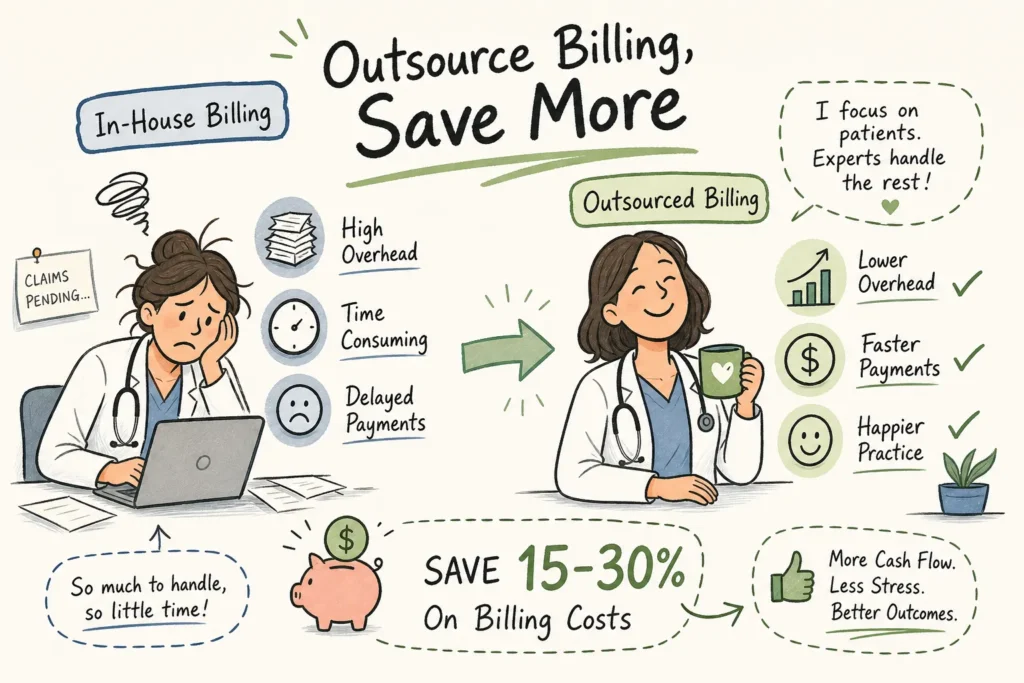
If you’re wondering how much does outsourcing medical billing save a small practice, the honest answer is: more than most owners expect. Most practice owners assume in-house billing is the safer, cheaper choice. Keep it close. Keep control. Avoid the outsourcing fee. That logic sounds reasonable until you actually run the numbers. The full cost gap between what you’re spending now and what you’d pay a billing partner typically runs $30,000 to $90,000 per year. This article walks through the real math, not rounded estimates or feel-good ranges, but a complete cost comparison you can apply to your own practice in under 10 minutes.
At WeBill Health, we frequently encounter practices that have been running billing in-house for years, convinced they’ve been doing the responsible thing. Then we show them the full cost picture. The conversation changes quickly.
What Running In-House Billing Actually Costs Per Year
Here’s the mistake most practices make: they look at the salary line and stop there. A billing specialist earning $42,000 a year feels affordable. That number is not what you’re actually paying.
Salary and Benefits: The Figure Most Practices Undercount
The fully loaded cost of one in-house billing employee starts with base salary, which typically runs $35,000 to $56,000 depending on experience and location. Add benefits and payroll taxes, which run 20% to 30% on top of salary, and that $42,000 salary becomes closer to $54,600 before you’ve paid for a single software license. That means software subscriptions, training, and overhead haven’t even entered the picture. A 2026 estimate for a fully loaded medical billing specialist at a small practice lands between $65,000 and $85,000 annually, with a practical midpoint around $72,000 to $75,000. For more detail on the real in-house cost drivers, see this analysis of how much it really costs to handle medical billing in-house.
Software, Training, and the Costs That Don’t Show Up on Payroll
Billing and practice management software runs $100 to $500 per provider per month for small practices. Annual training and certification costs add another $2,500 to $5,000. Then there’s IT support, office space, management oversight, and coverage when your biller is out sick or on vacation. Turnover is the hidden cost driver: replacing a billing staffer, accounting for job posting fees, manager time spent interviewing, and the productivity ramp for a new hire, can run $15,000 to $20,000, and small practices running lean enough that one departure creates real cash flow disruption. If you want a concise small-practice cost breakdown, this medical billing services cost breakdown for small practices is a useful reference.
Add all of it together and the honest all-in annual cost for one in-house billing employee is $75,000 to $90,000 per year. That is your real baseline for any fair comparison.
How Much Does Outsourcing Medical Billing Save a Small Practice? Start With Pricing
Outsourced billing vendors use three main pricing models, and knowing which one applies to your situation matters before you request a quote. For a detailed side-by-side look at in-house versus outsourced cost structures, review this medical billing cost comparison in-house vs. outsourced.
Percentage of Collections: The Most Common Model
Most outsourced billing companies charge between 5% and 9% of collections for small practices. On a practice collecting $600,000 per year, that translates to $30,000 to $54,000 annually. This model works because it aligns the vendor’s incentive with yours: they get paid more when you collect more, so clean claim submission and denial follow-up are in their financial interest.
Rates push toward the higher end when a practice has lower claim volume, a complex specialty, or a messy denial history that requires heavy manual follow-up. If your payer mix is clean and your denial rate is already low, you have negotiating room.
Per-Provider Monthly Fees and Per-Claim Pricing
Flat per-provider monthly fees typically run $200 to $1,000 per provider per month. Per-claim fees land between $3 and $10. Monthly fees suit practices with predictable volume because they make budgeting straightforward. Per-claim pricing fits practices with inconsistent claim flow, where paying per submission keeps costs proportional. Both models tend to come in well below the all-in cost of maintaining a dedicated in-house employee for practices of most sizes and collection volumes.
How Much Does Outsourcing Medical Billing Save a Small Practice? Real Numbers by Practice Size
Abstract comparisons don’t help much. Here’s what the math actually looks like at two common practice sizes.
Solo Provider Scenario (1 Physician, Approximately $400K in Collections)
In-house billing: $75,000 to $90,000 per year, all-in for one billing employee. Outsourced at 7% of $400,000: $28,000 per year. Estimated annual savings: $47,000 to $62,000. That figure doesn’t yet include any improvement in collections from better denial management. It’s the pure cost differential before any revenue upside.
For a solo physician, that gap often represents meaningful reinvestment, a part-time hire, a significant equipment purchase, or simply cash flow that wasn’t previously available.
Small Group Scenario (3 to 5 Providers, Approximately $1.2M to $2M in Collections)
At this size, most practices are running two billing staff members. That pushes the in-house cost to $150,000 to $180,000 per year. Outsourced billing at 6% of $1.5 million in collections: $90,000 per year. Estimated annual savings: $60,000 to $90,000. Small groups also absorb more denial management work internally as volume grows, which adds a hidden labor multiplier. Outsourcing eliminates that problem along with the headcount cost.
What Happens to Your Revenue After You Make the Switch
The cost savings are only half the picture. The other half is what happens to your collections once a specialized billing partner is managing your claims.
How Denial Reduction Translates to Actual Dollars
In-house billing at small practices typically produces first-pass denial rates of 12% to 18%. Outsourced billing with dedicated denial management commonly brings that number down to the 1% to 4% range, a reduction of roughly 8 to 14 percentage points. Industry benchmarks from vendors and RCM consultants typically report relative denial reductions of 30% to 45% after transitioning to a structured outsourced billing model. For a practice with a 15% denial rate on $600,000 in claims, a modeled 40% relative denial reduction recovers roughly $36,000 in previously lost or delayed revenue. Advanced solutions like predictive denial tools are increasingly used to cut claim denials and improve first-pass acceptance rates.
According to industry surveys and RCM research, up to 65% of denied claims are never resubmitted by in-house teams, they simply disappear into write-offs. A billing partner with a structured denial management process catches those claims before they become permanent losses.
What WeBill Health Clients Have Seen After Transitioning
Practices that move their billing to WeBill Health have seen collection rates improve meaningfully after transitioning, in a number of cases, gains of 15% to 30% within the first few billing cycles. Denial rates drop. Days in accounts receivable shorten. And the practice owner stops spending clinical time answering billing questions. These outcomes aren’t the result of working harder on billing; they’re the result of having billing managed by people who do it at scale and understand the payer-specific denial patterns that in-house staff rarely see coming.
The difference is specialty expertise. A high-volume billing shop processes claims. WeBill Health brings deep knowledge of your specialty, whether that’s physical therapy, behavioral health, ABA therapy, or primary care, and understands exactly where insurers are most likely to push back and how to prevent revenue loss before it starts.
How to Estimate Your Own Savings in Under 10 Minutes
You don’t need a consultant to run this math. You need three numbers and a simple formula.
The Three Inputs You Need
Start by building your actual in-house cost using the framework from the first section: salary plus benefits plus software plus training plus overhead. Most practices underestimate this by $15,000 to $25,000 before they add up all the line items. Then pull your annual gross collections from your billing system. Finally, identify your current denial rate, which your practice management software should report or your billing staff can estimate. Those three inputs drive the entire calculation.
Running Your Break-Even Calculation
The formula is simple. Outsourced billing cost equals gross collections multiplied by the vendor rate. Net savings equal your current in-house total cost minus the outsourced fee, plus estimated denial recovery from improved claim performance.
A worked example using conservative assumptions: $90,000 in-house annual cost, minus a $42,000 outsourced fee (7% of $600,000 in collections), plus $18,000 in denial recovery, modeled as a partial capture of claims previously written off at a below-average denial rate. That’s a $66,000 net annual benefit. If your number comes out positive, your break-even point is immediate. You save money starting in month one.
WeBill Health offers a no-cost billing assessment for small practices that want to run these numbers against their actual data rather than working from industry averages. It takes one conversation and gives you a practice-specific estimate rather than a guess.
Frequently Asked Questions: Outsourcing Medical Billing for Small Practices
How much does outsourcing medical billing save a small practice on average?
Most small practices save $30,000 to $90,000 per year when switching from in-house billing to an outsourced model. The range depends on practice size, current staffing costs, collections volume, and how much revenue is currently slipping through unchallenged denials.
Is outsourced billing worth it for a solo physician?
In most cases, yes. A solo physician collecting $400,000 per year typically spends $75,000 to $90,000 on fully loaded in-house billing. Outsourcing at 7% costs $28,000. The savings alone, before any collection improvement, often exceed $47,000 annually.
What percentage do outsourced billing companies charge?
Most charge 5% to 9% of collections for small practices. The exact rate depends on specialty complexity, claim volume, and denial history. Practices with clean payer mixes and higher volume generally secure rates toward the lower end.
How quickly do practices see results after switching to outsourced billing?
Cost savings are immediate on a per-dollar basis from the first month. Collection rate improvements vary by practice but typically become measurable within the first few billing cycles as denial management processes take hold.
The Bottom Line on Outsourcing Your Billing
In-house billing feels like the safe choice because it’s familiar and visible. But familiar and visible don’t mean cheap. When you count every dollar, software, benefits, payroll taxes, turnover costs, and the revenue walking out the door through unchallenged denials, the true cost of managing billing internally is usually far higher than what a qualified outsourced billing partner would charge.
Outsourcing medical billing for a small practice typically saves $30,000 to $90,000 per year depending on size, and that figure grows when you factor in recovered denied claims and the time physicians stop spending on administrative work. What trips most practices up isn’t the math, it’s not knowing all the costs they’re already absorbing.
If you’re ready to see what the numbers look like for your specific practice, connect with WeBill Health for a personalized savings estimate. The assessment is free, the calculation is yours to keep, and the decision stays with you.