
Most practices pick an RCM vendor the wrong way. They sit through a polished sales demo, negotiate the headline rate down a half-point, and sign. Then, 18 months later, they’re still chasing the same denials they were told would disappear. The math is brutal: a 5% denial rate against $2M in annual collections is $100,000 sitting in a payer’s pocket instead of yours. That’s not a billing inefficiency. That’s a strategic failure, and it’s exactly what separates practices that find the best RCM services in the USA from those that settle for the cheapest pitch in the room.
The standard for what a specialty-focused practice should demand from an RCM partner has shifted. This guide gives you the criteria to evaluate that difference, the benchmarks to hold vendors accountable, and a concrete framework to finalize your shortlist before you sign anything.
What separates a strong RCM partner from a basic billing vendor
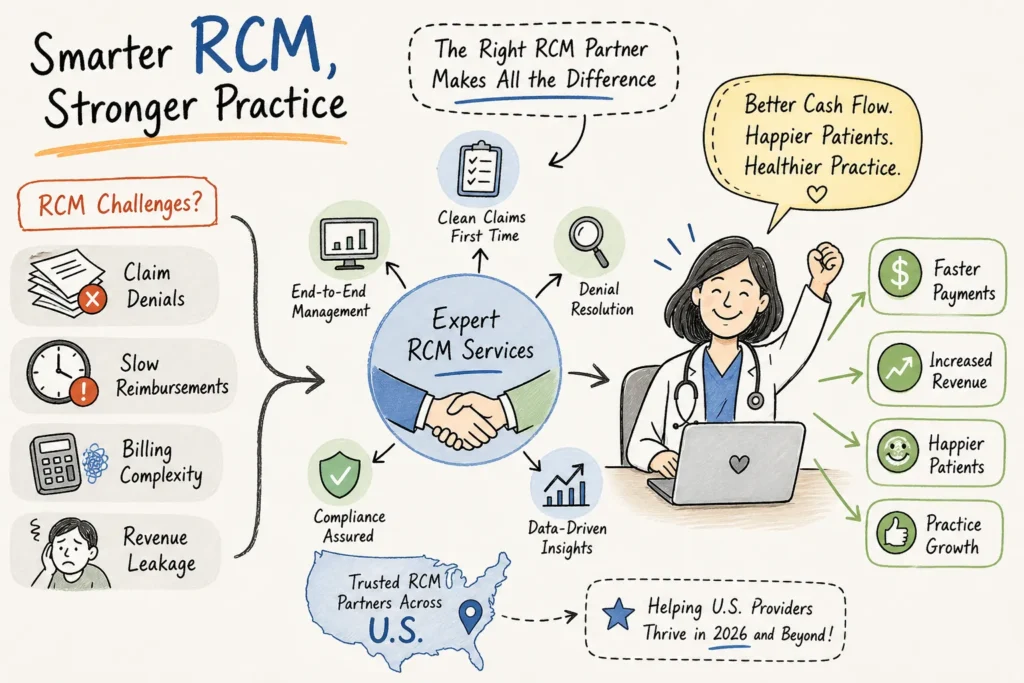
The distinction matters. A billing vendor submits claims and moves on. A true RCM partner prevents denials before submission, optimizes charge capture, and fights back when payers wrongfully reject legitimate claims. That difference is measurable in your AR days, your net collection ratio, and your monthly cash flow.
The baseline criteria most practices overlook
Four criteria matter most when evaluating an RCM partner: denial prevention rate, specialty coding depth, reporting transparency, and responsiveness during payer disputes. Most practices only ask about pricing. Pricing is the least predictive variable for actual revenue performance, and any vendor willing to compete purely on rate is telling you something about how they operate.
Transparency in reporting is especially undervalued. You need real-time access to claims status, denial breakdowns by payer and claim type, and AR aging reports. Vendors who make this data hard to access have reasons for that. Partners worth shortlisting share performance data proactively, because their numbers do the selling for them.
Why vendor size doesn’t equal vendor fit
Enterprise RCM firms like Optum, R1 RCM, and Conifer Health are built for hospital systems and large multi-site groups. Their infrastructure is a genuine advantage at scale. For a 6-provider behavioral health group or a solo PT clinic, that same infrastructure becomes a mismatch: your account gets lost in their client queue, your specialty nuances don’t register, and you end up paying for enterprise overhead without the corresponding outcomes.
The right vendor fits your complexity level. A practice under 20 providers needs a partner whose attention isn’t split across 300-bed health systems, and whose billing protocols are built around your specialty codes, not adapted from a generic template.
The specialty expertise gap that costs practices real money
Generalist RCM vendors apply one-size-fits-all coding logic across every specialty they serve. For practices in ABA therapy, physical therapy, or behavioral health, that gap translates directly into higher denial rates, missed modifier usage, and failed appeals. Payers have built utilization management algorithms that specifically target specialty codes. A generalist team won’t catch those denial triggers before submission, they’ll report the denials to you after the fact and call it a service.
Specialty-specific knowledge is the baseline requirement for high-risk specialties, not a premium add-on. It determines whether your RCM vendor actually improves your revenue cycle or simply processes paperwork and sends you a monthly report.
The performance metrics every RCM contract should guarantee
Stop negotiating on price and start negotiating on performance. These are the numbers that predict whether your revenue cycle actually improves.
Denial rates and first-pass acceptance benchmarks
The industry average denial rate sits between 5% and 10%. High-performing vendors bring this below 5%, with documented case study evidence showing improvement from 18% down to 6% or 7% in structured implementations. First-pass acceptance rates above 95% are achievable and should be defined in your contract, not just promised in a sales call. The national average first-pass rate is approximately 90%, which means a vendor delivering 95% or higher is genuinely outperforming the market. Some specialty-focused vendors have published client results approaching 98%, ask any vendor on your shortlist for documented figures specific to your specialty and volume range, not portfolio averages.
AR days and net collection ratio
Target AR days under 40. Published case study data shows structured RCM intervention consistently moves practices from 60+ days down to the 42, 52 day range. A multi-specialty group reducing AR from 62 days to 48 days while cutting denial write-offs by 42% is not unusual for well-executed RCM engagements. Net collection ratio above 95% to 96% is the benchmark for top-tier partners. Any vendor unwilling to provide their baseline averages for these two metrics is a red flag worth acting on immediately.
What the published case study data actually shows
Outcomes from published RCM implementation case studies include: an oncology service line growing net revenue by 24% post-implementation, an integrated delivery network reducing bad debt write-offs by 28%, and a multi-specialty group improving net collection ratio from 92% to 96%. These aren’t exceptional results, they’re the baseline for what a strong RCM partner should produce. Use these figures as your minimum performance threshold when negotiating contract terms, not as aspirational targets. When a vendor shares their own case studies on how leading providers optimized RCM performance, ask whether the data is independently verified or self-reported, and request direct client references who can confirm the numbers.
Pricing models decoded: which structure actually works for your practice
Most practices don’t fully understand what they’re agreeing to until the second invoice arrives. The three dominant pricing structures each carry different risk profiles, and the right choice depends on your volume, cash flow, and how much you trust the vendor’s incentive alignment.
Percentage-of-collections vs. flat fee
Percentage-based pricing typically runs 3% to 10% of net collections, with full-service RCM falling in the 4% to 8% range for most specialty practices. Flat-fee structures average $4 to $6 per claim or $1,000 to $1,500 per provider monthly. Percentage models align vendor incentives with your revenue: the vendor only earns more when you collect more, which motivates aggressive denial follow-up. Flat fees offer cost predictability but remove that financial motivation entirely, a real tradeoff for practices with high denial exposure.
Hybrid pricing and when it makes sense
A low monthly base fee combined with a reduced percentage of collections is increasingly standard for mid-sized practices. It gives the vendor stable baseline revenue while keeping the performance incentive intact on the collections side. For practices with highly variable monthly volume, hybrid pricing is often the smartest structure to negotiate. It protects you from overpaying in slow months while still rewarding the vendor for driving revenue during high-volume periods.
Hidden costs that inflate the real price
Setup fees (often around $300 per physician), software integration fees, report generation add-ons, and patient statement billing fees are frequently buried in contracts. Watch for broad language like “standard support” or “as needed” without a defined inclusion list, vendors can later classify common RCM tasks as billable extras. Always request a line-item fee schedule and ask explicitly: what triggers additional charges beyond the base agreement? For a granular comparison of software and pricing approaches, review an RCM software pricing comparison to better understand typical line items and fee structures.
Best RCM Services in the USA: Why Specialty Expertise and EHR Integration Define Outcomes
Your vendor’s technology stack and specialty knowledge are as important as any performance metric. For specialty practices evaluating the best RCM providers in the USA, this combination is often the single most predictive factor for actual revenue outcomes.
How specialty-specific billing knowledge affects denial rates
Payers have built utilization management algorithms that target specific specialty codes. A vendor without deep knowledge of those payer-side patterns won’t catch denials before submission. For ABA practices specifically, post-payment audits and recoupment demands are common, and documentation requirements for autism-related codes differ by state and by insurer. For physical therapy and behavioral health billing, modifier rules and medical necessity standards shift regularly across commercial and government payers. A billing partner who understands those standards and fights back on appeals is a direct financial advantage, not a secondary preference.
EHR integration levels and what “certified” actually means
Epic has a well-documented ecosystem of certified RCM integrations, with vendors including Availity, R1 RCM, Optum, and Waystar listed as integration partners. For Cerner/Oracle Health, NextGen, and athenahealth, integration depth varies significantly by vendor. “We integrate with your EHR” is not the same as a certified, pre-service-through-adjudication integration. Ask vendors to specify: which workflows are automated, which require manual touchpoints, and what their first-pass acceptance rate is specifically within your EHR environment.
What generalist RCM vendors consistently miss in high-risk specialties
For behavioral health providers, telehealth modifier and billing requirements have continued to shift under evolving CMS and payer guidance, and generalist teams applying static protocols to these codes leave revenue exposed. For ABA practices, documentation thresholds differ by payer and require evidence of session timing, supervision, goal progress, and medical necessity in formats that standard billing teams aren’t trained on. Specialty-focused outsourced RCM vendors build payer rule libraries for these edge cases. Generalists don’t. The denial rate difference is substantial: some specialty-focused vendors report denial rates in the 1% to 2% range, compared to industry averages that can exceed 10%, though results vary by practice size, specialty mix, and payer contracts.
Best RCM Services in the USA: How to Shortlist by Specialty and Scale
The right shortlist depends entirely on your practice size, specialty, and what your current revenue cycle problems actually are. Here’s how the major options stack up against real criteria.
WeBill Health: specialty-focused RCM with proactive denial prevention
WeBill Health is a U.S.-focused RCM partner built specifically for the specialties where generalist medical billing services consistently underperform: physical therapy, ABA therapy, behavioral health, mental health, and telehealth practices. Their model centers on proactive denial prevention, stopping denials before submission using payer-specific rule knowledge, rather than appealing them after the fact. For small-to-mid practices under 20 providers losing revenue to payer algorithms and utilization management denials, WeBill Health’s specialty depth and advocacy-focused approach make them a strong starting point on any shortlist. Their combination of billing execution and payer-side intelligence is designed for the exact complexity that generic platforms handle poorly.
Enterprise-scale options: Optum, R1 RCM, and Conifer Health
These three revenue cycle management companies consistently rank at the top of market presence lists: they have the infrastructure, technology platforms, and staffing depth to serve large health systems and multi-site groups. Optum is widely cited as the largest U.S. RCM provider. R1 RCM frequently ranks near the top of 2026 industry evaluations. Conifer Health rounds out the enterprise tier. The tradeoff is real: these vendors are designed for hospital-scale volume and complexity. A 3-provider mental health group will not receive the same attention or specialty-specific expertise from a firm whose core clients are 500-bed hospitals.
EHR-platform RCM options: athenahealth and Waystar
Athenahealth operates as an integrated EHR-plus-RCM platform, making it a practical choice for practices that want a single vendor managing both clinical records and revenue cycle in one environment. Waystar offers certified Epic integration with strong claims management automation. Both are worth evaluating if tight EHR-RCM workflow integration is your top priority. Neither provides the specialty-specific denial expertise that high-risk specialties require, so if you’re running a behavioral health or ABA practice, layering their technology with specialty-focused RCM support is worth considering.
How to evaluate and finalize your RCM vendor
Comparison is step one. The evaluation process is where practices lose discipline and sign with whoever made the most confident promises. A structured evaluation means holding every vendor to the same set of written performance questions and disqualifying any that can’t answer with specific data, before you ever reach contract negotiations.
The five questions every practice should ask before signing
These five questions separate performance-driven vendors from sales-driven ones. Ask each one directly and watch how the vendor responds:
- What is your average first-pass acceptance rate for practices in my specialty?
- What is your average AR days across current clients at my volume level?
- How do you handle payer appeals, and what is your documented appeal win rate?
- What are all fees beyond the base rate, itemized by service type?
- Can you provide two references from practices in my specialty and my size range?
Vague answers to any of these are disqualifying. A vendor who can’t give you specific numbers for their first-pass rate and AR days either doesn’t track performance rigorously or doesn’t want you to see it.
Data to request from every shortlisted vendor
Request 90-day performance reports from current clients, itemized fee schedules, denial rate breakdowns by payer and claim type, and documentation of their specialty coding protocols for your specific service lines. Any vendor who refuses to share client performance data has something to hide. The RCM providers in the USA worth working with share this proactively, because their numbers make the case for them.
Red flags that should end the conversation
Walk away from any vendor who demonstrates no specialty experience in your service area. Add to that list: unwillingness to commit to performance benchmarks in writing, and vague answers about the appeals process. Fee structures that bury add-on charges or contracts with no documented integration path for your EHR are equally disqualifying. The goal is a long-term partner relationship. A vendor who underperforms during evaluation will perform worse after onboarding, and the cost of switching mid-cycle makes choosing wrong an expensive mistake.
Make the decision based on outcomes, not a sales deck
The best RCM service in the U.S. is not the largest, and it’s not the cheapest. It’s the one built for your specialty, transparent about its performance metrics, and financially incentivized to fight for your revenue. For specialty practices in physical therapy, behavioral health, or ABA therapy, that standard points toward a partner with demonstrated payer-side expertise and a denial prevention model, not a generic platform applying the same protocols across every specialty it serves.
Use the criteria and questions in this guide to run a structured evaluation. Request real performance data, not projected outcomes. Compare denial rates, AR days, and net collection ratios from actual current clients in your specialty. The practice that builds its shortlist around the best RCM services in the USA based on documented outcomes, rather than pricing models and sales confidence, is the one that stops chasing denials 18 months from now.
If you’re ready to see what a specialty-focused RCM partner actually delivers for practices like yours, WeBill Health is a direct starting point. Request a performance review of your current billing operation and see the gap between where you are and where you should be.