
Physical therapy billing errors cost PT clinics real money every month, and most of those losses trace back to unit miscalculations, incorrect code selection, and payer denials that have zero connection to clinical quality. The billing side of running a physical therapy practice is genuinely technical. Small mistakes in code selection, modifier use, or documentation don’t just reduce your reimbursement on one claim; they compound into patterns that erode revenue steadily, often without anyone noticing until the numbers become impossible to ignore.
This guide covers the entire PT billing process from start to finish: selecting the right CPT codes, calculating units accurately, documenting visits so they survive payer review, and fighting back when a denial shouldn’t have happened. At WeBill Health, these are the problems we most commonly encounter when PT practices come to us after losing revenue to preventable billing errors. The fixes are learnable, and once you build them into your workflow, your clean claim rate can materially improve.
The CPT codes behind most PT visits
A relatively small set of codes covers the majority of outpatient PT services. Getting comfortable with these codes and their clinical distinctions is the single most important foundation skill for anyone handling physical therapy billing. The list below covers evaluations and the six treatment codes that appear most frequently on PT claims, along with the common coding mistakes that trigger audits.
For practitioners seeking a practical primer, see this beginner’s guide to CPT codes for physical therapy that walks through common code choices and documentation tips.
Evaluation and treatment codes to know
For initial evaluations, use 97161 (low complexity), 97162 (moderate complexity), or 97163 (high complexity) based on the number and severity of factors the evaluating therapist considers. When a formal re-assessment of the plan of care is needed mid-treatment, 97164 covers that re-evaluation. The complexity level isn’t optional; it’s a clinical determination that the documentation must support.
For treatment, the six codes that appear most often across outpatient PT claims are:
- 97110, Therapeutic exercise: direct, one-on-one exercise to improve strength, endurance, flexibility, or range of motion
- 97112, Neuromuscular re-education: treatment targeting balance, coordination, posture, or movement control
- 97116, Gait training: skilled instruction in walking mechanics, stair training, and gait biomechanics
- 97140, Manual therapy: hands-on techniques such as joint mobilization, soft tissue work, and passive movement
- 97530, Therapeutic activities: dynamic, functional tasks that improve mobility and daily activity performance
- 97535, Self-care training: instruction in home programs, ADL safety, and daily living skills
The code must match the actual skilled service provided, not just a general treatment category. Billing 97530 when the session was predominantly therapeutic exercise is the kind of mismatch that triggers audits and downcoding on review.
Modifiers that make or break a clean claim
Four modifiers cover most physical therapy coding situations, and applying them incorrectly, or leaving them off entirely, is a reliable path to denial. GP indicates the service is furnished under a physical therapy plan of care and is commonly required on outpatient PT claims. KX is required once a Medicare beneficiary’s combined PT and speech-language pathology charges exceed the 2026 threshold of $2,480, signaling that services remain medically necessary beyond that amount. Claims above the threshold without KX are automatically denied.
Modifier 59 identifies a service as distinct from another service billed on the same day, used specifically when NCCI edits would otherwise bundle two codes together. Note that some Medicare contractors prefer the more specific X{EPSU} modifiers over 59 in certain situations, so check your payer’s guidelines before defaulting to 59. CQ is required when a physical therapist assistant furnishes the service in whole or in part beyond the 10% de minimis threshold. Under current CMS rules, CQ-billed services are reimbursed at 85% of the otherwise applicable amount, so the modifier affects payment rate as well as compliance. For official Medicare guidance on therapy billing and modifier usage, review the CMS therapy services guidance.
Physical therapy billing: calculating therapy units correctly
Unit calculation errors are one of the most common reasons reimbursements come in lower than expected, and they’re also one of the fastest ways to end up on a payer’s audit radar. The mechanics aren’t complicated, but they require a consistent process.
Medicare’s 8-minute rule, step by step
Time-based PT codes are billed in 15-minute units. Under Medicare’s 8-minute rule, you can only bill a unit when at least 8 minutes of direct, one-on-one skilled treatment were provided. The critical step that many billing staff miss: combine total timed minutes across all timed CPT codes in a session before applying the threshold, not code by code.
Here’s a worked example. Twenty-five minutes of therapeutic exercise plus 12 minutes of manual therapy equals 37 total timed minutes. Divide by 15 to get 2 full units with 7 minutes remaining. Since the remainder is under 8 minutes, you bill 2 units total. Change the manual therapy portion to 15 minutes and the total becomes 40 minutes, 2 full units with 10 minutes remaining. That remainder clears the 8-minute threshold, giving you 3 billable units. The remainder rule can either add or cost you a unit, which is why the math matters every single time. For practical examples and common practitioner pitfalls, see this guide to the 8-minute rule.
How private payer rules differ from Medicare
Many commercial payers follow the same 15-minute, 8-minute framework Medicare uses, but not all of them do. Some plans impose daily unit caps regardless of how many timed minutes were provided; a payer might cap reimbursement at 4 units per day even when the session time would support 5 or 6 units under the standard calculation. Billing staff must check each payer’s contract terms before submitting, not assume Medicare therapy billing rules apply universally. Payer-specific unit caps are a consistent source of unexpected denials for PT practices billing multiple insurance types, and the caps are rarely spelled out clearly in benefit summaries, as Florida Medicaid’s plan-level limitations illustrate.
What your documentation must show to get paid
Correct physical therapy coding means nothing if the documentation doesn’t back it up. Payers reviewing time-based PT claims look for specific elements, and missing any one of them gives them a legitimate basis to deny or reduce payment.
Required elements for timed-code claims
Every treatment note must include the exact minutes per timed service (or start and stop times), the specific skilled intervention that maps to the CPT code billed, documented direct one-on-one contact time, date of service, and the provider’s signature with credentials. Non-billable time, setup, breaks, documentation, and equipment preparation, must not be included in your timed minutes. Payers look for this distinction during audits, and notes that blend billable and non-billable time into a single “session time” figure are exactly the kind of documentation that gets claims overturned on review.
Medical necessity language that survives payer review
“Medical necessity” in PT documentation means showing three things clearly: a measurable functional deficit, a skilled intervention plan tied to that deficit, and objective evidence of progress or clinical rationale for why function would decline without continued care. Weak language like “patient tolerated treatment well” or “continued with HEP” doesn’t establish skilled necessity. Strong language identifies the specific impairment, connects it to a functional limitation the patient can’t manage independently, and explains what the skilled therapist is doing that couldn’t be safely performed by the patient or a non-licensed aide.
Payers now use utilization management algorithms to flag claims that lack this specificity, a trend well-documented in industry commentary on automated prior authorization systems. Vague documentation doesn’t just risk one denial; it can trigger a systematic review of your entire claim history with that payer. Writing defensible notes isn’t extra work. It’s the baseline your practice needs to protect its revenue.
Why PT claims get denied and what to do immediately
Physical therapy claim denials fall into two broad categories: administrative errors that should have been caught before submission, and clinical or coding-based denials that require a more substantive response.
Authorization, eligibility, and administrative errors
These denials are almost always preventable with front-end verification. Eligibility denials happen when a patient’s coverage has lapsed, benefits are exhausted, or the provider is out of network on the date of service. The fix is eligibility verification before every visit cycle, not just at initial intake. Authorization denials occur when prior auth is missing, expired, or the visit limit has already been reached; proactive tracking of authorization expiration dates and visit counts eliminates most of these. Administrative errors (wrong member ID, incorrect date of birth, duplicate submissions) are caught by running a line-by-line claim audit before submission, not after a denial arrives.
Medical necessity and coding-based denials
These denials are harder because they often reflect systematic process gaps rather than isolated mistakes. Insufficient documentation for medical necessity, diagnosis-to-procedure mismatches, incorrect modifier use, and timed billing calculation errors each require a different fix at the workflow level. When these denials appear repeatedly, the problem isn’t the claim, it’s the process that produced it. Practices working with a specialized physical therapy billing partner like WeBill Health gain a proactive advantage: payer-specific coding expertise applied before claims go out, not just resubmissions after the fact.
For a practical checklist of frequent denial causes and quick corrective steps, see this industry summary of the common reasons your physical therapy claims are getting denied.
Appealing denied PT claims without losing revenue
Many practices leave revenue on the table by either not appealing denials or filing appeals that are too generic to succeed. A clean appeal process starts with reading the denial carefully and choosing the right response type.
Reading the denial and choosing the right response
The first step is always to read the EOB or denial letter and identify the exact reason code. Administrative or coding errors go back as corrected claims, which are typically processed faster than formal appeals. Medical necessity denials and authorization disputes require a formal appeal with supporting clinical documentation. Filing a formal appeal for an error that should have been corrected and resubmitted wastes time; filing a corrected claim for a medical necessity dispute bypasses the appeals process entirely and usually fails. Matching the response to the denial type is the step practices most often skip.
Building an appeal that payers can’t ignore
For medical necessity appeals, the appeal letter must tie the diagnosis to a functional impairment, explain the skilled intervention rationale, and document objective progress measures or the clinical risk of decline without continued care. Vague appeals that restate the claim information without adding clinical substance are routinely upheld by payers. For authorization-related denials, include the authorization number, visit counts, dates, and any written or documented payer communication that supports the coverage expectation.
When systematic denials driven by insurer utilization management algorithms keep recurring despite correct claims, individual appeal effort alone won’t fix the root cause. Working with a billing service that specializes in PT denial recovery, like WeBill Health, gives clinics a structured path to recover reimbursements that were wrongly withheld. That kind of recovery requires payer-specific expertise built over years of working with PT practices specifically.
Physical therapy billing: putting it all together for your practice
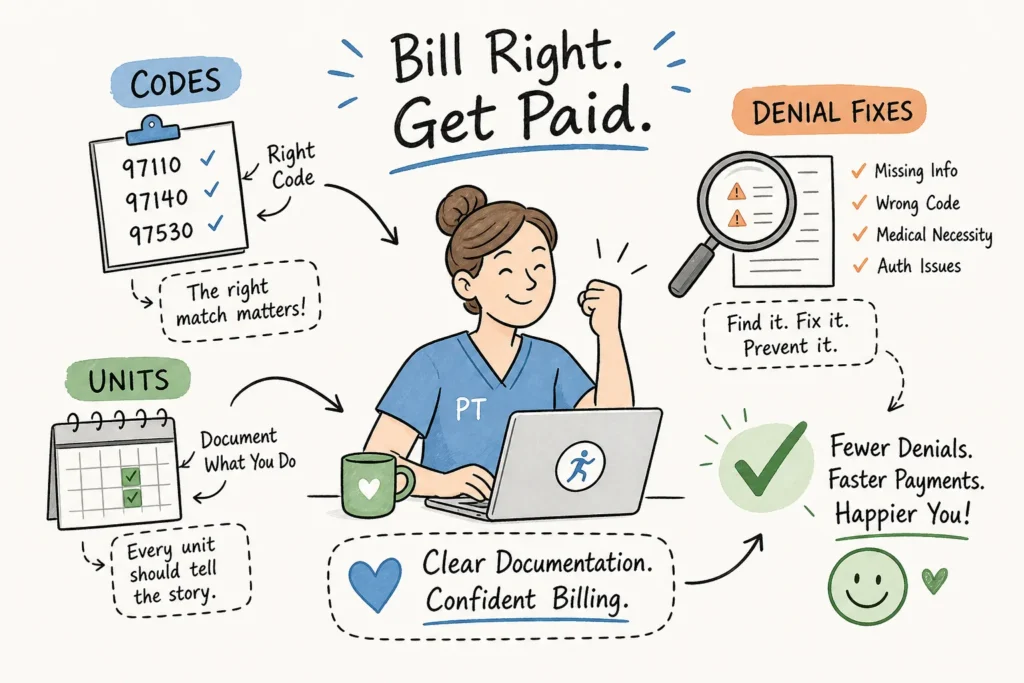
Physical therapy billing is demanding, but it’s also highly manageable when you break it into its core components: correct CPT code selection, accurate unit calculation, airtight documentation, and a proactive denial management process. None of these components work in isolation. A correctly coded claim with weak documentation still gets denied. Strong documentation behind an incorrectly calculated claim still results in underpayment.
Build these habits into your daily workflow and you’ll close most of the revenue gaps PT practices commonly face:
- Know your modifiers and when each one is required
- Count timed minutes using the total-session method before applying the 8-minute threshold
- Write documentation that proves skilled necessity in specific, functional terms
- Verify eligibility and authorization before claims go out
- Appeal every denial that lacks a legitimate clinical or administrative basis
If your practice doesn’t have the bandwidth to stay current on evolving payer rules, utilization management denials, and appeal deadlines, you don’t have to manage it alone. WeBill Health works specifically with PT practices to reduce denial rates and recover reimbursements that payers should have paid. Learn how our PT billing services work and what a cleaner claim process could mean for your bottom line.