
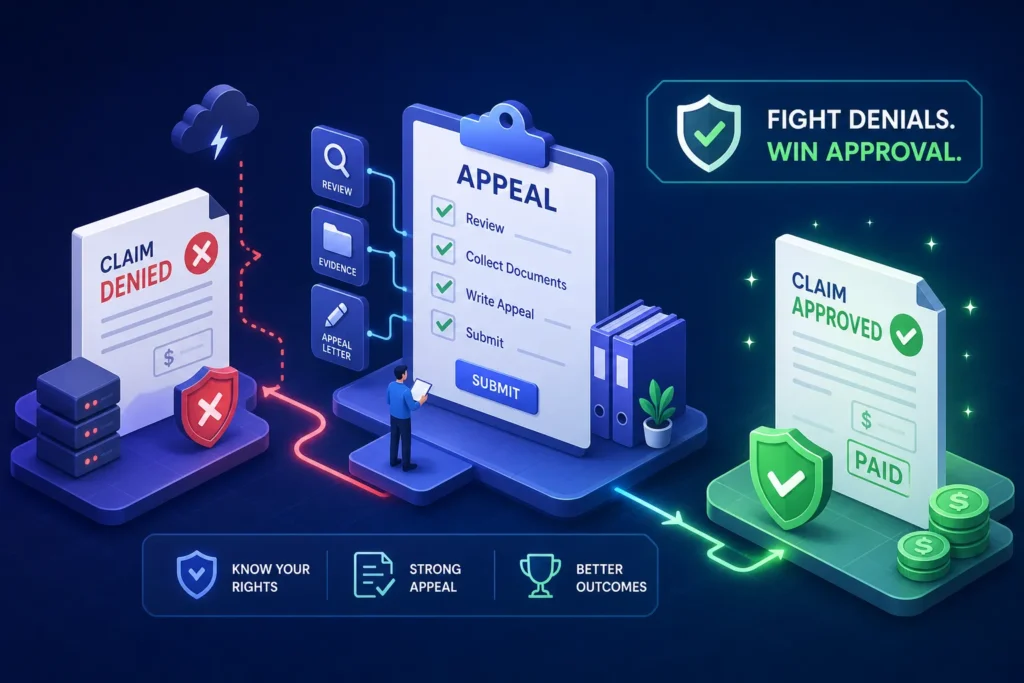
Roughly 44% of internal insurance appeals succeed in overturning a denial, yet many small practices rarely file one. That represents real revenue left uncollected while providers assume the payer’s decision is final. This guide explains the claim appeal process and how to overturn denials to recover revenue you’ve already earned. The appeal process isn’t a long shot. It’s a structured, deadline-driven workflow, and knowing the rules gives you a genuine chance to get paid for care you already delivered.
This guide walks through every step, from reading the denial letter to escalating to independent external review. Small practices that work with a billing partner like WeBill Health can have this entire workflow managed on their behalf, but if you’re handling appeals in-house, the process is learnable. Here’s what you need to know.
What a Denial Letter Actually Tells You
Before you appeal anything, you need to understand exactly what you’re responding to. Providers who skip this step write appeals that miss the point entirely, addressing medical necessity when the real issue is a coding mismatch or an expired prior authorization. Reading the denial correctly is the foundation of a successful appeal.
The Explanation of Benefits (EOB) and the denial letter together give you three critical pieces of information: the denial reason code, the payer’s stated rationale, and the deadline to respond. Pull both documents before any appeal work begins. The reason code alone tells you which category of denial you’re dealing with, which directly determines your response strategy.
Denial codes fall into a few core categories: medical necessity (CO-50), coding errors (CO-11), eligibility and coverage issues (CO-204, CARC 27), missing prior authorization (CO-15), and timely filing violations (CO-29). Each requires a different evidence set and a different argument. Conflating them wastes time and fails to address what the payer is actually asking for.
Claim Appeal Process: Levels, Timelines, and Deadlines You Can’t Miss
The claim appeal process has a defined structure, and deadlines are strictly enforced in most cases. Missing a filing window typically means losing your right to appeal, regardless of how strong your case is, though some plans or regulators allow exceptions in limited circumstances, such as documented good cause. Every practice needs a calendar-based tracking system just to protect the right to appeal.
Internal Claim Appeal Process: Your First and Most Important Step
Under federal rules, most group health plans allow at least 180 days to file an internal appeal. Once filed, the plan must decide within 72 hours for urgent care, 30 days for pre-service claims, and 60 days for post-service claims. These decision windows are set by federal regulation, and you can cite them directly if the payer stalls. See the CMS appeals fact sheet for additional federal guidance. Note that state laws and individual plan documents may set more generous timelines, so always check the specific plan’s governing documents alongside federal minimums.
External Review: When the Internal Appeal Doesn’t Move the Needle
If the internal appeal is denied, federal law gives you the right to request an independent external review, typically within four months of receiving the internal denial notice. External reviewers operate independently from the insurer, and their decisions are generally binding on the plan, though state-based processes vary. The NAIC consumer guide on appealing denied claims is a helpful overview of how external reviews work in many states. Between 27% and 40% of cases that reach external review are overturned, which makes it worth pursuing even after an internal loss.
Medicare vs. Commercial Plan Appeal Paths
Original Medicare runs a five-level appeals process through Medicare contractors, an Administrative Law Judge (ALJ), the Medicare Appeals Council, and potentially federal district court. Medicare Advantage plans start with a plan reconsideration, then route denied cases to an Independent Review Entity (IRE) before following the same federal appeal path. Commercial plans follow the ACA’s internal-then-external structure but may include additional internal review levels depending on the plan documents. Self-funded employer plans generally follow federal rules rather than state external review law, because ERISA preempts state insurance regulation for those plans.
Building a Documentation Package That Actually Overturns Denials
A well-organized documentation package is what separates a successful appeal from a rejected one. Payers respond to specificity, not volume. The goal is to build a record that directly addresses the denial reason and leaves no room for a secondary rejection on different grounds.
For medical necessity denials, the strongest package starts with the denial letter and EOB, followed by clinical notes that capture diagnosis, exam findings, treatment history, and why the specific service was required. A physician letter of medical necessity should explicitly address the payer’s stated denial reason rather than simply restate the diagnosis. Published clinical guidelines or peer-reviewed sources strengthen the package when the denial turns on whether the treatment is evidence-based.
Technical denials require a different evidence set: prior authorization records, CPT and ICD-10 documentation, payer policy language, and operative or procedure notes that tie the submitted code to the actual service performed. The appeal needs to show that the code accurately reflects what was done and that the documentation in the chart supports it. Bringing payer-specific coverage criteria into the argument directly addresses the most common objection payers use to sustain a coding denial.
Writing an Appeal Letter That Payers Actually Respond To
The appeal letter is where most providers lose ground. Generic letters that restate the claim information without addressing the specific denial reason rarely succeed. Payers are looking for a direct, evidence-supported argument that the denial was incorrect, not a summary of the original claim.
An effective appeal letter opens by identifying the claim, the denial reason code, and the specific decision being challenged. The body presents the clinical or administrative rationale in clear terms, referencing the supporting documents by name and page. The closing explicitly requests that the payer overturn the decision and states the outcome you’re asking for. Language like “medical necessity was established by the enclosed clinical documentation” and “the submitted code accurately reflects the service rendered as supported by the operative report” signals to reviewers that the appeal was prepared by someone who understands the process. For providers wanting a concrete template, the AMA sample appeal letter template offers a useful starting point you can adapt to the denial type.
Tailoring the letter to the denial type is essential. A medical necessity appeal emphasizes clinical evidence and physician judgment tied to the patient’s specific condition. A coding denial appeal focuses on how the documentation maps to the submitted CPT code. An experimental treatment denial requires citing published guidelines that show the treatment is consistent with the accepted standard of care. One generic template cannot do all three jobs effectively.
When Peer-to-Peer Reviews Change the Outcome
A peer-to-peer review is a direct phone conversation between the treating provider and the insurer’s medical reviewer. For medical necessity denials, it can be an effective tool that many small practices underuse, often because they don’t know it’s an option or lack the bandwidth to pursue it.
The ideal window for requesting a peer-to-peer is before or immediately after the internal appeal is filed. Many insurers require the request within five business days of an adverse prior authorization decision, and some only allow it once. The call itself is typically brief, often under 15 minutes, but it lets the treating provider speak directly to patient-specific clinical factors that a chart review alone doesn’t capture. That direct clinical conversation can move a denial that documentation alone won’t overturn.
If the internal appeal and peer-to-peer review both fail, external review is the next step. Beyond that, providers can file complaints with their state insurance commissioner, contact CMS for Medicare-related disputes, or consult a healthcare attorney for high-value cases with potential contractual remedies. The right escalation path depends on the denial type, the plan type, and the dollar amount at stake.
Why Small Practices Outsource the Entire Appeals Workflow
Filing appeals takes time, expertise, and consistent follow-through. For a small practice with one or two administrative staff also managing scheduling, authorizations, and front-desk operations, the appeals process frequently falls through the cracks. The financial cost of that gap compounds quickly.
Every unworked denial is lost revenue. When staff lack the training to identify which level of appeal applies, pull the right documentation, or write a denial-specific letter, the practice absorbs the loss by default. Success at the internal stage depends on appeals being filed on time, addressed to the correct denial reason, and supported by complete documentation. Practices without a structured process fall well short of that benchmark, their appeals arrive late, address the wrong issue, or lack the supporting evidence to hold up under review.
WeBill Health manages the full appeals workflow for small and mid-sized practices: reviewing denial letters, building documentation packages, drafting appeal letters, coordinating peer-to-peer requests, and escalating to external review when necessary. Providers working with WeBill Health don’t have to choose between fighting payers and seeing patients. The appeals process runs as a standard workflow, and the practice gets paid for the work it already did. For an independent, practical walkthrough of the steps involved in filing an appeal, see this step-by-step guide to appealing a denied health insurance claim.
Denials Don’t Have to Be Final
The claim appeal process is not a coin flip. It’s a structured system with defined timelines, documentation requirements, and escalation paths that, when followed correctly, overturns denials nearly half the time at the internal appeal stage alone. That number improves further when appeals are filed with the right evidence, addressed to the correct denial reason, and tracked through every level of review.
The practices that recover the most denied revenue treat the claim appeal process as a standard workflow, not an occasional exception. Build the process, track the deadlines, and match every response to the specific denial reason code you received. If your practice doesn’t have the bandwidth to run that workflow consistently, partnering with WeBill Health ensures denials are worked through every available level, so your revenue cycle keeps moving even when your team is focused entirely on patient care.