
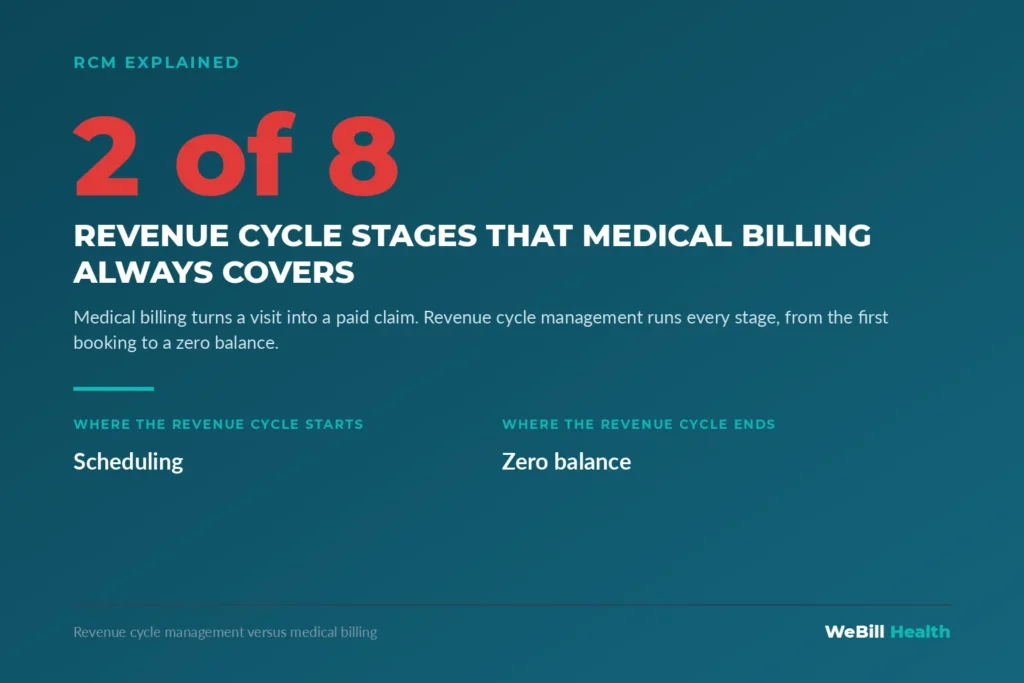
Short answer: no. Medical billing is one stage inside revenue cycle management. Billing turns a visit into a claim and works to get that claim paid. Revenue cycle management (RCM) covers every step that decides whether your practice gets paid, from the moment a patient books to the moment the account reaches a zero balance.
The difference matters because most lost revenue starts outside the billing step. A claim can be coded perfectly and still deny because eligibility was never checked, an authorization expired, or the provider was not enrolled with that payer.
The difference in one table
| Stage | Medical billing | Revenue cycle management |
|---|---|---|
| Scheduling and eligibility checks | No | Yes |
| Prior authorization | No | Yes |
| Payer credentialing and enrollment | No | Yes |
| Coding and claim submission | Yes | Yes |
| Payment posting | Yes | Yes |
| Denial follow up and appeals | Sometimes | Yes |
| Patient balances and statements | Sometimes | Yes |
| Root cause reporting | Rarely | Yes |
When does the revenue cycle start and end?
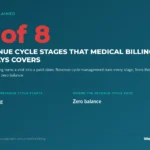
The revenue cycle starts when a patient schedules an appointment, because that is when insurance details are collected and eligibility can be checked. It ends when the account for that visit reaches a zero balance. That happens in one of three ways: the payer pays in full, the patient pays their share, or the remaining balance is adjusted or written off with a documented reason.
A paid claim can still leave the cycle open. If the payer paid less than your contracted rate, the account stays open until the underpayment is appealed or recovered.
What is end to end revenue cycle management?
End to end RCM means one partner runs every stage, so a problem found at one stage gets fixed at the stage that caused it. The work falls into three parts.
- Front end: scheduling, insurance verification, prior authorization and patient registration.
- Middle: charge capture, coding, review of each claim against payer rules, and submission.
- Back end: payment posting, denial follow up, appeals, A/R follow up, patient statements and reporting.
At WeBill Health, every claim receives human pre submission review against payer rule libraries organized by specialty and by carrier. See how the full service works on our end to end revenue cycle management page.
What is the front end revenue cycle?
The front end revenue cycle is everything that happens before the patient is seen: collecting accurate demographics and insurance details, verifying eligibility and benefits, securing prior authorization, and explaining the patient’s expected share. Errors made here travel through every later stage and usually surface weeks later as a denial, so this is where denial prevention pays off most.
Do you need full RCM or just billing?
Billing only support can work for a practice whose denial rate is low, whose credentialing is current and whose front desk verifies every visit. A practice that sees any of the signs below usually needs the full cycle covered.
- Your denial rate is above 10 percent.
- A growing share of your A/R is older than 90 days.
- New providers are waiting on payer enrollment before they can bill.
- Your front desk is too stretched to verify eligibility and authorizations on every visit.
To see where your practice stands, check your Revenue Defense Score or request a Revenue Defense Audit.