
Short answer: A well child visit that also addresses a significant problem supports two codes: the preventive code and a problem oriented E/M code from 99212 through 99215 with modifier 25. The problem does not have to be new if separate work is documented. Some payers reduce the second code; Ambetter payment policy CC.PP.057, Problem Oriented Visits Billed with Preventative Visits, pays it at 50 percent.
Updated October 2026
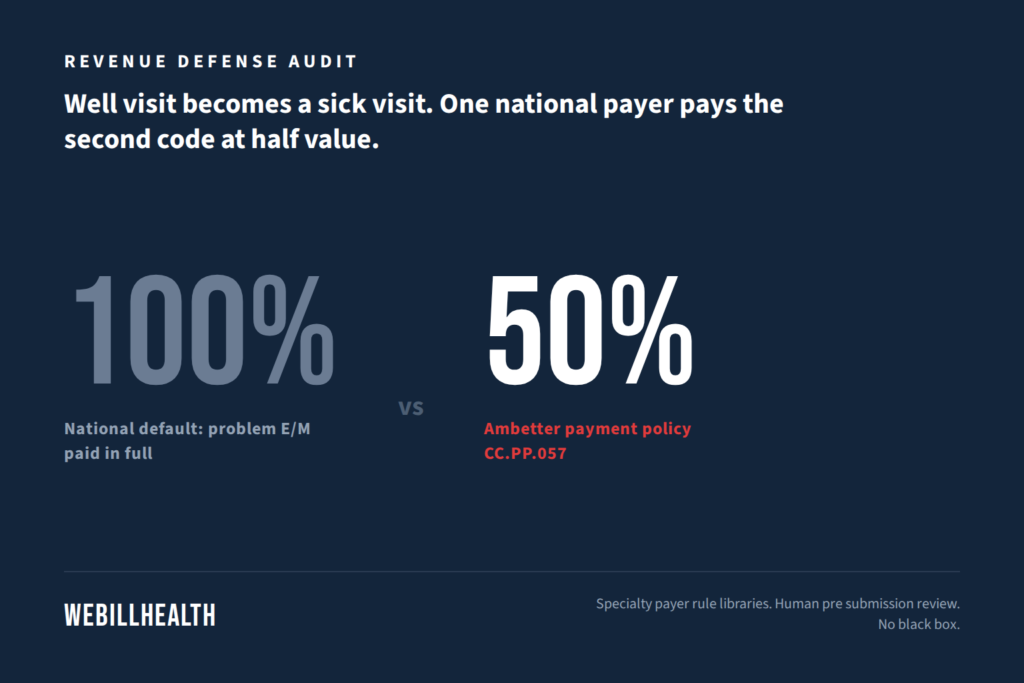
When a well child visit turns up a real problem, a rash a parent already tried two creams on, an ear pulled at for two days, wheezing that was not there at the last checkup, that visit is worth two codes, not one. Bill the preventive code and a separately identifiable problem E/M with modifier 25, and the second code is not paperwork. On at least one national payer’s own published policy, it pays exactly half.
Pediatric practices see this pattern daily. A parent books a routine checkup and mentions, almost as an afterthought while the physician is already in the room, that something else has been bothering the child. The physician evaluates it, documents it, and treats it in the same visit. Nothing about that is unusual and nothing about it is optional under CPT rules. What is inconsistent is what happens next in the billing system.
Some practices code the preventive visit alone and let the problem ride along uncoded, treating the extra work as part of the checkup. Others append modifier 25 automatically to every well visit that mentions a symptom, whether or not the work actually justifies it. Both habits cost money, in opposite directions. The first gives away paid work. The second invites a payer audit that can claw back far more than the disputed code was ever worth.
What actually has to be true before modifier 25 applies
The American Medical Association’s own guidance on reporting modifier 25 states that it applies when “an abnormality is encountered or a preexisting problem is addressed” during a preventive visit and that problem “is significant enough to require additional work to perform the key components of a problem oriented E/M service.” A trivial finding, a stable rash the parent mentions in passing, does not qualify. A finding that requires its own history, its own assessment, and its own plan does.
The problem does not have to be new. Coding guidance from the American Academy of Pediatrics’ coding alert program addresses this directly: an existing chronic condition, not just an acute complaint, can justify modifier 25 if the physician performs real, separately documented work on it during the same visit. Occasional wheezing noticed at an annual wellness exam, worked up and treated, supports 99212 through 99215 with modifier 25 next to the preventive code just as an acute ear infection would.
The AMA’s own worked example is a well visit case almost identical to what pediatric practices see every week. A mother brings her three year old for a scheduled health maintenance visit. During the appointment she raises two days of ear pulling and irritability. The physician performs the full preventive exam and separately evaluates the ear, documenting inflammation consistent with acute otitis media along with the medical decision making behind starting an antibiotic. The AMA’s answer: report 99392 for the preventive visit and the appropriate 99212 through 99215 code with modifier 25 for the ear infection. Two codes, two documented services, one visit.
What one properly coded visit is worth, and what one uncoded visit costs
A problem E/M code appended with modifier 25 is not a small line item. Established patient problem visits in the 99212 through 99215 range commonly reimburse in the range of 50 to 150 dollars depending on the payer, the region, and the level of history, exam, and medical decision making the documentation supports. A pediatric practice that sees even a handful of well visits a week where a real problem surfaces, and simply absorbs that work into the preventive code instead of billing for it, is giving away that amount every time, on a clean claim that never shows up as a denial or a write off anywhere in the aging report.
Run that across a 3 to 5 provider practice seeing dozens of well visits a week, and the uncoded problem work adds up to real money sitting in exam room documentation that was never translated into a second CPT code. Nothing in a denial log ever flags it, because the claim that went out was never wrong. It was simply incomplete.
The payer policy that pays this differently than the national rule assumes
Most billing guidance, including the AMA’s own, describes modifier 25 as a documentation gate. Meet the criteria and both codes get paid at their normal contracted rate. That assumption holds with most commercial payers and most state Medicaid programs. It does not hold everywhere.
Ambetter, the marketplace brand run by Centene, publishes a payment policy on problem oriented visits billed with preventive services that departs from that default in writing. Its stated reimbursement rule is direct: the plan pays “the preventative medicine code plus 50 percent of the problem oriented E&M code.” The policy states this 50 percent reduction applies whether or not modifier 25 is even appended, as long as clinical review validates the service as significant and separately identifiable. The rationale given in the policy itself is that a practice does not incur duplicate indirect costs, vitals, scheduling, staffing, the exam room, when both services happen in the same encounter.
| Question | National default (AMA/CPT guidance) | Ambetter (Centene), payment policy CC.PP.057 |
|---|---|---|
| Does modifier 25 change what gets paid? | Determines whether the second code is payable at all | Reduction applies regardless of whether modifier 25 is appended |
| What does the problem E/M code pay if approved? | Full contracted rate for that E/M level | 50 percent of the problem oriented E/M code |
| Stated rationale | Distinct, separately identifiable service performed | No duplicate indirect costs in a combined encounter |
| What still triggers approval | Documentation supporting a significant, separately identifiable service | First time evaluation of a condition, a distinct diagnosis, a worsening condition, or unrelated supplies requiring separate assessment |
A practice that bills every Ambetter combined visit expecting the same reimbursement it gets from a commercial PPO or a state Medicaid plan following the CPT default is not being underpaid by error. It is being paid exactly what that payer’s own written policy says it will pay. The gap only becomes a problem when nobody on the billing side knows the policy exists and the practice assumes every payer settles the same way.
That gap runs in both directions. A practice unaware of the 50 percent rule underestimates expected revenue and cannot tell a clean, policy driven reduction from an error worth appealing. A practice that assumes the reduction applies everywhere risks under billing a payer that actually pays the full rate.
Find out what your combined visits are actually paying
A Revenue Defense Audit is a forensic review of your existing accounts receivable, payer by payer. For a pediatric practice, that means checking every well visit that also carried a problem E/M code against what each specific payer actually reimbursed, not what the fee schedule implies it should have. Most practices have never separated the two.
How to defend the second code before the claim goes out
The history, the exam findings specific to the complaint, and the medical decision making all have to support the E/M level billed, independent of the preventive components already documented elsewhere in the note. Write the problem visit as though it stood entirely on its own.
Base the problem visit level on history and medical decision making rather than repeating the physical exam already performed for the checkup. Duplicating exam elements across both services does not add revenue and can read as padding to a reviewer.
Trivial findings do not carry modifier 25. A stable birthmark or a routine medication refill does not meet the significant, separately identifiable standard, and appending the modifier anyway is exactly the pattern payers scrutinize hardest in audits.
Every payer in the panel needs a known rule on file before the claim goes out, so the expected reimbursement on the books matches what will actually post. A 50 percent reduction nobody budgeted for looks like an error until someone checks the policy behind it.
The two services should stay legible as two services in the chart, even when they happened in the same room in the same fifteen minutes. A reviewer reading the note six months later has to be able to see where the checkup ended and the sick visit began.
How WeBill Health defends combined visit revenue
WeBill Health maintains internal payer rule libraries organized by specialty and by carrier, spanning more than 500 payer rulesets. Those libraries are built and updated by people who work claims in your specialty every day, and every claim receives human pre submission review against them before it goes out. There is no black box and no algorithm we ask you to take on faith. When a payer publishes a rule like Ambetter’s 50 percent reduction on combined visits, an expert adds it to your practice’s library and applies it to every claim that matches.
For a pediatric practice that means the reviewer checking a combined well and sick visit knows which payers in your panel pay the full contracted rate on the problem E/M code and which pay half, knows the documentation each one requires to approve modifier 25 in the first place, and flags a claim heading out under the wrong assumption before it is submitted, not after it denies. Our providers operate on a 98% clean claim rate, a 48 hour submission guarantee, and a 40% reduction in accounts receivable within 90 days, because every claim we touch is coded to the specific payer it is going to, not to a single national default.
Practices working with WeBill Health see an average 25% increase in collections within six months, driven by specialty specific coding and reduced days in accounts receivable, not by seeing more patients.
See where your practice is exposed
Get your Revenue Defense Score. See exactly how exposed your practice is to denials, undercoding, and payer specific rules like Ambetter’s combined visit policy, before a claim goes out at half the value you expected.
Frequently asked questions
Can I bill a preventive visit and a sick visit on the same day?
Yes. When a physician addresses a significant, separately identifiable problem during a scheduled preventive visit, CPT and AMA guidance support reporting the preventive code along with the appropriate problem oriented E/M code, 99212 through 99215 for an established patient, with modifier 25 appended to the E/M code.
Does the problem have to be a new complaint to qualify for modifier 25?
No. An existing chronic condition can qualify if the physician performs real, documented work on it beyond what the preventive visit already covers. What matters is whether the work meets the significant, separately identifiable standard, not whether the problem is new.
Will every payer pay the problem E/M code at the full rate?
No. Most commercial and Medicaid payers reimburse the problem E/M code at its normal contracted rate when modifier 25 criteria are met, but not all do. Ambetter’s published payment policy reduces the problem oriented E/M code to 50 percent of its normal value on a combined visit, regardless of whether modifier 25 is appended.
Does a minor finding during a well visit justify a second code?
No. A trivial finding, such as a stable birthmark or a routine medication refill for a controlled chronic condition, does not meet the significant, separately identifiable standard and should not be billed with modifier 25.
What documentation actually supports modifier 25 on a combined visit?
The problem visit needs its own history, evaluation, and medical decision making documented separately from the preventive components of the note, showing the additional physician effort the problem required beyond the wellness exam itself.
What happens if a practice never separately codes the problem visit?
The preventive claim still pays cleanly, so nothing flags in a denial report. The practice simply never bills for the additional documented work, forfeiting a payable code on every combined visit indefinitely.
Sources
- Reporting CPT Modifier 25, American Medical Association
- Setting the Record Straight on Proper Use of Modifier 25, American Medical Association
- Can an Existing Problem Qualify You to Use Modifier 25? Pediatric Coding Alert, AAPC
- Payment Policy CC.PP.057, Problem Oriented Visits Billed with Preventative Services, Ambetter
- How to Insist on Payment, Modifier 25, Pediatric Coding Alert, AAPC