
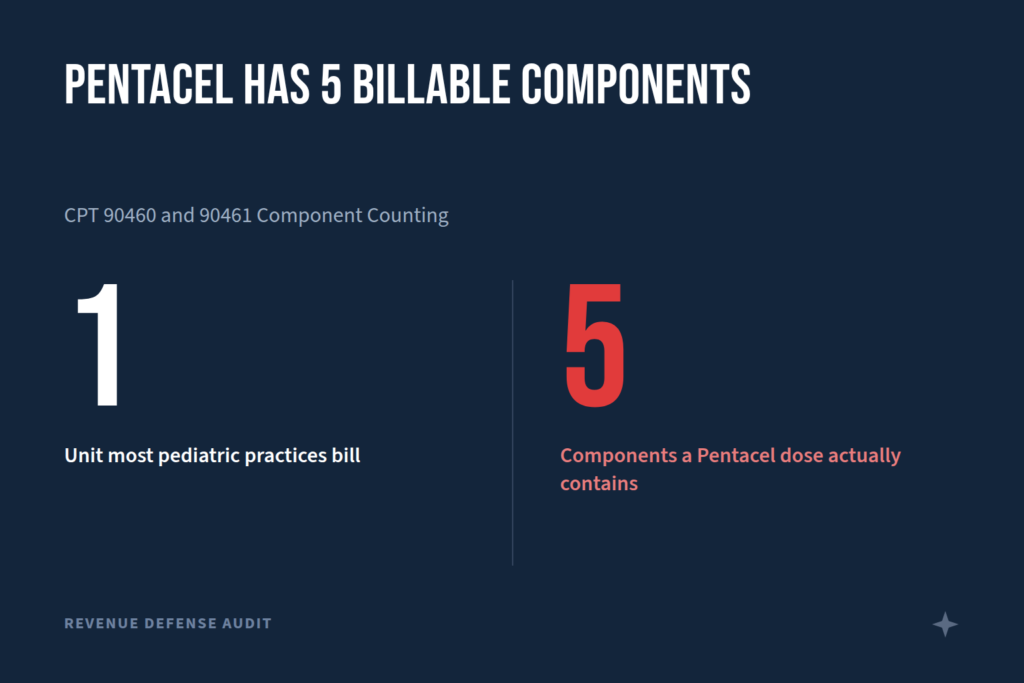
Short answer: CPT 90460 pays for the first component of each vaccine when a physician or qualified professional gives face to face counseling on the same date, and add on code 90461 pays for every additional component. A component is each antigen that prevents disease from one organism, so a Pentacel or Pediarix dose bills as 90460 x1 plus 90461 x4.
Updated October 2026
CPT 90460 pays for the first component of a vaccine. Add on code 90461 pays for every component after that. Most pediatric practices bill 90460 once per vaccine given and stop, even when that vaccine carries three, four, or five separate antigens. Every component beyond the first is a real, payable unit of 90461, and a practice that never counts past one is losing paid revenue on a clean claim, visit after visit.
Pediatric practices administer combination vaccines constantly. DTaP, MMR, Pediarix, and Pentacel are standard entries on the ACIP childhood schedule, and each one bundles multiple antigens into a single injection. The coding rule for that bundle is specific: bill once for the first component, then add a unit of 90461 for every component after it. In practice, front desk and billing staff frequently treat “one vaccine administered” as “one unit of 90460” and never check how many antigens the product they just gave actually contains.
This is not a denial. The claim goes out clean, the payer pays it, and nothing in an aging report or a denial log ever flags the missing units. That is exactly what makes it dangerous. An eight minute rule violation in physical therapy or a Modifier 25 documentation gap in primary care eventually shows up as a rejected claim. Undercounted vaccine components never do. The practice simply collects less than the product it administered was worth, on every combination vaccine, every day, indefinitely.
What actually counts as a component under 90460 and 90461
CPT defines a component as each antigen in a vaccine that prevents disease caused by one organism. Multivalent antigens or multiple serotypes targeting a single organism still count as one component. A thirteen valent pneumococcal conjugate vaccine is one component, not thirteen, because every strain it covers comes from the same organism. The count that matters is organisms targeted, not antigen subtypes or serotypes within a single organism.
Report 90460 once for the first component of each vaccine administered, with physician or qualified health care professional counseling furnished face to face to the patient or caregiver on the same date of service. Report 90461 once for every additional component in that same vaccine, with no modifier 51 required. When a practice gives more than one vaccine at the same visit, 90460 is billed with a unit for each vaccine’s first component, and some clearinghouses will reject repeated 90460 line items as duplicates. The fix is to report 90460 with the correct unit count on a single line rather than multiple identical lines.
| Components | Common vaccines | Correct administration coding |
|---|---|---|
| 1 | HPV, influenza, meningococcal, pneumococcal (PCV), rotavirus, IPV, Hib (standalone) | 90460 x1 |
| 2 | Td, Hib-HepB combination | 90460 x1, 90461 x1 |
| 3 | DTaP, MMR | 90460 x1, 90461 x2 |
| 5 | Pentacel (DTaP-IPV/Hib), Pediarix (DTaP-HepB-IPV) | 90460 x1, 90461 x4 |
A well visit where a toddler receives Pentacel, PCV, and a rotavirus dose is not three units of 90460. It is one unit of 90460 for Pentacel’s first component, four units of 90461 for Pentacel’s remaining components, one more unit of 90460 for the PCV first component, and one more unit of 90460 for the rotavirus first component. Six billable administration units total. Practices coding by habit instead of by product typically bill three.
What one undercounted vaccine costs a 3 to 5 provider pediatric practice
Administration payments for 90460 and its components commonly range from roughly 20 to 40 dollars per unit depending on the payer and the underlying fee schedule. At those rates, a single dose of Pentacel or Pediarix billed as one unit instead of five leaves four components, meaning roughly 80 to 160 dollars, sitting unclaimed on a claim that already paid clean.
A pediatric practice giving combination vaccines at even a handful of well visits a day is not losing that once. It is losing it on every combination dose, every day the pattern goes uncorrected. None of it appears as a denial, a write off, or a variance anyone is tracking, because the claim was never wrong from the payer’s perspective. It was simply billed for less than the product actually contained.
The objection nobody raises: your payers do not all count the same way
The CPT and AAP rule described above is the national standard, and most commercial payers and Medicaid programs follow it. Not all of them do. MassHealth’s own physician bulletin on pediatric immunization administration codes states plainly that it reimburses on a per vaccine basis, not on a per antigen or per component basis, and that billing 90461 on top of a combination vaccine under that policy will be paid at zero value.
That is a direct, written contradiction of the CPT component rule, from a state Medicaid program covering a population where it matters most. Roughly half of children in the United States are covered by Medicaid or CHIP, and Medicaid billing rules are set state by state, not nationally. A billing process built entirely around the CPT default will overbill and get flagged in a state that pays per vaccine, and a process built entirely around one state’s per vaccine rule will undercount everywhere else. Getting this right requires knowing which rule the payer in front of you is actually running, not applying one rule everywhere and hoping it holds.
Find out what your component counting is costing you
A Revenue Defense Audit is a forensic review of your existing accounts receivable. For a pediatric practice, that means reconciling administration units billed against the actual antigen count of every combination vaccine given in a live claim sample, payer by payer, and showing you both what you overbilled and what you never claimed. Most practices are surprised by the second number.
How to defend every component before the claim goes out
Verify the component count against the product administered, not against what the front desk remembers billing last time. Pentacel is five components whether or not the person building the claim knows it.
Several clearinghouses auto reject a second identical 90460 line as a duplicate charge. Report repeated first components as units on one line instead of stacking separate line items.
The counseling itself has to be face to face, on the same date of service, and delivered by a physician or other qualified health care professional. If clinical staff without that qualification did the counseling, or if it happened on a different date than the administration, the claim reverts to the non counseling codes 90471 through 90474.
Keep a payer specific record of which of your contracts pay per component and which, like MassHealth, pay per vaccine regardless of antigen count. Do not assume the CPT default holds everywhere.
Reconcile administration units billed against vaccines actually given, before the claim goes out. That single check catches both the overbilled duplicate line and the undercounted combination product. Most practices skip it, because it means someone has to physically match the product to the code.
How WeBill Health defends pediatric vaccine revenue
WeBill Health maintains internal payer rule libraries organized by specialty and by carrier, spanning more than 500 payer rulesets. Those libraries are built and updated by people who work claims in your specialty every day, and every claim receives human pre submission review against them before it goes out. There is no black box and no algorithm we ask you to take on faith. When a state Medicaid program changes how it pays for a combination vaccine, an expert updates the library and applies it to your claims.
For a pediatric practice that means the reviewer checking your claim knows that Pentacel is five components and PCV is one, knows which of your payer contracts pay per component and which pay per vaccine, and knows that a duplicate 90460 line will bounce before it ever reaches the payer. Our providers operate on a 98% clean claim rate, a 48 hour submission guarantee, and a 40% reduction in accounts receivable within 90 days, because every claim we touch is coded and documented to hold up under audit from the day it is submitted, not the day a reviewer decides to look.
Practices working with WeBill Health see an average 25% increase in collections within six months, driven by specialty specific coding and reduced days in accounts receivable, not by a change in how many patients walk through the door.
See where your practice is exposed
Get your Revenue Defense Score. See exactly how exposed your practice is to denials, undercoding, and credentialing gaps, specialty by specialty, before a payer’s per vaccine policy finds the gap for you.
Frequently asked questions
What is the difference between CPT 90460 and 90461?
90460 is billed once for the first component of each vaccine administered with physician or qualified health care professional counseling. 90461 is the add on code billed for every additional component in that same vaccine, with no modifier 51 required.
How many components does DTaP have for billing purposes?
DTaP has three components, one each for diphtheria, tetanus, and pertussis, since each protects against disease caused by a different organism. It bills as 90460 for the first component and two units of 90461 for the remaining two.
MMR also has three components, and combination products such as Pentacel and Pediarix carry five each.
Do I bill 90460 once per visit or once per vaccine?
Once per vaccine’s first component, not once per visit. A visit where three separate vaccines are given includes three separate units of 90460, one for each vaccine’s first component, plus 90461 for any additional components within a combination product.
What happens if a nurse, not a physician, provides the counseling?
90460 and 90461 require counseling from a physician or other qualified health care professional, not clinical staff alone. If only a nurse or medical assistant delivered the counseling, the claim has to use the non counseling administration codes 90471 through 90474 instead.
Can adults be billed under 90460 and 90461?
No. These codes apply only to patients from birth through 18 years of age. Vaccine administration for patients 19 and older is reported under 90471 through 90474 regardless of whether counseling occurred.
Does every payer pay per component?
No. The CPT default is per component, and most commercial payers and Medicaid programs follow it, but some state Medicaid programs pay per vaccine instead. MassHealth’s own policy states that 90461 billed on top of a combination vaccine is paid at zero value under its per vaccine reimbursement rule. Practices need payer specific logic, not one rule applied everywhere.
Sources
- Coding for Vaccine Administration, American Academy of Family Physicians
- Frequently Asked Questions for the Pediatric Immunization Administration Codes, American Academy of Pediatrics
- Physician Bulletin 90, Pediatric Immunization Administration Codes, MassHealth
- ABCs of Coding Vaccine Administration, Physicians Practice
- Fundamentals of Coding Vaccine Administration, Outsource Strategies International
- Strategic Improvements in Your RCM to Reduce Your Practice’s Claim Denials, Medical Group Management Association