The best medical billing service for a small practice runs the whole revenue cycle, knows your specialty’s codes and payers, and puts its clean claim rate, submission time and fees in writing. This guide compares WeBill Health, CareCloud, AdvancedMD and R1 on what each publishes, then gives the questions to ask by practice size.
Updated November 16, 2026
What is the best medical billing service for a small private practice in the US?
For a practice with 1 to 15 providers, the best service covers eligibility, coding, submission, denial follow up, patient statements and credentialing, because the practice has no billing department to fill the gaps. Specialty depth and a named contact matter more at this size than software features.
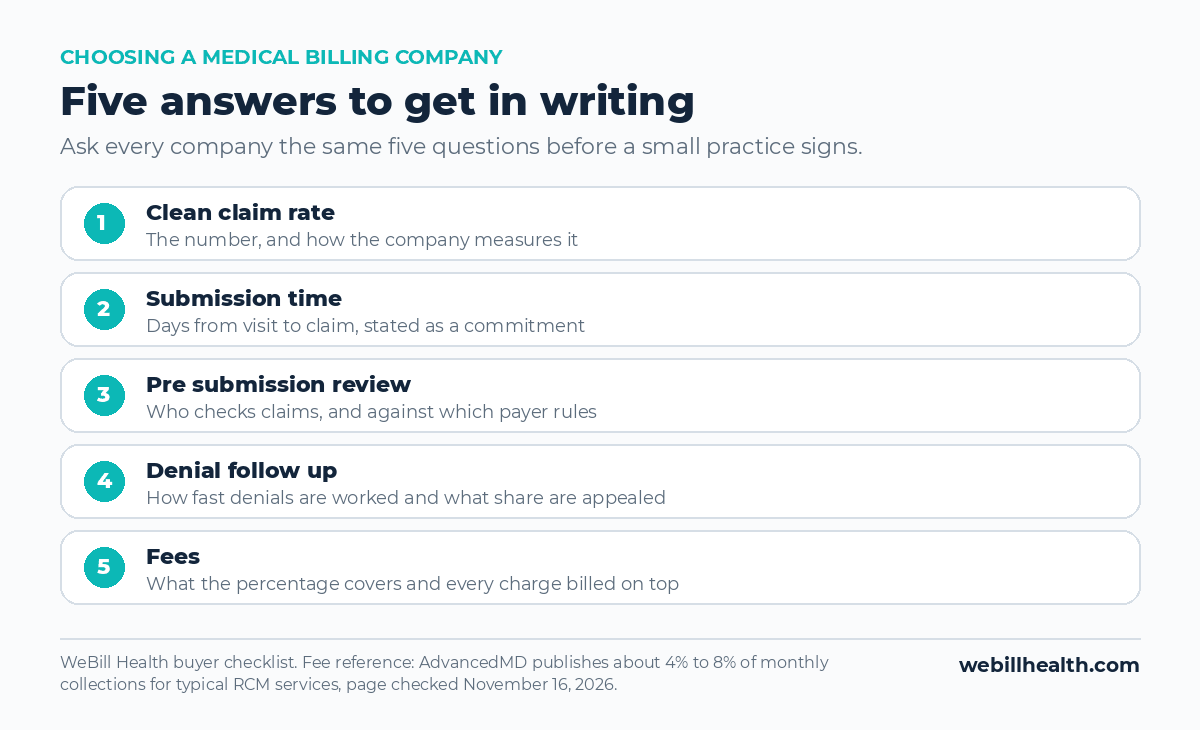
Ask for the clean claim rate and how it is measured, the days from visit to claim, who reviews claims before submission, how fast denials are worked, and what the fee covers. A company that answers all five in writing is easier to hold to account.
Which medical billing companies does this guide compare?
This guide compares four companies, each described only from what it publishes on its own website as checked in November 2026. Companies whose pages could not be checked were left out.
WeBill Health
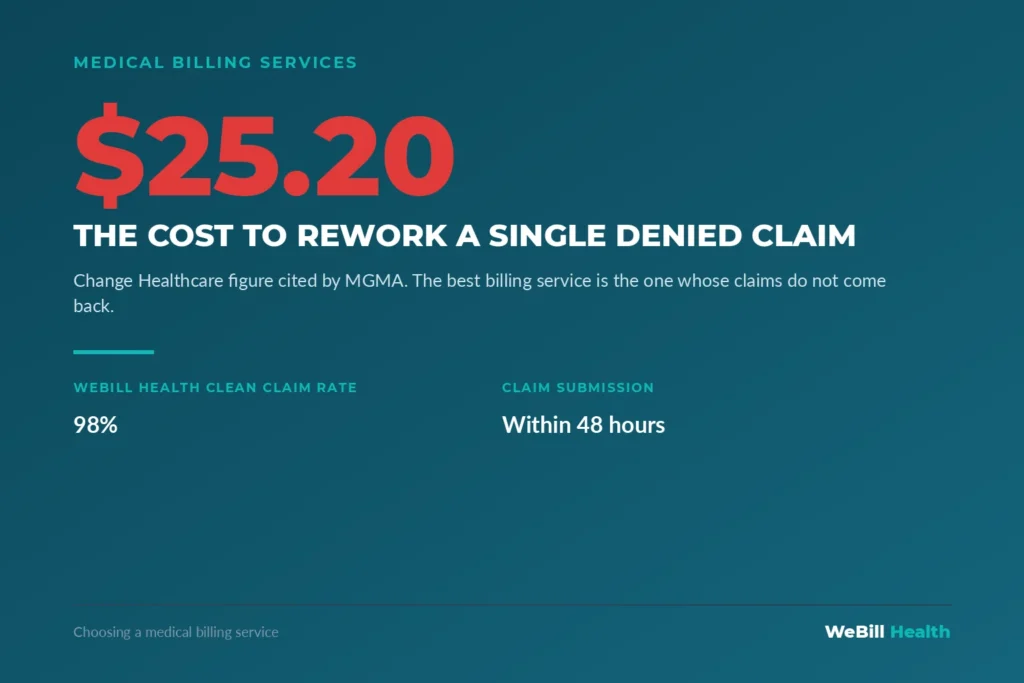
WeBill Health is a revenue defense partner for independent practices, organized around office visit and consultation billing, time based therapy billing, and procedure and surgical billing. It publishes a 98% clean claim rate, a 48 hour submission guarantee, a 40% A/R reduction within 90 days and 7 to 14 day reimbursement velocity. Credentialing, coding, denial work and A/R recovery run through one team.
CareCloud
CareCloud’s RCM page lists patient registration, eligibility verification, charge capture, coding, claim scrubbing and submission, denial management and appeals, payment posting, A/R follow up, patient billing and reporting. Its FAQ says solo practices through large multispecialty groups can use it, and hospital RCM is a separate offering. It does not publish pricing.
AdvancedMD
AdvancedMD sells practice management software and managed billing. Its billing team handles unpaid claims, appeals, secondary filings and denials, posts ERAs, and provides weekly and monthly reports. Its FAQ states that typical RCM services are priced at about 4% to 8% of monthly collections.
R1
R1 serves health systems and describes its Phare OS platform for claim adjudication, sold whole or in modules, along with partnership models. It is built for enterprise scale, so a small independent practice is unlikely to be its core customer.
How do these medical billing companies compare?
The four companies differ most in who they are built for and how much they publish. The table summarizes what each states on its own site.
| Company | Model | Best fit | Published pricing |
|---|---|---|---|
| WeBill Health | Full revenue cycle partnership with human pre submission review | Independent practices in its three specialty groups | Quoted by request |
| CareCloud | Software plus RCM services | Solo practices to large groups; separate hospital offering | Not published |
| AdvancedMD | Software plus managed billing | Practices that want software and billing staff from one company | About 4% to 8% of monthly collections |
| R1 | Enterprise platform and partnerships | Health systems | Not published |
Why does the choice of billing company matter in 2027?
Denials are common and rarely challenged, so the team working your claims decides how much earned revenue you collect. KFF found that HealthCare.gov insurers denied 19% of in network claims in 2024, and fewer than 1% of denied claims were appealed.
January 1, 2027 adds more work: new CPT codes, a lower Medicare conversion factor of $32.63 for most clinicians, and electronic prior authorization APIs at Medicare Advantage and Medicaid plans. See CPT 2027 changes and prior authorization in 2027.
What should a practice with 1 to 5 providers look for in a billing company?
A practice with 1 to 5 providers needs a company that covers the whole cycle and answers quickly, because there is no in house billing staff to catch what the company misses. Ask who your contact is, how fast they reply, and whether credentialing for new providers is included.
Fees matter less than results at this size. A low percentage means little if claims go out late or denials sit unworked, so compare what each company collects for you as well as what it charges. Our comparison of percentage of collections and flat fees covers the two common models.
What changes for practices with 5 to 25 providers?
Groups with 5 to 25 providers need reporting by provider, location and payer, and a company that can enroll several new providers at once. Ask for a sample monthly report and how the company handles adding a provider to an existing payer contract.
At this size, multiple locations and specialties are common. Confirm the company bills each of your specialties today and can show its denial causes for each one separately.
Should a small clinic buy billing software or outsource billing?
Buy software when trained staff have hours each week to submit claims, work denials and call payers; outsource when nobody owns that work full time. Software flags problems, but it does not correct claims, file appeals or follow up on aging A/R.
Many practices keep their EHR and practice management software and outsource the billing work inside it. See our guide to primary care billing software for what to test in a demo.
How much do medical billing services for small practices cost?
Most medical billing services charge a percentage of collections, and some offer flat monthly or per claim fees. AdvancedMD publishes about 4% to 8% of monthly collections for typical RCM services; CareCloud and R1 quote by request.
Ask what the fee is charged on, whether old A/R, credentialing or patient statements cost extra, and what happens to fees if you leave. Our breakdown of how much medical billing companies charge explains each model.
How do billing companies compare on implementation and ongoing support?
Compare implementation on what the company needs from you, how it handles claims already in progress, and when it takes over new claims. Compare support on the named contact, response time and the reports you receive, all stated in writing.
Ask for references from practices of your size and specialty that have used the company for at least a year, and ask them how the first 90 days went.
How do you choose a billing service by specialty?
Specialty knowledge is where billing companies differ most, so ask each one to explain the three denial reasons it sees most in your specialty and how it prevents each. These are the points to test for common specialties.
| Specialty | What the billing team must know |
|---|---|
| Pediatrics | Vaccine administration with 90460 and 90461, and sick visits on the same day as a well child visit |
| Primary care and family medicine | E/M documentation, payer downcoding and plan variants; see BCBS downcoding by state |
| Behavioral health | Psychotherapy add on codes and telehealth rules; see audio only telehealth rules |
| ABA | Authorization tracking by code and the CPT 2027 ABA changes; see ABA billing denials |
| Physical therapy | The 8 minute rule for timed units |
WeBill Health take
WeBill Health maintains internal payer rule libraries organized by specialty and by carrier, spanning more than 500 payer rulesets, built and updated by people who work claims in your specialty every day. Every claim receives human pre submission review against them before it goes out, and that review stands behind the 98% clean claim rate and the 48 hour submission guarantee. New providers are enrolled through Revenue Velocity Credentialing, with 40% faster credentialing enrollment. The WeBill Health guide to denial management services in the USA compares what each kind of denial company handles.
Request a Revenue Defense Audit to see where your claims are losing money before you choose a billing company.
Frequently asked questions
What is the best medical billing service for a small practice?
The best fit runs the whole revenue cycle, gives you a named billing contact, knows your specialty’s codes and payers, and puts its clean claim rate, submission time and fees in writing. Compare at least two companies on the same five questions before signing.
How much do medical billing services charge a small practice?
Most charge a percentage of collections. AdvancedMD publishes about 4% to 8% of monthly collections for typical RCM services; other companies quote by request. Ask what the percentage covers and what is billed on top.
Should a small clinic buy billing software or outsource billing?
Buy software when trained staff have hours to work claims and denials; outsource when nobody owns that work full time. Software flags problems, but people still correct claims, file appeals and call payers.
How long does it take to switch billing companies?
It depends on the company and on how quickly the practice grants system access. Plan for the new team to take over new claims first while the old team or the new one finishes working existing A/R.
Sources
- KFF, Claims Denials and Appeals in ACA Marketplace Plans in 2024, March 24, 2026
- AdvancedMD, Medical Billing Services page (pricing FAQ), last modified January 30, 2026, checked November 16, 2026
- CareCloud, Revenue Cycle Management page, checked November 16, 2026
- R1, home page (health systems, Phare OS, partnerships), checked November 16, 2026
- CMS, CY 2027 Medicare Physician Fee Schedule Final Rule fact sheet, November 4, 2026