Short answer: The orthopedic billing mistakes that cost practices the most are office visits billed with modifier 25 on injection days without a separate problem, visits billed inside the 90 day global period without modifier 24, decision for surgery visits billed without modifier 57, missing or wrong laterality modifiers, and selected spine and knee procedures performed without the prior authorization Medicare now requires in six states. Each one can be caught before the claim goes out.
Updated November 2026. Orthopedic surgery is one of the specialties hit hardest by the 2027 Medicare physician fee schedule, mainly because of a new 20% cut to office visits billed with modifier 25 on the same day as a minor procedure. Getting the modifiers right now protects both this year’s claims and next year’s payments.
The 5 orthopedic billing mistakes that cost practices the most
Five mistakes cause most orthopedic billing losses, and each one turns on a modifier, a global period or an authorization that the claim did not show.
1. Modifier 25 on injection days without a separate problem
A joint injection such as 20610 has a 0 day global period, so the evaluation that leads to it is part of the procedure. A separate office visit with modifier 25 is supported only when the note shows a significant, separately identifiable problem. From January 1, 2027, Medicare pays 20% less for the lower paid service when a visit with modifier 25 is billed with a 0 day global procedure on the same day. CMS had proposed 50% and finalized 20%. Billing modifier 25 on every injection visit now costs money twice: in audits and in the payment itself.
2. Visits billed inside the 90 day global period
Major orthopedic surgery carries a 90 day global period, and routine follow up visits in that window are included in the surgical payment. Those visits are reported with 99024 so the practice can track them. A visit for an unrelated problem is billable only with modifier 24 and a diagnosis that shows it has nothing to do with the surgery. A follow up visit billed as a regular office visit denies, and a pattern of them draws review.
3. Decision for surgery visits billed without modifier 57
The visit where the surgeon decides to perform a major surgery is payable when it happens on the day before or the day of surgery, but only with modifier 57. Without it, the visit falls inside the global package and is not paid. Modifier 57 is not used for minor procedures; the 2026 NCCI policy manual points those cases to modifier 25 instead.
4. Missing or wrong laterality
Orthopedic claims depend on the side of the body: RT and LT for one side, 50 for a bilateral procedure where the code allows it. A missing modifier, a side that does not match the note or imaging, or two lines billed for a bilateral procedure leads to denials and duplicate claim edits. Laterality also matters for the ICD 10 code, which must name the same side.
5. Spine and knee procedures without WISeR prior authorization
Since January 2026, Medicare’s WISeR model has required prior authorization or prepayment review for selected services in Arizona, New Jersey, Ohio, Oklahoma, Texas and Washington. The orthopedic and spine services on the list include knee arthroscopy for osteoarthritis, cervical fusion, epidural steroid injections and vertebral augmentation. A practice in those states that schedules the procedure without the authorization faces prepayment review and slower payment.
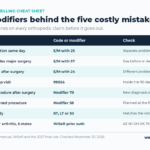
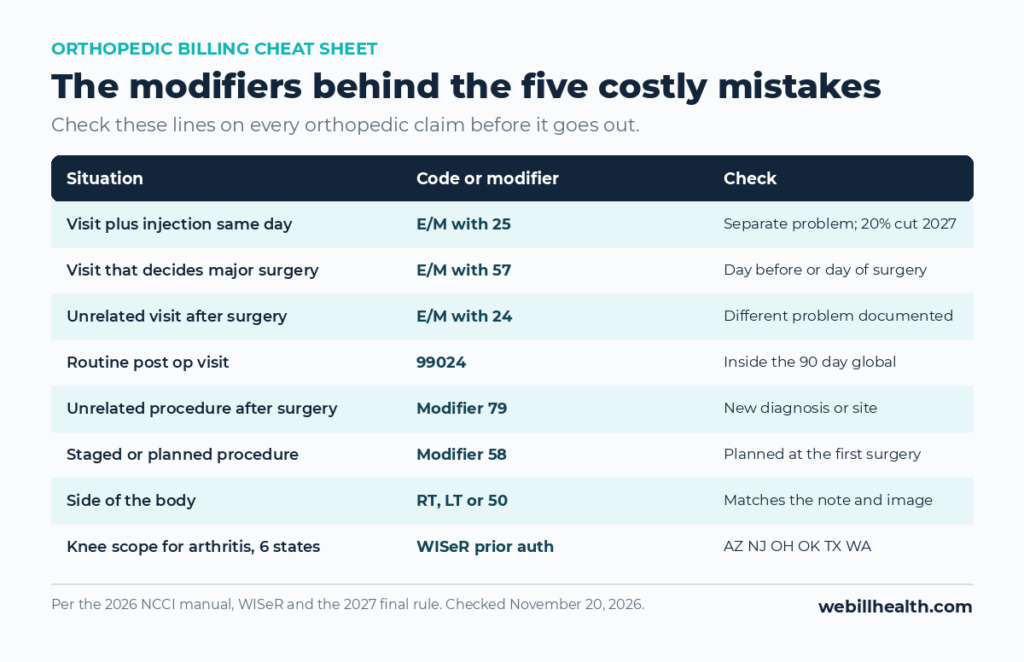
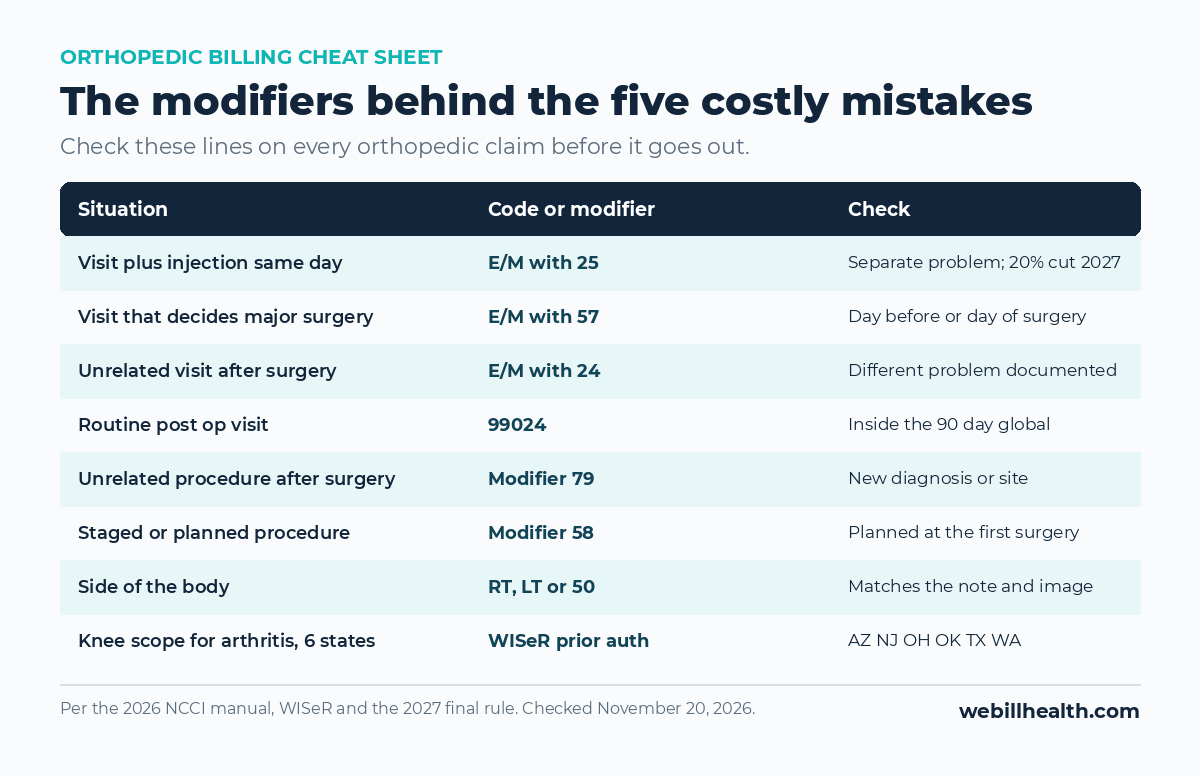
Orthopedic billing cheat sheet: the modifiers to check on every claim
These are the codes and modifiers to check on every orthopedic claim, because each one sits behind at least one of the five mistakes above.
| Situation | Code or modifier | What to check |
|---|---|---|
| Office visit and injection on the same day | E/M with modifier 25 | A separate problem is documented; 20% cut from 2027 |
| Visit that decides a major surgery | E/M with modifier 57 | Day before or day of surgery |
| Unrelated visit after surgery | E/M with modifier 24 | A different problem is documented |
| Routine post operative visit | 99024 | Inside the 90 day global period |
| Unrelated procedure after surgery | Modifier 79 | New diagnosis or anatomic site |
| Staged or planned procedure | Modifier 58 | Planned at the time of the first surgery |
| Side of the body | RT, LT or 50 | Matches the note, imaging and ICD 10 code |
| Knee arthroscopy for arthritis in 6 states | WISeR prior authorization | AZ, NJ, OH, OK, TX or WA |
What changes for orthopedic billing in 2027?
The biggest 2027 change for orthopedic billing is the 20% payment cut for an office visit billed with modifier 25 on the same day as a 0 day global procedure, finalized in the CY 2027 Medicare physician fee schedule released November 4, 2026. The same rule lowers the conversion factor for most physicians by 2.31% to $32.6286. See the CMS modifier 25 payment cut for 2027 and the 2027 physician fee schedule final rule.
What is included in the orthopedic global surgery period?
The global surgery period for a major orthopedic procedure covers the day before surgery, the day of surgery and 90 days after, including routine follow up visits and treatment of complications that do not require a return to the operating room. Minor procedures carry a 0 or 10 day period that covers only the procedure day, or the procedure day and the 10 days after.
Which orthopedic billing codes matter most?
The orthopedic billing codes that matter most are the office visit codes, joint injection codes such as 20610 and 20611, and the surgical codes with their global periods. Alongside them, 99024 tracks post operative visits, and the modifiers 24, 25, 57, 58, 79, RT, LT and 50 decide whether each line is paid.
Why are orthopedic claims denied so often?
Orthopedic claims are denied often because many visits and procedures happen inside a global period, and the claim must use the right modifier to show which services are separate. Bundling edits add a second layer: see why orthopedic surgery claims deny for bundled procedures.
How to catch orthopedic billing mistakes before the claim goes out
Catch orthopedic billing mistakes with a short review of each claim before it goes out, focused on the five patterns above.
- Check that every modifier 25 visit documents a separate problem from the procedure.
- Check each visit date against open global periods, and use 24, 57 or 99024 as the visit requires.
- Check RT, LT or 50 against the note, the imaging and the ICD 10 code.
- Check WISeR authorization for listed procedures in the six states.
- Check bundling edits before billing more than one procedure on the same day.
The WeBill Health take
Orthopedic practices lose the most money on claims where the clinical work was right and the modifier was wrong. WeBill Health keeps internal payer rule libraries organized by specialty and by carrier, covering more than 500 payer rulesets, and every claim receives human pre submission review against them before it goes out. That review supports a 98% clean claim rate and a 48 hour submission guarantee. Orthopedics sits in WeBill Health’s Procedure and Surgical billing group; see orthopedic billing at WeBill Health.
Want to see which of these five mistakes your claims carry? Request your Revenue Defense Audit and we will show you your denials by payer, code and reason.
Frequently asked questions
How much will Medicare cut a same day visit billed with modifier 25 in 2027?
From January 1, 2027, Medicare pays 20% less for the lower paid service when an office visit billed with modifier 25 happens on the same day as a procedure with a 0 day global period, such as a joint injection. CMS had proposed 50% and finalized 20%.
When do you use modifier 57 instead of modifier 25?
Use 57 on the visit where the decision for a major surgery with a 90 day global period is made, on the day before or the day of surgery. Use 25 for a separate problem on the same day as a minor procedure with a 0 or 10 day global period.
Can you bill a visit during the 90 day global period?
Only when the visit is for a problem unrelated to the surgery, billed with modifier 24 and a diagnosis that shows the difference. Routine follow up visits are included in the surgical payment and are reported with 99024 for tracking.
Which orthopedic procedures need Medicare prior authorization in 2026?
In Arizona, New Jersey, Ohio, Oklahoma, Texas and Washington, the WISeR model requires prior authorization or prepayment review for selected services including knee arthroscopy for osteoarthritis, cervical fusion, epidural steroid injections and vertebral augmentation.
Sources
- Holland & Knight, CMS issues CY 2027 Medicare physician fee schedule final rule, November 13, 2026
- Medical Economics, final 2027 fee schedule softens the same day visit penalty, November 4, 2026
- CMS, NCCI Policy Manual for Medicare Services, Chapter 12, revision January 1, 2026
- Congressional Research Service, Overview of the Medicare WISeR model, updated May 12, 2026