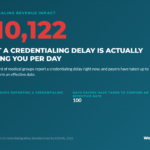

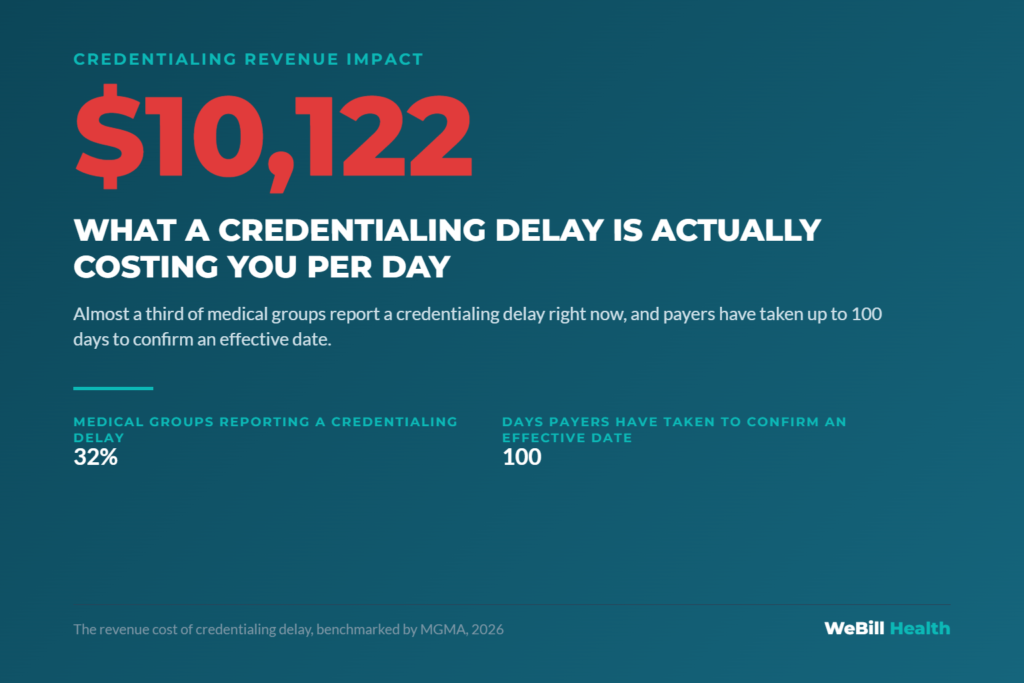
A one day delay in credentialing a new provider costs a medical group roughly 10,122 dollars in lost billing capacity, according to the survey MGMA still cites as the industry benchmark. Almost a third of medical groups now report some form of credentialing delay, and payers have historically taken up to 100 days to confirm an effective date once an application is filed. None of that revenue comes back once the delay is over. It is simply gone.
A newly hired provider or a newly opened location can see patients from day one. They cannot bill most payers until credentialing clears, and rent, payroll, and overhead do not pause while that paperwork sits in a queue. The gap between a provider’s start date and their effective billing date is where practices quietly lose the most predictable revenue in the entire revenue cycle, and almost nobody puts a number on it until it is already a problem.
What follows is that number, sourced to MGMA’s own credentialing survey data, so you can see exactly what a delay is costing your practice before deciding how much urgency it deserves.
What a credentialing delay actually looks like in 2026
MGMA’s most recent credentialing poll, run in November 2025, found 65 percent of medical groups report provider files moving on time. The other 32 percent report some form of delay: 23 percent describe an active backlog, 3 percent point to credentialing verification organization delays, and 6 percent expect completion sometime in the first quarter. Practices that reported delays pointed to the same handful of causes every time, payer enrollment delays, slow references and board verifications, thin staffing, and slow turnarounds from third party vendors.
MGMA also flags October through December as the sharpest crunch period, when plan year deductibles reset and holiday staffing thins out right as enrollment volume peaks. As MGMA put it, lost provider capacity during that window is unrecoverable revenue, not a delay that evens out later.
The calculator: what your delay actually costs
The 10,122 dollar per day figure comes from a Merritt Hawkins survey MGMA has cited as the standard benchmark for onboarding delay cost since 2021, and it still circulates as the reference number in credentialing discussions today. It is a national average across specialties, not a number specific to your payer mix or your market, which is exactly why it is a starting point rather than your actual figure.
| Days delayed | Illustrative cost at 10,122 dollars a day |
|---|---|
| 30 days | About 303,660 dollars |
| 60 days | About 607,320 dollars |
| 90 days | About 910,980 dollars |
| 100 days, the upper end payers have historically taken to confirm an effective date | About 1,012,200 dollars |
Nobody eats the full ninety or hundred day figure in practice, since some services can be billed retroactively once an effective date is confirmed and some payers move faster than others. The table exists to show the shape of the exposure. A delay measured in weeks becomes a specific dollar amount walking out the door on a schedule nobody is tracking.
See where your own number lands. Get your Revenue Defense Score, six questions and sixty seconds for a benchmarked read on your credentialing and enrollment exposure, specific to your specialty instead of the blended national average above.
Why credentialing delays keep happening
Almost none of the delay MGMA’s respondents describe originates with a single dramatic failure. It is a payer sitting on an application longer than expected, a reference that takes three follow up calls to return, a board verification queued behind hundreds of others, or a credentialing file handed to a third party vendor who is juggling dozens of practices at once with no dedicated point of contact for yours. Each cause is individually survivable. Stacked together across CAQH attestation, PECOS enrollment, and a half dozen commercial payer applications running in parallel, they add weeks that nobody notices until a provider has been seeing patients for two months without a single claim clearing.
Working harder on the same manual process does not fix that math. Removing the parts of that process that depend on a payer, a reference, or a vendor happening to move quickly this week instead of next month does.
How WeBill Health closes the credentialing gap
Revenue Velocity Credentialing runs 24 hours a day, 7 days a week across your CAQH attestation and PECOS enrollment lifecycle, so nothing sits waiting for a business day to start moving again. Practices working with WeBill Health see credentialing enrollment complete up to 40 percent faster than the industry pace MGMA’s survey data describes, which is the difference between a new provider generating revenue in weeks instead of months.
Credentialing is also where a new client relationship with WeBill Health typically starts. Getting a provider live faster is the first proof point before a practice ever hands over its full revenue cycle, and it is deliberately built that way.
Frequently asked questions
How much does a credentialing delay actually cost a medical practice?
Using the Merritt Hawkins benchmark MGMA cites, a one day credentialing delay costs a medical group roughly 10,122 dollars in lost billing capacity. A 90 day delay against that same benchmark runs close to 911,000 dollars, though the exact figure depends on specialty and payer mix.
How long does provider credentialing typically take in 2026?
MGMA’s November 2025 survey found 65 percent of medical groups report provider files moving on time, while 32 percent report some form of delay. Payers have historically taken up to 100 days to confirm an effective date once an application is submitted, though timelines vary by payer and specialty.
What actually causes most credentialing delays?
MGMA’s respondents point to payer enrollment delays, slow references and board verifications, thin or disorganized staffing, and slow turnarounds from third party credentialing vendors, compounded by an October through December crunch season when enrollment volume peaks alongside holiday staffing shortages.
Can a practice bill retroactively once credentialing clears?
Some payers allow retroactive billing back to a confirmed effective date, which softens the impact of the delay tables above. Retroactive billing rules vary significantly by payer, which is part of why a practice specific benchmark matters more than the national average.
Does a faster CAQH attestation actually speed up enrollment?
Yes. CAQH attestation delays are a common bottleneck before a payer application can even be reviewed. Continuous monitoring of the attestation cycle removes one of the most common self inflicted causes of delay before it ever reaches the payer’s side of the process.
What is the fastest way to reduce credentialing delay at my practice?
Remove the steps that depend on a payer, reference, or vendor moving quickly on their own schedule. Continuous CAQH and PECOS lifecycle management, rather than periodic manual status checks, is what closes most of the gap MGMA’s survey data describes.
Find out what your credentialing exposure actually is
The national numbers above are a starting point. Your specialty, your payer mix, and your current credentialing pipeline are not.
Request your Revenue Defense Score. Six questions, sixty seconds, and a specialty benchmarked read on where credentialing and enrollment delay is actually costing your practice revenue right now.
Prefer to talk it through? Book a 30 minute call with a US based billing manager who works your specialty.
Sources
- Confronting credentialing, reappointment crunch time in your medical practice, MGMA Stat, November 2025
- More than half of practices report credentialing-related denials on the rise in 2021, MGMA Stat, citing a Merritt Hawkins provider onboarding delay survey
- Revenue Velocity Credentialing, WeBill Health
- Revenue Defense Score, WeBill Health