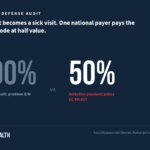


If you bill an office visit on the same day you perform a minor procedure, CMS is proposing to pay one of them at 50 percent. Not the denial you can appeal. Not the modifier you can correct. A structural cut written into the CY 2027 Physician Fee Schedule proposed rule, released July 14, 2026.
Here is the mechanic. When a separately identifiable office or outpatient E/M visit is furnished by the same physician, or a physician in the same group practice, on the same day as a 0 day, 10 day, or 90 day global procedure, the most expensive service gets paid at 100 percent. Everything else that day gets paid at 50 percent. That is Modifier 25 revenue, cut in half, by rule rather than by review.
This lands on two of our specialty clusters at once. Modifier 25 denials are already the single largest revenue threat in primary care and family health. Global surgical period miscoding is already the quiet leak in orthopedics, podiatry, pain management, and physiatry. CMS just proposed to make both of them worse at the same time, and it applies whether your documentation is flawless or not.
Now the part almost nobody is connecting
CMS justifies the cut by arguing there are efficiencies when one physician performs both services, and that current methodology is “likely duplicating payment.” But in the same proposed rule, in the practice expense section, CMS describes the very data underpinning that methodology as “resource intensive but ultimately unreliable surveys with low response rates,” and commits to a multi year effort to replace it.
Read those two positions together. CMS is claiming it can detect payment duplication inside a cost methodology it concurrently calls unreliable enough to dismantle. Either the practice expense data is precise enough to prove duplication, in which case the overhaul is unnecessary, or it is not, in which case a 50 percent cut is resting on numbers CMS already disowns. Both cannot be true.
The AAFP made the underlying argument in 2018, when Blue Cross Blue Shield of Rhode Island tried the identical 50 percent policy. Their position was that the resource based relative value scale already accounts for redundancy when a minor procedure happens during an E/M encounter. Cutting 50 percent on top of that does not correct double payment. It creates double counting in the other direction.
The pattern worth naming
CMS proposed something structurally similar in 2019 and did not finalize it. The AMA has confirmed it will oppose this version. In the same 2027 rule, CMS proposed barring payment for remote monitoring delivered by contracted clinical staff, a response to OIG findings that flagged 45 outlier practices out of more than 4,600 that billed RPM in 2024. In both cases CMS reached for a blanket structural rule where targeted enforcement against identified outliers was available. The AAFP asked BCBSRI to find the outliers instead of penalizing every physician in the market. That request is eight years old and still unanswered.
What this means for your practice right now
Do not wait for the comment period to close on September 14 to find out what your exposure is. Two reasons.
First, commercial payers do not need CMS to act. BCBSRI implemented this in 2018. Anthem announced then withdrew a version of it. Every payer watching this proposed rule now has federal cover to revisit the policy regardless of what CMS finalizes.
Second, and more immediate, the scrutiny arrives before the rule does. When a payment policy this visible is on the table, Modifier 25 documentation becomes an audit target in the interim. Practices that cannot demonstrate a significant, separately identifiable service on the same day are not facing a rate cut. They are facing recoupment.
WeBill Health does not wait for a final rule to defend your revenue. WeBill Health maintains internal payer rule libraries spanning more than 500 payer rulesets, and every claim receives human pre submission review against them before submission, matched to your specialty’s actual exposure, whether that is Modifier 25 documentation thresholds in family medicine, global period sequencing in orthopedics, or the same day encounter logic that determines whether two services survive as two services. Our providers operate on a 98% clean claim rate, a 48 hour submission guarantee, and a 40% average A/R reduction, because every claim we touch is coded and documented to hold up under audit from the day it is submitted, not from the day the auditor arrives.
You do not need a final rule to tell you where you are exposed. You need the number today.
Two ways to get it
Get a Revenue Defense Audit. We run a forensic review of your existing A/R and surface the same day encounter leakage, global period miscoding, and Modifier 25 documentation gaps that nobody else is looking for.
Get your Revenue Defense Score. See exactly how exposed your practice is to denials, undercoding, and credentialing gaps, specialty by specialty, before the payers do the math for you.
Sources
- Calendar Year (CY) 2027 Medicare Physician Fee Schedule Proposed Rule, CMS Fact Sheet, July 14, 2026
- July 31, 2026 National Advocacy Update, American Medical Association
- AAFP Decries 50 Percent Cut for E/M Codes with Modifier 25, AAFP
- CMS proposed ban on contracted RPM staff should not survive the comment period, Medical Economics
- CMS Issues CY 2027 Medicare Physician Fee Schedule Proposed Rule, Holland & Knight