Short answer: The cardiology billing mistakes that cost practices the most are 2026 deleted codes still in the charge master, hospital based studies billed globally without modifier 26, stress tests billed whole when the work was split, echocardiograms billed with a diagnosis that does not meet the coverage policy, and imaging performed without the payer’s prior authorization. Each one can be caught before the claim goes out.
Updated November 2026. Cardiology claims carry high values, so a small coding error costs more per claim than in most specialties. The 2026 CPT update made that risk larger by rewriting the PCI and leg revascularization code families.
The 5 cardiology billing mistakes that cost practices the most
Five mistakes cause most cardiology billing losses, and each one turns a high value claim into a denial, an underpayment or a recoupment.
1. Deleted 2026 codes still in the charge master
The 2026 CPT update deleted the PCI branch add on codes 92921, 92925, 92929, 92934, 92938 and 92944, because the main codes now cover branches, and added 92930 for two or more lesions in one major coronary artery and 92945 for chronic total occlusion with combined approaches. It also deleted lower extremity revascularization codes 37220 to 37235 and replaced them with 46 new codes in the 37254 to 37299 range. A charge master or superbill that still carries the old codes produces claims that deny on arrival.
- Compare the charge master and procedure templates with the 2026 code set.
- Check that coronary plaque analysis now bills as 75577, which replaced Category III codes 0623T to 0626T.
2. Hospital studies billed without modifier 26
When a cardiologist reads an echocardiogram, stress test or nuclear study performed with hospital equipment and staff, the practice bills only the professional part with modifier 26. Billing the global code duplicates the hospital’s technical claim and either denies or creates an overpayment that is later recouped.
3. Stress tests billed whole when the work was split
93015 reports the complete stress test. When one provider supervises and another interprets, or the facility owns the equipment, each bills its own part: 93016 for supervision, 93017 for the tracing and 93018 for the interpretation and report. Billing 93015 in a split setting is a common cause of duplicate claim denials.
4. Echocardiograms that do not meet the coverage policy
Medicare contractors cover transthoracic echocardiography only for the conditions and frequencies in their local coverage determination. CGS updated its LCD L34338 effective October 8, 2026. A diagnosis that the policy does not list, or a repeat echo without a documented change in the patient’s condition, usually denies for medical necessity.
5. Imaging done without prior authorization
Many commercial and Medicare Advantage plans require prior authorization for nuclear imaging, cardiac CT and some echocardiograms, often through a radiology benefit manager. A study performed without the approval on file usually cannot be billed to the patient either. See prior authorization changes in 2027.
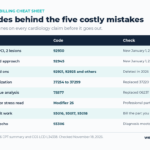
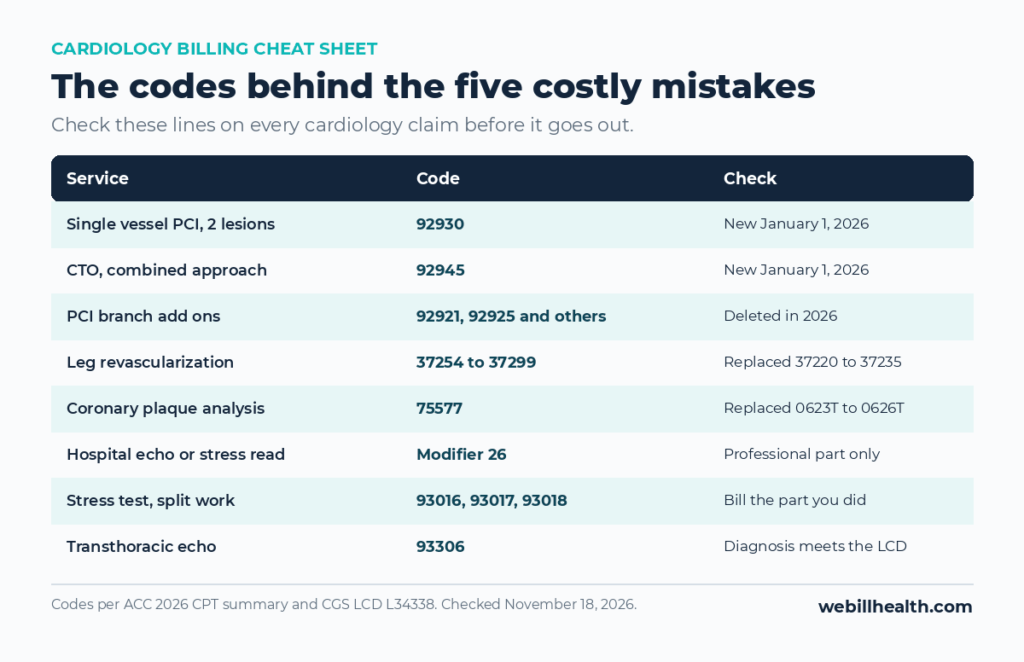
Cardiology billing cheat sheet: the codes to check on every claim
These are the codes to check on every cardiology claim, because each one sits behind at least one of the five mistakes above.
| Service | Code | What to check |
|---|---|---|
| PCI, two or more lesions in one major artery | 92930 | New January 1, 2026 |
| Chronic total occlusion, combined approach | 92945 | New January 1, 2026 |
| PCI branch add ons | 92921, 92925 and others | Deleted in 2026; remove from templates |
| Lower extremity revascularization | 37254 to 37299 | Replaced 37220 to 37235 |
| Coronary plaque analysis | 75577 | Replaced 0623T to 0626T |
| Hospital based echo or stress read | Modifier 26 | Professional part only |
| Stress test with split work | 93016, 93017, 93018 | Bill only the part you performed |
| Transthoracic echocardiogram | 93306 | The diagnosis meets the LCD |
What changed in cardiology billing in 2026?
The biggest 2026 changes in cardiology billing were the rewrite of PCI coding, with two new codes and six branch codes deleted, and the replacement of 16 leg revascularization codes with 46 new ones. The American College of Cardiology also notes new remote monitoring and interrogation codes for newer implanted devices, and a Category I code for coronary plaque analysis.
Which cardiology billing codes matter most?
The cardiology billing codes that matter most are the PCI and catheterization codes, echocardiography such as 93306, the stress test codes 93015 to 93018, nuclear imaging, device interrogation and remote monitoring codes, and the office visit codes. The professional and technical modifiers 26 and TC decide how much of each one the practice is paid.
Why are cardiology claims denied so often?
Cardiology claims are denied often because one claim can carry several high value codes, each with its own coverage policy, frequency limit and site of service rule, so a single missing modifier or diagnosis can stop the whole claim. Prior authorization rules for imaging add a second point of failure before the service is even performed.
How does Medicare pay cardiology in 2027?
Medicare pays cardiology professional services on the physician fee schedule, and the final 2027 schedule lowers the conversion factor 2.31% to $32.63 from January 1, 2027. Office visits billed with a procedure also face the new same day rule. See the 2027 physician fee schedule final rule and the CMS modifier 25 payment cut for 2027.
How to catch cardiology billing mistakes before the claim goes out
Catch cardiology billing mistakes with a short review of each claim before it goes out, focused on the five patterns above.
- Check every procedure code against the current year’s code set.
- Check where each study was performed and add modifier 26 or TC to match.
- Check that split stress tests bill only the component performed.
- Check echo diagnoses and dates against the contractor’s LCD.
- Check that a prior authorization number is on file for every imaging study that needs one.
The WeBill Health take
Cardiology practices lose the most money on claims that look correct to anyone who does not code cardiology every day. WeBill Health keeps internal payer rule libraries organized by specialty and by carrier, covering more than 500 payer rulesets, and every claim receives human pre submission review against them before it goes out. That review supports a 98% clean claim rate and a 48 hour submission guarantee. Cardiology sits in WeBill Health’s Procedure and Surgical billing group; see cardiology billing at WeBill Health.
Want to see which of these five mistakes your claims carry? Request your Revenue Defense Audit and we will show you your denials by payer, code and reason.
Frequently asked questions
Which cardiology codes were deleted in 2026?
The 2026 CPT update deleted the PCI branch add on codes 92921, 92925, 92929, 92934, 92938 and 92944, the coronary thrombolysis codes 92975 and 92977, and the lower extremity revascularization codes 37220 to 37235, which were replaced by 46 new codes in the 37254 to 37299 range.
When does a cardiologist bill modifier 26?
When the cardiologist reads a study but the hospital or another entity owns the equipment and staff, such as an echocardiogram or stress test performed in a hospital outpatient department. Modifier 26 reports the professional part only.
Can a stress test be billed in parts?
Yes. 93015 reports the whole test, while 93016, 93017 and 93018 report supervision, the tracing and the interpretation separately. Each provider bills only the part it performed.
Why are echocardiograms denied?
Most echo denials come from a diagnosis that does not meet the local coverage determination, a repeat study without a documented change in the patient’s condition, or a missing prior authorization from a commercial plan.