Short answer: The urgent care billing mistakes that cost clinics the most are the wrong place of service code, S9083 and S9088 billed the same way for every payer, procedures billed without modifier 25 on a separately supported visit, CLIA waived tests sent without modifier QW, and E/M levels that the note does not support. Each one can be caught before the claim goes out.
Updated November 2026. Urgent care billing loses money in small, repeated amounts: one claim with the wrong place of service, one test without its modifier, one visit coded a level higher than the note can defend. Across thousands of walk in visits a year, those small amounts add up.
The 5 urgent care billing mistakes that cost clinics the most
Five mistakes cause most of the urgent care billing losses we see, and each one leaves money denied, reduced or never billed for care the clinic already gave.
1. The wrong place of service code
CMS defines place of service 20, Urgent Care Facility, as a location distinct from a hospital emergency room, an office or a clinic, whose purpose is to diagnose and treat illness or injury for unscheduled, ambulatory patients seeking immediate medical attention. Most payers expect POS 20 from an urgent care center. Some contracts load the center as a physician office, and those payers can reject a POS 20 claim.
- Record the place of service each payer contract requires.
- Set the practice management system to apply that POS by payer, not one default for every claim.
2. S9083 and S9088 billed the same way for every payer
S9083 is a global urgent care fee billed in place of the visit code, while S9088 is an add on billed with the visit code. Medicare recognizes neither one, and commercial and Medicaid plans disagree on which they pay. One default for every payer underpays some claims and gets others denied. Our guide to S9083 and S9088 payer divergence walks through the payer differences.
3. Procedures billed without a separately supported visit
Laceration repairs, splints and wound care are common urgent care procedures, and the evaluation that leads to the procedure is usually part of the procedure payment. A separate E/M with modifier 25 is supported only when the provider did significant, separately identifiable work, such as treating a second problem.
- Document the separate problem in its own section of the note, with its own assessment and plan.
- Do not add modifier 25 to every visit with a procedure; payers review that pattern.
4. CLIA waived tests without modifier QW
Rapid strep, flu and similar point of care tests are CLIA waived, and many of them need modifier QW to be paid. CMS’s October 2026 laboratory update repeats that new waived tests must carry QW to be recognized as waived, and that claims from a certificate of waiver lab without QW are denied. A few waived tests, including 81002 and 81025, do not need QW.
- Keep the CLIA certificate number and type current in the billing system.
- Check each quarterly CMS waived test update for new codes your center runs.
5. E/M levels the note does not support
Visit levels in urgent care are chosen by medical decision making or total time, and payers increasingly reduce levels the record does not support. Blue Cross Blue Shield plans in Illinois, Texas, Oklahoma and Montana began paying commercial E/M claims at a lower validated level from July 1, 2026, when records do not support the billed level. See BCBS downcoding in 2026, state by state.
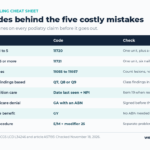
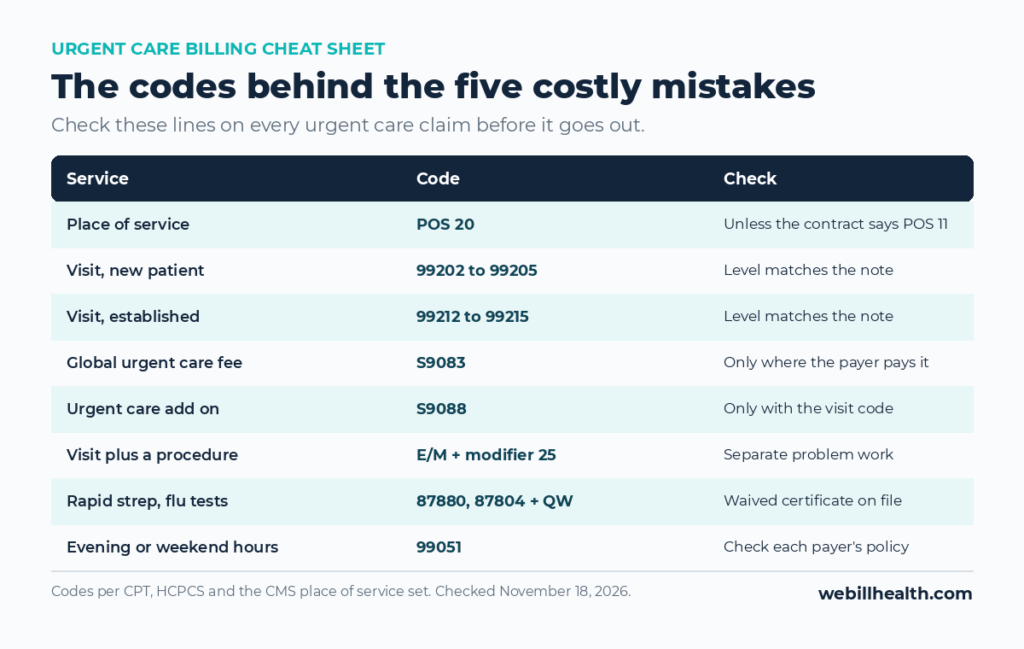
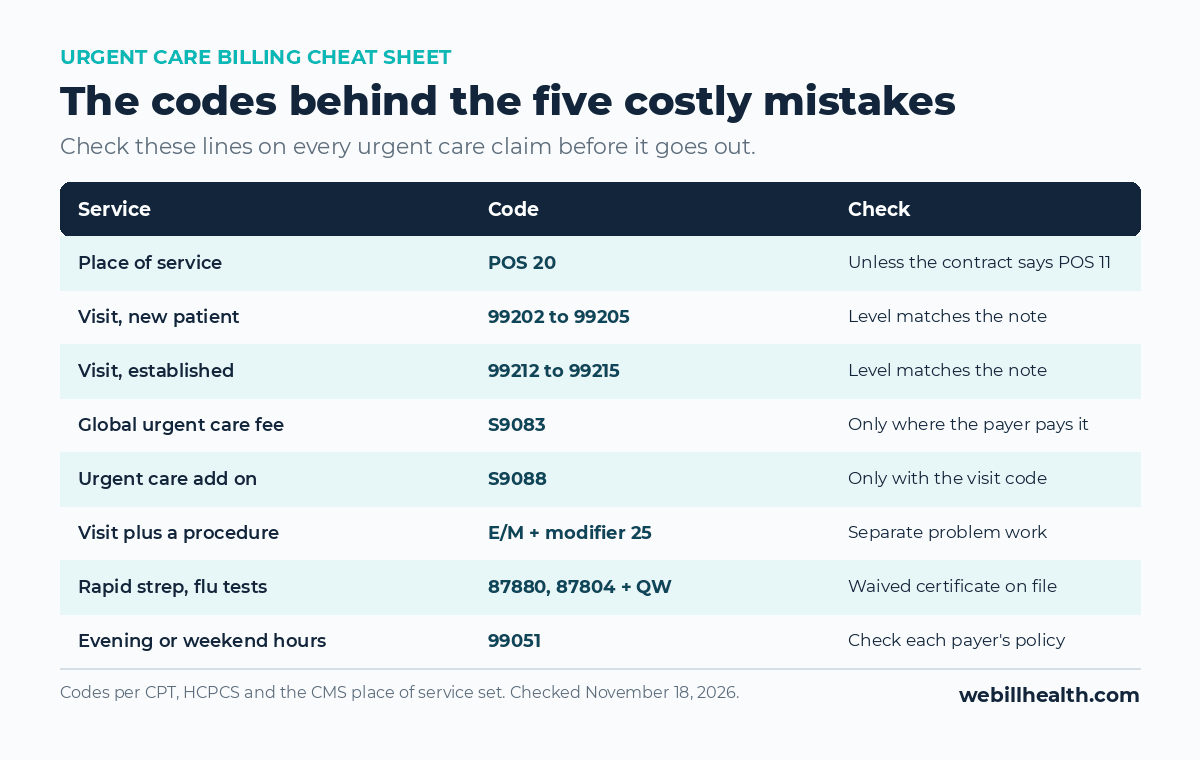
Urgent care billing cheat sheet: the codes to check on every claim
These are the codes to check on every urgent care claim, because each one sits behind at least one of the five mistakes above.
| Service | Code | What to check |
|---|---|---|
| Place of service | POS 20 | Use POS 11 only where the contract requires it |
| Visit, new patient | 99202 to 99205 | The level matches the note |
| Visit, established patient | 99212 to 99215 | The level matches the note |
| Global urgent care fee | S9083 | Billed only where the payer pays it, in place of the visit code |
| Urgent care add on | S9088 | Billed only with the visit code, where the payer pays it |
| Visit plus a procedure | E/M with modifier 25 | Separate problem work is documented |
| Rapid strep and flu tests | 87880, 87804 with QW | A current CLIA certificate is on file |
| Evening or weekend hours | 99051 | Each payer’s policy, since many do not pay it |
What place of service code does urgent care use?
Urgent care centers use place of service 20, Urgent Care Facility, unless a payer contract requires another code. The exception is the contract that loads the center as a physician office, which usually expects POS 11. A freestanding emergency department licensed as an emergency department bills differently from an urgent care center.
Which urgent care billing codes matter most?
The urgent care billing codes that matter most are the office visit codes 99202 to 99215, the payer specific S9083 and S9088, procedure codes for repairs and splints, and the point of care test codes with their QW modifier. Most of an urgent care center’s revenue runs through those four groups, so most of its denials do too.
How does Medicare pay for urgent care visits?
Medicare pays urgent care visits through the standard office visit codes on the physician fee schedule, and it does not recognize S9083 or S9088. That makes Medicare claims simpler than commercial ones, but the rate still moves each year: the final 2027 physician fee schedule lowers the Medicare conversion factor 2.31% to $32.63 from January 1, 2027. See the 2027 physician fee schedule final rule.
Can urgent care bill a visit and a procedure on the same day?
Yes, urgent care can bill a visit and a procedure on the same day when the visit includes significant, separately identifiable work, reported with modifier 25 on the E/M code. A patient who comes in for a cut finger and is also treated for an ear infection supports both. A patient seen only for the cut usually supports the repair alone.
Same day billing is also changing for Medicare. See the CMS modifier 25 payment cut for 2027.
How to catch urgent care billing mistakes before the claim goes out
Catch urgent care billing mistakes with a short review of each claim before it goes out, focused on the five patterns above.
- Check the place of service against the payer’s contract.
- Check that S9083 or S9088 appears only for payers that pay it, and in the right position.
- Check that every modifier 25 visit has a separate problem documented.
- Check every waived test line for QW and a current CLIA certificate.
- Compare the E/M level with the medical decision making or time in the note.
The WeBill Health take
Urgent care centers rarely lose money on one large claim. They lose it on the same small error repeated across every walk in visit, so one fix to a payer rule protects thousands of future claims. WeBill Health keeps internal payer rule libraries organized by specialty and by carrier, covering more than 500 payer rulesets, and every claim receives human pre submission review against them before it goes out. That review supports a 98% clean claim rate and a 48 hour submission guarantee. Urgent Care sits in WeBill Health’s Office Visit and Consultation billing group; see urgent care billing at WeBill Health.
Want to see which of these five mistakes your claims carry? Request your Revenue Defense Audit and we will show you your denials by payer, code and reason.
Frequently asked questions
What place of service code does urgent care use?
Urgent care centers bill place of service 20, Urgent Care Facility, unless a payer contract sets the center up as an office and requires POS 11. Check each contract, because a POS that does not match the payer’s setup can reject the claim.
Can urgent care bill an E/M visit and a procedure on the same day?
Yes, when the visit includes significant, separately identifiable work beyond the usual evaluation before the procedure. Add modifier 25 to the E/M code and document the problem work in its own section of the note.
Do urgent care tests need the QW modifier?
Many CLIA waived tests, such as rapid strep and flu tests, need modifier QW to be paid. A few waived tests, including 81002 and 81025, do not need it. The center also needs a current CLIA certificate on file.
Should urgent care bill S9083 or S9088?
It depends on the payer. S9083 is a global fee billed in place of the visit code, and S9088 is an add on billed with it. Medicare recognizes neither, so follow each commercial and Medicaid contract.