It wasn’t supposed to end like this.
Dr. Marcus Chen was a respected chiropractor in suburban Philadelphia, providing exceptional patient outcomes, earning five-star reviews, and maintaining a long waiting list. He adapted through recessions, insurance policy changes, and even the pandemic.
Yet in February 2023, he shut down his clinic.
Not because patients stopped coming, not because of a lawsuit, and not because of financial misconduct.
He closed because $47,283 in legitimate, payable claims were never collected, and the billing company he trusted let it happen.
This is the part where most providers say, “That could never be me.”
But it happens more often than anyone talks about.
The Invisible Financial Bleed Behind a Healthy Practice
On the surface, Dr. Chen’s practice was thriving:
- Over 120 patient visits weekly
- Fast-filled appointment slots
- Clean documentation
- Loyal patient base
But beneath those surface numbers, his cash flow was collapsing. The RCM company he had worked with for 11 years was submitting claims, yet not defending them properly. Reports looked “normal,” everything looked “on track,” but the unpaid claim pile kept growing silently.
Here’s what those reports didn’t show:
- 23 claim denials, never appealed
- $18,400 stuck in “pending status,” never followed up
- $11,200 underpaid by insurance, accepted without review
- $17,683 aging past timely filing deadlines
Most painful truth:
He trusted them because he had no reason not to.
When Cash Flow Turns Into Survival Mode

By late 2022, Accounts Receivable had ballooned to 87 days.
His line of credit was maxed out.
Payroll was coming from personal savings.
The stress was suffocating.
Every call to the billing company ended with generic answers:
“We are working on it, please be patient.”
But bills do not wait.
Rent does not wait.
Employees do not wait.
Insurance payers, however, delay on purpose.
In January 2023, a consultant reviewed his AR and uncovered three painful findings:
- 34% of outstanding revenue had already expired, completely lost
- 41% was recoverable, but only with aggressive follow-up
- 25% required documentation that was never requested from him
Conclusion: The issue wasn’t incompetence, it was indifference.
The Hidden Truth About Most Billing Companies
Here is the harsh reality:
Most RCM companies get paid whether you collect or not.
Their compensation is based on what they submit, not on what they recover.
So when a denial comes in, or a claim is underpaid, or a deadline is approaching…
They lose nothing by ignoring it.
The provider loses everything.
There is zero financial incentive for them to fight.
What Made Up the $47,283 Lost Revenue?
1. Denials Never Appealed, $14,200 Lost
Most of these claims were completely winnable with:
- A single appeal letter
- Attached clinical documentation
- They were not complicated cases.
- They were simply ignored until deadlines passed.
2. Claims Allowed to Expire, $17,683 Lost
Insurance delayed processing until timely filing windows closed.
A responsible billing partner would have:
- Tracked every claim
- Contacted payer reps
- Escalated before deadlines
None of this happened.
3. Underpayments Accepted Without Review, $11,200 Lost
Insurance paid 70 to 80% of contracted reimbursement rates.
The biller took the first payment, closed the claim, and moved on.
4. Payer Documentation Requests Ignored, $4,200 Lost
The payer asked for additional information.
The biller never notified Dr. Chen.
Appeal deadline expired, claim denied.
All four categories were avoidable losses.
The Day Everything Broke
In late January, Dr. Chen made the call no provider ever wants to make:
“I can’t do this anymore. I’m shutting down next month.”
No anger, no argument, just exhaustion from fighting battles he never should have fought alone.
His clinic closed, his two employees lost their jobs, and long-term patients were forced to find new care. Meanwhile, the billing company simply sent their final invoice, then carried on with other clients.
That entire $47K was gone, not due to poor care, but due to a lack of urgency.
The System Is Designed To Make You Give Up
Insurance companies operate on two assumptions:
- Providers are too busy to appeal
- Most billers won’t push back
And, unfortunately, they’re often right.
Providers are focused on healing patients, not dealing with:
- Payer disputes
- Writing appeal letters
- Tracking aging claims
- Verifying underpayments
- Chasing document requests
So claims sit.
Deadlines pass.
Revenue disappears.
The Difference Between Submitting and Protecting Revenue
Most billing companies are claim processors:
- Submit claims
- Post payments
- Send monthly reports
WeBill Health is different.
We fight for your revenue.
We track every claim like it’s our own money.
We escalate aggressively.
We challenge every underpayment.
We appeal every denial with urgency.
Because the money you earned should never be optional income.
One Question Every Provider Should Ask Their RCM Today
Ask them this directly:
“How many appeals did you file for my clinic in the last 90 days?”
If they pause, check their notes, or give a generic answer,
it means you are not being protected.
Your Practice Deserves Better
If your AR over 60 days is growing,
if denials are being explained away as “normal,”
if collections do not match effort…
It’s not your fault.
You are being let down.
Dr. Chen’s story didn’t have to end in closure.
Yours doesn’t have to either.
At WeBill Health:
- We recover what others give up on,
- We care because our success depends on yours,
- We protect your revenue as if it’s our own.
Your practice future should never be determined by billing negligence.
Final Words
You built your practice through years of dedication, sacrifice, and care.
You deserve a revenue partner who fights just as hard.
Let’s stop silent revenue leakage before it claims another clinic.
WeBill Health, We Are The Wall
Want to know where your practice is losing revenue? Request your Revenue Defense Audit and we will review your denials, A/R and payer mix by payer, code and reason. For a quick read first, get your Revenue Defense Score in 60 seconds.
Frequently Asked Questions
How can unpaid claims close a busy practice?
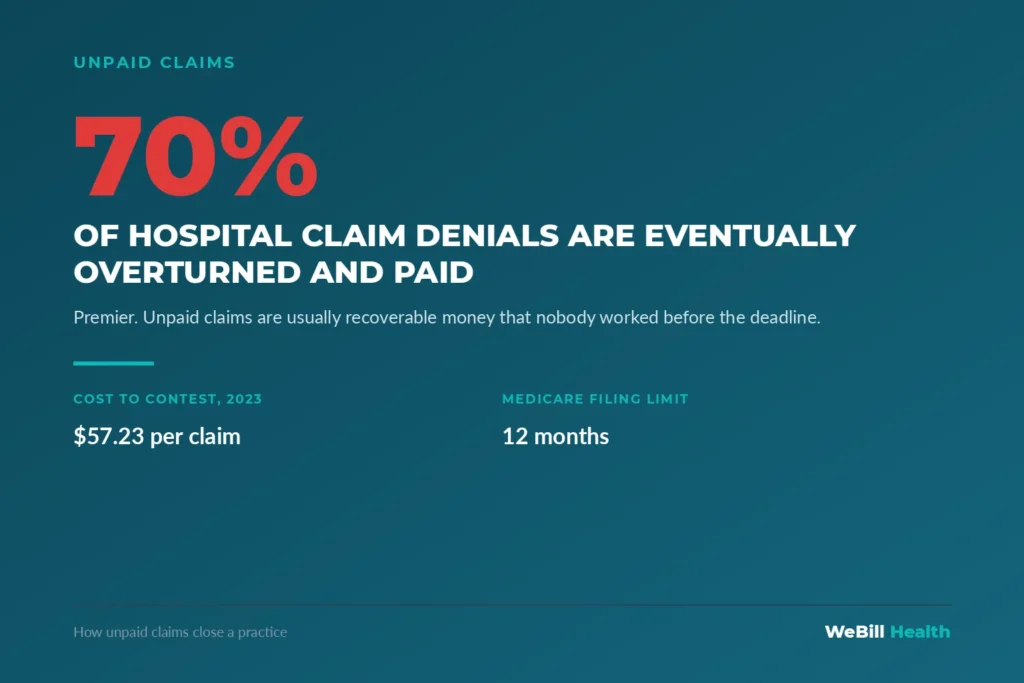
Unworked denials and expired claims drain cash slowly while visit volume still looks healthy. In this case A/R climbed to 87 days, and most of the $47,283 lost came from denials that were never appealed and claims allowed to pass their filing deadlines.
What should I ask my billing company?
Ask how many appeals they filed for your practice in the last 90 days and which denials they let go, and why. A partner who works denials can answer from records the same day.
What are the warning signs that denials are not being worked?
A/R over 60 days that keeps growing, denials described as normal without a root cause, and collections that do not keep pace with your visit volume.