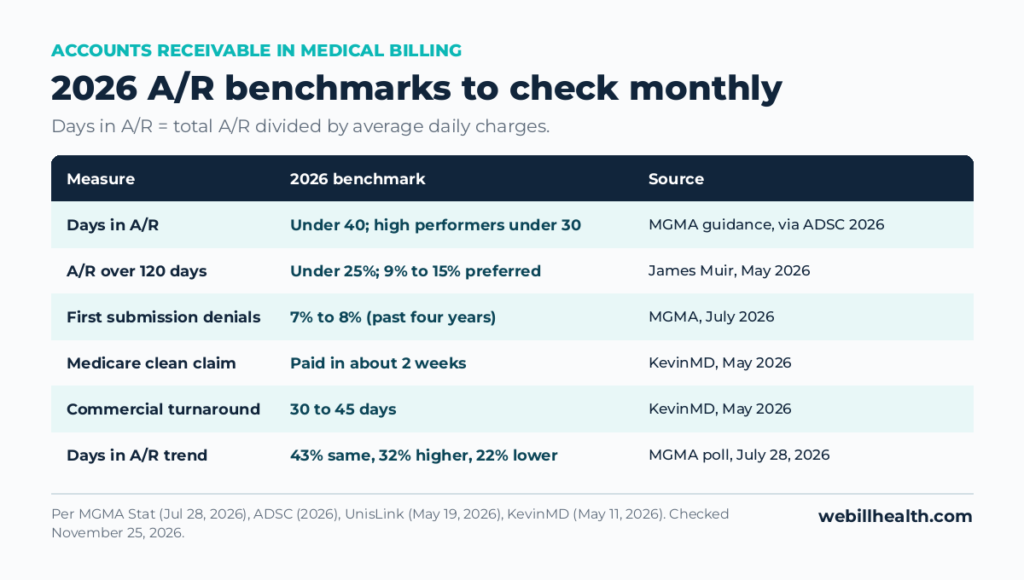
Short answer: Accounts receivable in medical billing is the money payers and patients still owe a practice for care it has already delivered. Practices track it as days in A/R: total A/R divided by average daily charges. When that figure climbs, cash is stuck in claims. The oldest claims are the ones most likely never to pay.
Updated November 2026 with MGMA’s July 2026 days in A/R poll and 2026 benchmark guidance. Every figure below links to its source.
What is accounts receivable in medical billing?
Accounts receivable in medical billing is every dollar billed for a completed visit that has not yet been collected. It includes claims waiting on a payer, claims that denied and wait for rework, and balances patients still owe after insurance. A/R is earned revenue, but it does not pay rent or payroll until it turns into cash, so the size and age of the balance matter as much as the total.
How do you calculate days in accounts receivable?
You calculate days in accounts receivable by dividing total A/R by average daily charges, a method MGMA describes as turning receivables into a measure of time. Average daily charges are usually gross charges over the last 90 days divided by 90. For example, a practice carrying $300,000 in A/R with $6,000 in average daily charges has 50 days in A/R.
What is a good days in A/R number in 2026?
A good days in A/R number for a physician practice is under 40, and high performers stay below 30, according to MGMA benchmark guidance summarized by ADSC’s Gene Spirito in 2026. The average alone can mislead, though. One practice in MGMA’s July 2026 poll kept insurance A/R within 28 days, yet its overall figure was 32 because self pay balances aged longer.
Three in four practices saw no improvement. In MGMA’s July 28, 2026 poll of 203 medical group leaders, 43% said days in A/R were about the same as a year earlier, 32% said they were higher and only 22% said they were lower. Respondents with rising A/R named payer behavior most often, including delays and more initial denials.
What do the accounts receivable aging buckets tell you?
Aging buckets show how long each dollar has waited: 0 to 30 days, 31 to 60, 61 to 90, 91 to 120 and over 120. The over 120 bucket is the warning sign, because a healthy average can hide a pile of old claims. In a May 2026 presentation, James Muir of UnisLink set the benchmark at less than 25% of A/R over 120 days, with 9% to 15% preferred.
MGMA’s DataDive report on 2024 data shows the split by ownership. Physician owned practices raised their share of A/R in the 0 to 30 day bucket by roughly 2 to nearly 7 percentage points, while hospital and system owned groups saw that share fall by double digits and their over 120 share climb.
Accounts receivable in medical billing benchmarks compared
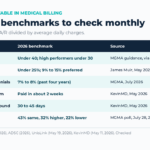
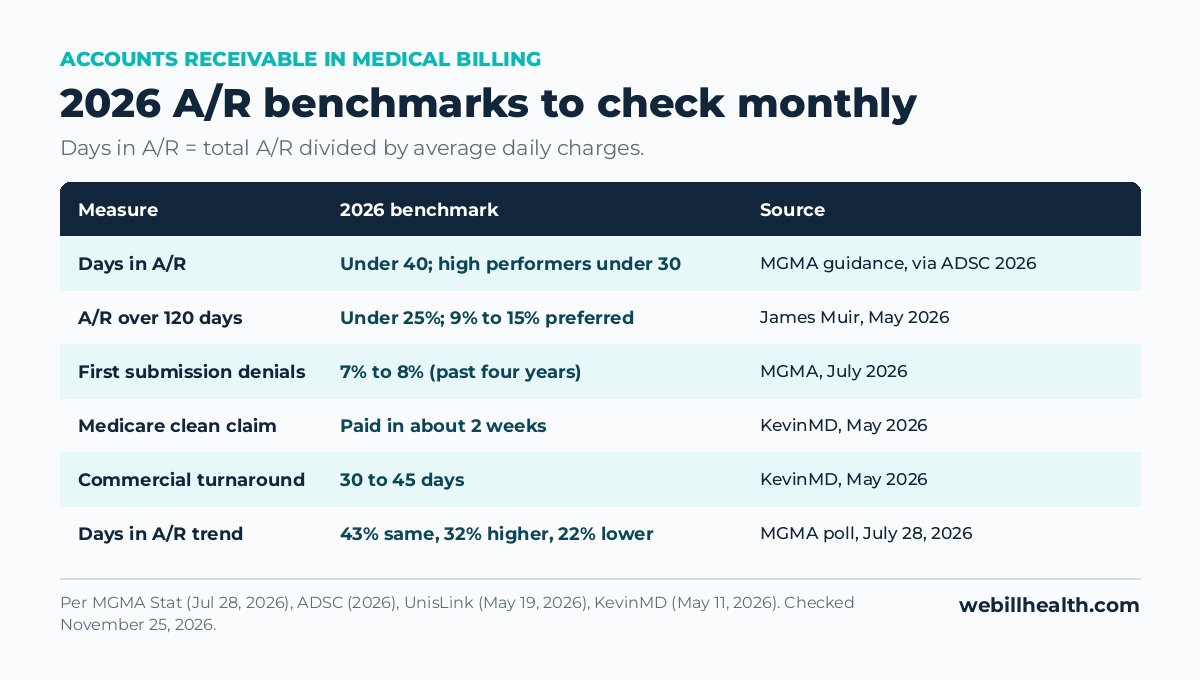
These are the accounts receivable benchmarks a practice owner can check against its own aging report each month.
| Measure | 2026 benchmark | Source |
|---|---|---|
| Days in A/R | Under 40; high performers under 30 | MGMA guidance, via ADSC 2026 |
| A/R over 120 days | Under 25% of total; 9% to 15% preferred | James Muir, May 2026 |
| First submission denial rate | 7% to 8% across the past four years | MGMA, July 2026 |
| Medicare clean electronic claim | Paid in about 2 weeks | KevinMD, May 2026 |
| Commercial payer turnaround | 30 to 45 days | KevinMD, May 2026 |
| 60 day cash performance | 96.74%, down from 100.28% (H1 2026 vs H1 2025) | Kodiak, via TechTarget |
Why does accounts receivable in medical billing keep growing?
Accounts receivable grows when one of four stages slows down. A May 2026 KevinMD analysis by GetPracticeHelp splits days in A/R into the time from visit to clean claim, payer adjudication time, the denial and rework cycle, and patient collection time. The first stage is the one a practice controls most directly. The third is where most money leaks: in a January 2026 MGMA poll, 48% of leaders named denials and appeals their largest source of revenue leakage, against 23% who named front end issues.
The same analysis notes that a denial rate above 10% can look stable at first and then build a backlog. As GetPracticeHelp put it, “the diagnostic question is which one is actually driving the number.”
What does old accounts receivable in medical billing cost a practice?
Old A/R costs a practice twice: the cash it cannot use today, and the claims that pass a payer’s filing or appeal deadline and drop to zero. Kodiak data from 2,400 hospitals and 375,000 physicians for the first half of 2026 put final write offs at 3.07% of net revenue, money billed and never collected.
Worked example, with round assumptions: the practice above has $300,000 in A/R and $6,000 in average daily charges, or 50 days. Bringing that down to 35 days frees 15 days of charges, about $90,000, as cash once. If 25% of the $300,000 sits past 120 days, that is $75,000 in the bucket where claims are most likely to run out of time.
How do you lower accounts receivable in medical billing?
MGMA’s July 2026 guidance gives practical steps that shorten each stage of the cycle.
- Close encounters within 72 hours and post charges within two days, since MGMA cites a three to seven day lag across the sector.
- Work denials daily, starting with the highest dollar claims and the nearest appeal deadlines.
- Review the five most common denial codes each month for causes the front desk can prevent.
- Collect patient responsibility at check in, with a standard way for staff to explain estimates.
- Run A/R aging by payer and bring payer delays into contract talks.
It works. One practice in the poll cut its days in A/R from 67 to under 34.
What could change for A/R in 2027?
Payer turnaround rules are moving. Since January 1, 2026, CMS-0057-F has required Medicare Advantage, Medicaid and CHIP plans to decide standard prior authorization requests within 7 days and urgent ones within 72 hours, which shortens the wait before some claims can be billed. Separately, the Medicare Advantage Prompt Pay Act (H.R. 5454, S. 2879), backed at a June 2026 congressional briefing, would require plans to pay at least 95% of clean claims promptly, with 14 days the standard for electronic claims. It has not passed, so practices should not budget on it.
The WeBill Health take
Days in A/R is the number most owners watch, and as Physicians Practice noted in August 2026, it is also the last one to move. By the time it climbs, the denials and slow claims behind it are weeks old. The fix starts with the aging report by payer and a weekly look at what sits past 90 days.
WeBill Health works A/R the same way. Clients see a 40% A/R reduction within 90 days, 7 to 14 day reimbursement velocity on their top five payers, and an average 25% increase in collections within six months through specialty specific coding and reduced days in A/R. A weekly velocity report tracks claims submitted, denials worked and collections received. The open question for 2027: if prompt pay rules do pass for Medicare Advantage, will commercial plans follow, or will the gap between payers grow?
Want to see what is sitting in your aging buckets? Request your Revenue Defense Audit and we will show you A/R by payer and age, and which claims are closest to running out of time. Related reading: the Denial Root Cause Playbook, claim appeal deadlines by payer and the cost of claim denials.
Frequently asked questions
What is accounts receivable in medical billing?
It is the money still owed to a practice for care already delivered, from payers and from patients. It includes pending claims, denied claims waiting for rework and patient balances.
How do you calculate days in A/R?
Divide total accounts receivable by average daily charges. A practice with $300,000 in A/R and $6,000 in average daily charges has 50 days in A/R.
What is a good days in A/R for a medical practice?
Under 40 days, with high performers below 30, per MGMA benchmark guidance cited in 2026. Less than 25% of A/R should be over 120 days old.
Are days in A/R getting better in 2026?
Not for most practices. In MGMA’s July 28, 2026 poll, 43% reported days in A/R about the same as a year earlier, 32% higher and 22% lower.
Sources
- MGMA Stat (Chris Harrop), Days in A/R holds steady for most practices, July 28, 2026 poll
- ADSC (Gene Spirito, MBA), Is your revenue cycle actually healthy? The numbers that matter in 2026
- James Muir, UnisLink, Understanding the numbers that boost practice revenue, May 19, 2026
- KevinMD (GetPracticeHelp), Accounts receivable days hide four billing problems, May 11, 2026
- TechTarget, Insurers deny less just to claw back more later (Kodiak H1 2026 data), September 23, 2026
- Physicians Practice (Keith A. Reynolds), 9 billing numbers your practice should know cold, August 12, 2026
- CMS, Interoperability and Prior Authorization Final Rule (CMS-0057-F) fact sheet, checked November 25, 2026
- Congress.gov, S. 2879, Medicare Advantage Prompt Pay Act (bill text), checked November 25, 2026
- AHA, Representatives join hospital leaders at briefing on MA prompt payment legislation, June 3, 2026