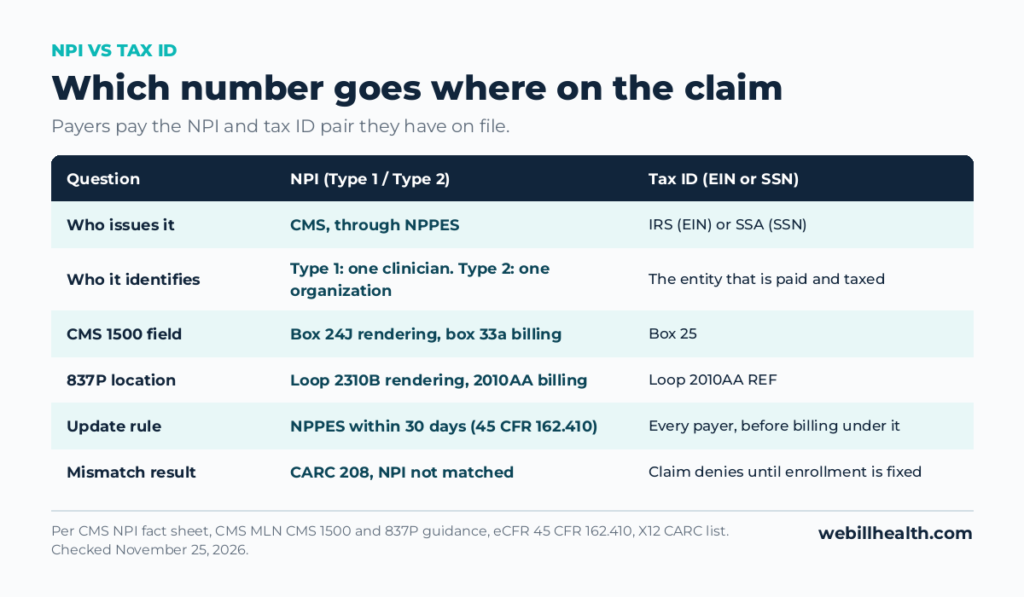
Short answer: In the NPI vs tax ID question, the NPI tells a payer who provided the care. The tax ID tells the payer who gets paid. Every claim carries both, and payers check that the pair matches their enrollment file. When the NPI and tax ID on a claim do not line up with what the payer has loaded, the claim denies, even when the care and the coding are correct.
Updated November 2026 with the current CMS enrollment forms and 2026 payer guidance. Every rule below links to its source.
What is the difference between an NPI and a tax ID?
The difference between an NPI and a tax ID is purpose. The National Provider Identifier is a 10 digit number issued by CMS through NPPES under HIPAA, and it identifies a provider in claims and other standard transactions. The tax ID is the number the IRS uses for the business: an Employer Identification Number (EIN) for most practices, or a Social Security number for a sole proprietor. In short, the NPI names the clinician or organization, and the tax ID names the entity the payer sends money to and reports on a 1099.
What is a Type 1 NPI and who needs one?
A Type 1 NPI belongs to an individual provider, such as a physician, nurse practitioner, therapist or sole proprietor. According to the CMS NPI fact sheet, an individual can hold only one NPI for life, so it follows the clinician from job to job. On a group claim, this is the number that shows who rendered the service.
What is a Type 2 NPI and does a group practice need one?
A Type 2 NPI belongs to an organization, such as a group practice, clinic or agency, and an organization can hold more than one. A group that bills under its own tax ID should apply for one and use it for payer enrollment and billing. A clinician who is incorporated can also hold two numbers: a Type 1 for themselves and a Type 2 for the corporation or LLC.
However, the Type 2 number alone does not get a group paid. As SimplePractice put it in November 2026, a Type 2 NPI does not automatically establish network participation. The payer still has to enroll the group and link each clinician to it.
What is a tax ID on a medical claim?
The tax ID on a medical claim is the federal tax identification number of the billing entity. CMS defines it as the EIN or SSN of the health care professional or supplier who provided the service, and it can belong to a person or a group. For Medicare enrollment, an organization needs an EIN, which is the same as its IRS issued tax identification number.
NPI vs tax ID compared side by side
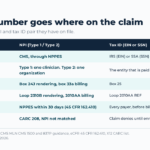
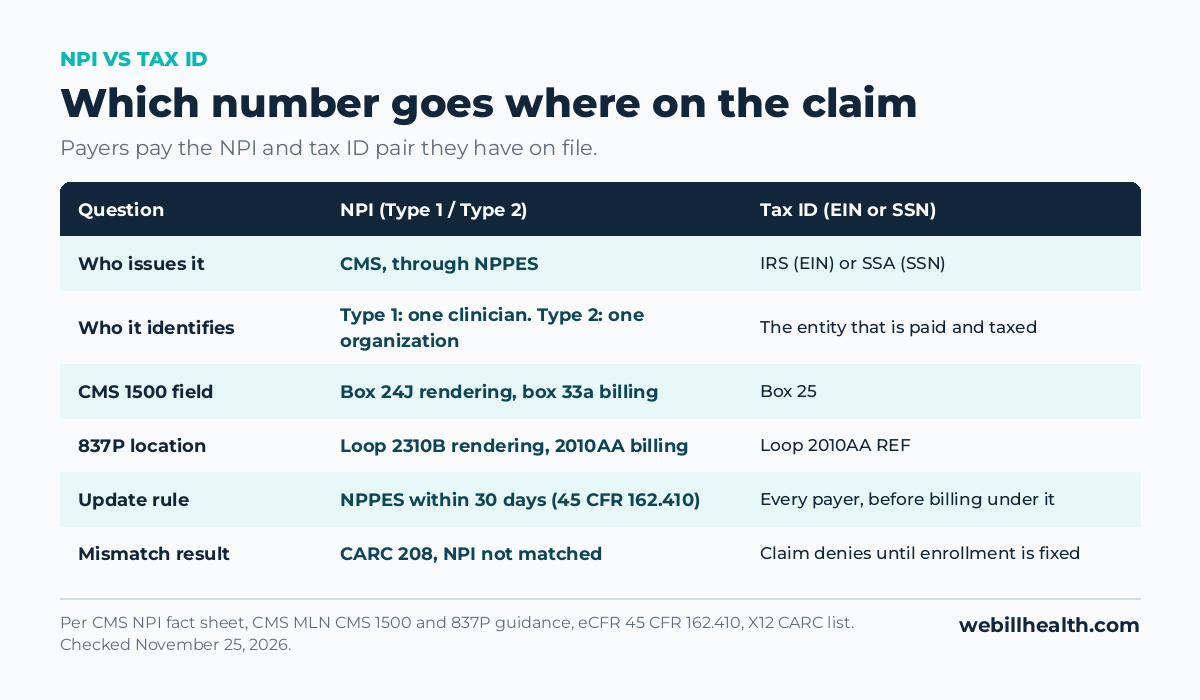
The NPI vs tax ID split is easiest to see in one table. Each row is a question a payer asks when it adjudicates the claim.
| Question | Type 1 NPI | Type 2 NPI | Tax ID (EIN or SSN) |
|---|---|---|---|
| Who issues it | CMS, through NPPES | CMS, through NPPES | IRS (EIN) or SSA (SSN) |
| Who it identifies | One clinician | One organization or subpart | The entity that is paid and taxed |
| How many | One per person, for life | One or more per organization | One per legal entity |
| CMS 1500 field | Box 24J (rendering) | Box 33a (billing) | Box 25 |
| 837P location | Loop 2310B (rendering) | Loop 2010AA (billing) | Loop 2010AA REF |
| Update rule | Report changes to NPPES within 30 days | Report changes to NPPES within 30 days | Report to each payer before billing under it |
Where do the NPI and tax ID go on the CMS 1500 and 837P?
On the paper CMS 1500, box 24J carries the rendering provider’s Type 1 NPI, box 33a carries the billing provider’s NPI, and box 25 carries the tax ID. On the electronic 837P, the billing provider’s NPI and tax ID both sit in Loop 2010AA, with the tax ID in the REF segment, and the rendering provider sits in Loop 2310B. A solo clinician who bills in their own name may put the same Type 1 NPI in both places. A group puts its Type 2 NPI in the billing field and each clinician’s Type 1 NPI in the rendering field.
Why do NPI and tax ID mismatches deny claims?
NPI vs tax ID mismatches deny claims because payers pay the pair they have on file, not the numbers you meant to send. A payer checks its own enrollment and affiliation records, not just the national NPI registry. Iowa Medicaid’s crosswalk, for example, sends a rendering provider who does not share the pay to provider’s tax ID to CARC 208, which means the NPI was not matched. So an old tax ID, a Type 2 NPI the payer never linked to your group, or a new clinician not yet tied to the group’s tax ID all produce the same result: the claim stops.
Worked example, with round assumptions: a five provider group adds a sixth clinician who sees 15 patients a day. The payer has not yet linked her Type 1 NPI to the group tax ID, so three weeks of her claims deny. That is 15 visits a day for 15 working days, or 225 claims. At an assumed $100 allowed per visit, about $22,500 sits unpaid until the enrollment is fixed and every claim is resubmitted.
What happens to Medicare billing when a provider joins a group?
When a provider joins a group, Medicare pays the group only after the provider reassigns benefits to it. CMS now captures reassignment on the CMS-855I, and the CMS-855R is no longer used for it. The form also requires the legal business name and tax ID to match the name and TIN used to obtain the NPI. If the group itself is not yet enrolled, it must enroll on the CMS-855B, or enroll at the same time, before the reassignment can take effect.
Timing matters because Medicare allows retroactive billing for only 30 days before the enrollment effective date under 42 CFR 424.521, and only when circumstances prevented earlier enrollment. Visits before that window are not billable to Medicare at all.
What must you update when your NPI or tax ID details change?
Federal rules require covered providers to report changes to their NPPES record within 30 days, under 45 CFR 162.410. Medicare also asks for a 30 day report of a change of ownership or control or a practice location change, a point CMS repeated at its March 2026 Provider Enrollment Compliance Conference. Commercial payers then need the change in their own systems before claims under it will pay.
The safe order is simple. First, update NPPES. Next, update Medicare in PECOS. Then send the change to every commercial and Medicaid payer and get written confirmation before the first claim goes out under the new details. Jake Voogd, LMFT, writing for SimplePractice, said that “a few minutes obtaining written clarification from a payer is time well spent.”
The WeBill Health take
Most NPI vs tax ID denials start in enrollment records that drifted away from the way the practice actually bills. The costly version shows up when a practice forms an LLC, adds a provider or opens a location, and keeps billing before every payer has the new pairing on file.
WeBill Health runs credentialing in the practice’s own name and Tax ID, so the contracts stay with the practice. It delivers 40% faster credentialing and monitors CAQH and PECOS 24/7, which keeps the NPI, tax ID and location records that payers match against current. One question is worth watching in 2027: as payers lean harder on automated matching, will fewer mismatched claims get a human second look?
Not sure every payer has your current pairing on file? Request your Revenue Defense Audit and we will check enrollment status and the denials tied to it. For the enrollment side, see Revenue Velocity Credentialing, what credentialing costs in 2026 and Medicaid provider enrollment by state.
Frequently asked questions
Is an NPI the same as a tax ID?
No. The NPI is a 10 digit provider identifier issued by CMS. The tax ID is the IRS number for the entity that is paid, usually an EIN, or an SSN for a sole proprietor. Claims need both.
Does a group practice need a Type 2 NPI?
A group that bills under its own tax ID should get a Type 2 NPI and use it as the billing provider. Each clinician still reports their own Type 1 NPI as the rendering provider.
Which box on the CMS 1500 holds the tax ID?
Box 25 holds the federal tax ID of the billing entity. Box 33a holds the billing NPI and box 24J holds the rendering provider’s NPI.
How fast do NPI changes have to be reported?
Covered providers must report changes to their NPPES record within 30 days under 45 CFR 162.410. Each payer then needs the change in its own system before claims under it will pay.
Sources
- CMS, NPI Fact Sheet (Type 1 and Type 2 NPIs), checked November 25, 2026
- eCFR, 45 CFR 162.410, provider NPI obligations including 30 day updates, checked November 25, 2026
- CMS, Medicare Claims Processing Manual, Chapter 26, CMS 1500 Items 24J, 25 and 33a (Rev. 14466, May 27, 2026)
- CMS, Form CMS-855I, reassignment of benefits and TIN matching, checked November 25, 2026
- CMS, Medicare Provider Enrollment Compliance Conference, New Regs for 2026, March 18, 2026
- CMS MLN, Medicare Enrollment for Providers Who Submit Claims to MACs (EIN requirement), checked November 25, 2026
- eCFR, 42 CFR 424.521, retrospective billing, checked November 25, 2026
- SimplePractice (Jake Voogd, LMFT), Billing under a group NPI vs. an individual NPI, November 4, 2026
- BehaveHealth, CARC 208: payer cannot link the NPI to its records (Iowa crosswalk), accessed September 29, 2026
- DrChrono, Individual vs Organizational NPIs, last modified January 16, 2026
- X12, Claim Adjustment Reason Codes (CARC 208), checked November 25, 2026