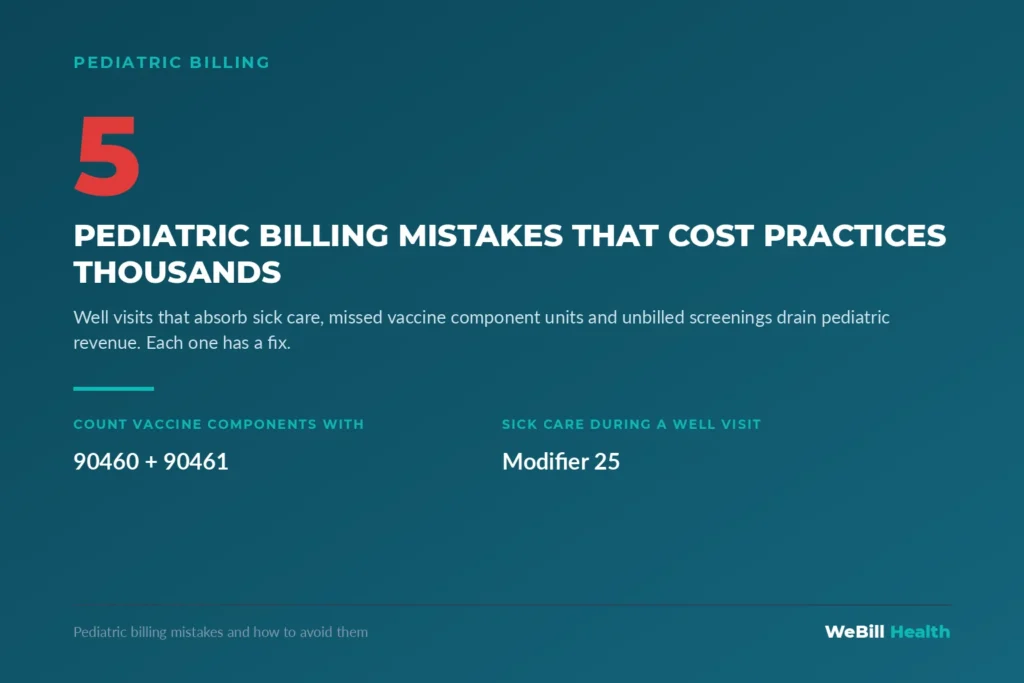
Short answer: The pediatric billing mistakes that cost practices the most are sick care folded into the well visit without modifier 25, developmental and behavioral screenings denied for missing documentation, vaccine components undercounted on 90460 and 90461, counseling for declined vaccines left unbilled under the new 2026 codes, and telehealth claims with the wrong modifier or place of service. Each one can be caught before the claim goes out.
Updated November 2026. Pediatric billing loses money in small pieces: one uncounted vaccine component, one sick visit absorbed by a well visit, one counseling conversation that never reached the claim. Each looks minor on a single claim. Across a year of well visits it adds up to thousands of dollars.
The 5 pediatric billing mistakes that cost practices the most
Five mistakes cost pediatric practices the most, and each one leaves money unbilled or denied on care the practice already gave.
1. Sick care folded into the well visit
When a child comes in for a checkup and the provider also treats an ear infection, the preventive code (99381 to 99395) does not pay for that extra work. Without a separate problem oriented E/M code carrying modifier 25, the sick care goes unpaid.
- Document the problem in its own section of the note, with its own assessment and plan.
- Bill the problem visit (for example 99213 with modifier 25) alongside the preventive code, and link the problem diagnosis, such as H66.90 for otitis media, to that line.
- Keep each payer’s policy on file, because some still bundle the two. Our guide to when a well child visit becomes a sick visit walks through the math.
In our pediatric billing work, this is the leak we see most often. It is also where payer policy is moving against practices. Several plans now pay the sick visit at 50% when it is billed with a well visit, even with modifier 25 and full documentation: Moda Health, Centene’s Ambetter plans including Superior HealthPlan in Texas, Blue Cross Blue Shield of Michigan since June 2024, and Sentara Health Plans. The Minnesota Medical Association has challenged Blue Cross Blue Shield of Minnesota over cuts of 20% to 50%.
A reduced payment is still a payment. Folding the sick visit into the well visit pays nothing for that work. Bill it whenever the problem needed significant, separate work, and check which of your payers apply a reduction so you can predict the true payment.
2. Developmental and behavioral screenings denied
Developmental screening (96110) and brief emotional or behavioral assessment (96127) are paid per standardized instrument. Payers deny them when the note does not name the tool and its result.
- Name the instrument in the note, such as ASQ 3 or M CHAT, and record the score.
- Use the matching screening diagnosis: Z13.41 for autism screening and Z13.42 for developmental delay screening.
- Record what happened next, for example a referral after a positive screen.
3. Vaccine components undercounted
Administration with counseling is billed per component, not per injection. A combination vaccine can carry three or four components, and billing one 90460 with no 90461 units leaves most of that payment behind. Our 90460 and 90461 component counting guide lists the counts for common vaccines.
- Bill 90460 for the first component of each vaccine and 90461 for each additional component.
- Pair every administration line with its vaccine product code.
- For Vaccines for Children stock, follow your state’s rule for the product line, which is often modifier SL.
4. Counseling for declined vaccines left unbilled
Since January 1, 2026, CPT codes 90482, 90483 and 90484 cover counseling by a physician or other qualified health care professional when a recommended vaccine is not given that day. They are time based: 3 to 10 minutes, more than 10 up to 20 minutes, and more than 20 minutes. They are billed once per date of service, and modifier 25 goes on the E/M when that visit is separately identifiable. Before 2026, most of this work went unpaid.
- Document counseling time separately from any time counted for administered vaccines.
- Check each payer’s policy, because coverage is still mixed and some payers ask for other codes.
5. Telehealth claims with the wrong modifier or place of service
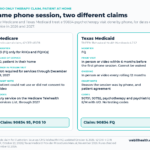
Virtual visits are denied when the modifier or place of service does not match the payer’s rule. Modifier 95 is the common choice for audio and video visits and 93 for audio only, while some Medicaid programs still require GT. Place of service 02 or 10 depends on where the patient was.
- Keep a payer by payer telehealth sheet and update it when policies change.
- Note in the visit record that the service was real time audio and video, or audio only.
Z00.121 or Z00.129: which well child code to use
Use Z00.121, routine child health exam with abnormal findings, when the exam turns up something abnormal, and add a separate code for that finding. Use Z00.129, routine child health exam without abnormal findings, when it does not. Picking Z00.129 and then billing a problem visit on the same day is a common mismatch that invites a denial. For the full rules and the payer edits behind them, see Z00.121 vs Z00.129: 5 well child coding mistakes.
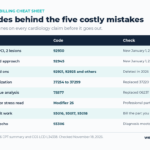
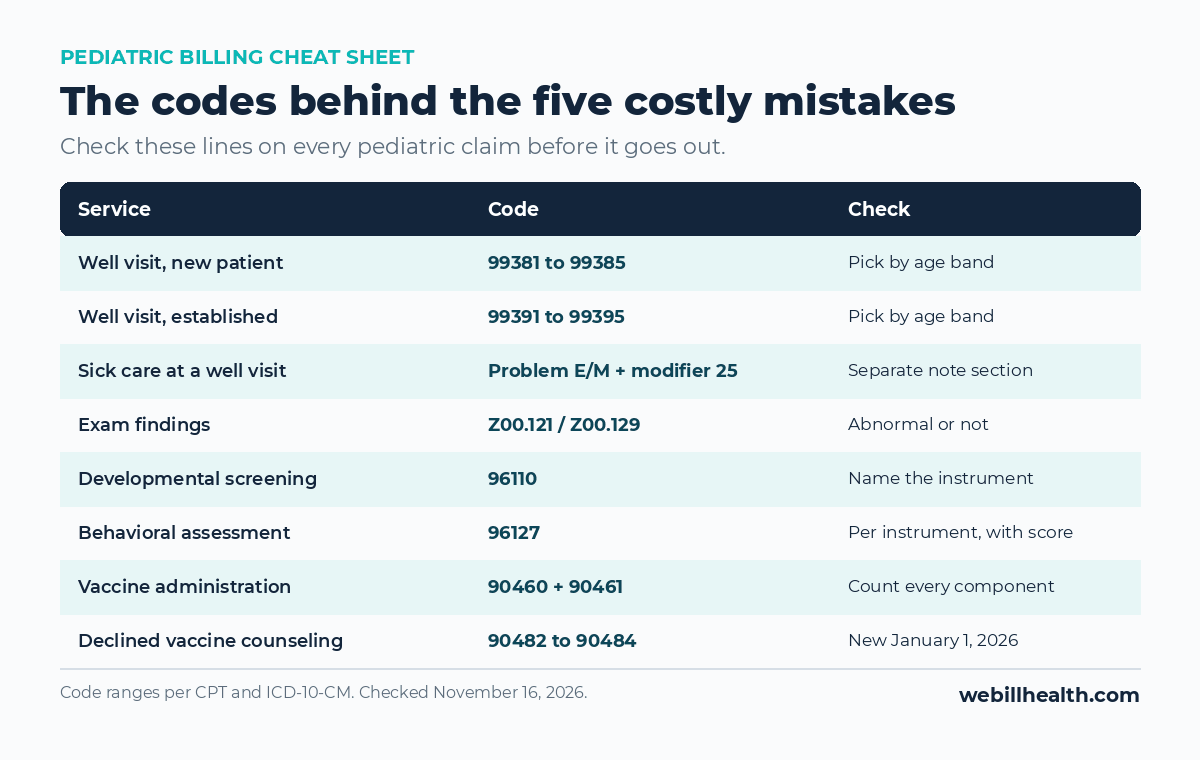
Pediatric billing cheat sheet: the codes behind these mistakes
These are the codes to check on every pediatric claim, because each one sits behind at least one of the five mistakes above.
| Service | Code | What to check |
|---|---|---|
| Well visit, new patient | 99381 to 99385 | The code matches the child’s age band |
| Well visit, established patient | 99391 to 99395 | The code matches the child’s age band |
| Sick care at a well visit | Problem E/M with modifier 25 | The problem has its own section in the note |
| Exam findings | Z00.121 or Z00.129 | Abnormal findings get Z00.121 plus a code for the finding |
| Developmental screening | 96110 | The instrument is named and scored |
| Brief behavioral assessment | 96127 | One unit per instrument, with the score |
| Vaccine administration with counseling | 90460 and 90461 | Every component is counted, with a product code on each line |
| Counseling for a declined vaccine | 90482 to 90484 | Counseling time is documented separately |
What does pediatric billing and coding include?
Pediatric billing and coding covers preventive visits by age band, problem visits, developmental and behavioral screenings, vaccine administration and counseling, and the payer rules that decide how each one is paid. It differs from adult billing mainly in the volume of preventive services, the vaccine component rules and the role of Medicaid and the Vaccines for Children program.
What billing errors are common in complex pediatric hospital cases?
In complex pediatric hospital cases, the common billing errors are critical care codes that do not match the child’s age, daily intensive care codes billed alongside services they already include, and newborn claims filed before the baby has coverage of its own. Neonatal critical care, pediatric critical care and low birth weight intensive care each use their own code families, and the right one depends on the child’s age and condition on that day.
Newborn claims are a frequent source of denials when the baby is billed under a parent’s member ID after the payer’s newborn window closes. Confirm the newborn’s own enrollment before the claim goes out.
What the 2026 data and industry voices say
Chip Hart of PCC, a longtime pediatric practice management voice, reported in March 2026 that “about half of our clients had billed one of these codes this year” for the new counseling codes (PCC). AAPC’s Pediatric Coding Alert describes early payer guidance as mixed, noting that Blue Cross Blue Shield of Massachusetts placed 90482 to 90484 on its nonpayment list (AAPC). The American Academy of Pediatrics is asking payers to cover them.
The WeBill Health take
Pediatric practices give revenue away in small pieces: an uncounted vaccine component, a sick visit folded into a well visit, and now counseling for a vaccine the family declined. Fixing all three is mostly a matter of documentation and a check before each claim goes out. Across WeBill Health clients, specialty specific coding and reduced days in A/R produce an average 25% increase in collections within six months.
How to catch these mistakes before the claim goes out
Catch pediatric billing mistakes with a short review of each claim before it goes out, focused on the five patterns above.
- Review every well visit claim for a missed modifier 25 problem visit.
- Match each vaccine administration line to its product code and component count.
- Hold any claim with an open documentation gap until the note is complete.
- Keep each payer’s rules in one reference your billing team updates when a policy changes.
- Hold monthly coding rounds on difficult cases, and consider the AAPC Certified Pediatric Coder (CPEDC) credential for your billers.
What we are still watching
We are tracking how major payers in our client states pay 90482 to 90484 in their first year, and what the 2027 CPT update changes for preventive visit codes. We will update this guide as that data comes in.
Your turn: How many vaccine components did your practice give last month, and how many did you bill?
Frequently Asked Questions
Can I bill a sick visit and a well child visit on the same day?
Yes, when the problem needs significant, separately identifiable work. Bill the preventive code (99381 to 99395) and the problem oriented E/M with modifier 25, and document the problem in its own section of the note. Some payers still bundle the two, so keep each payer’s policy on file.
When do I use Z00.121 instead of Z00.129?
Use Z00.121 when the routine child health exam finds an abnormality, and add a code for that finding. Use Z00.129 when the exam finds nothing abnormal.
Can we bill for vaccine counseling when the family declines the vaccine?
Since January 1, 2026, CPT codes 90482 to 90484 cover counseling by a physician or other qualified health care professional when the vaccine is not given that day. They are time based, billed once per date of service, and payer coverage is still mixed, so check each payer’s policy.
How do I count units for 90460 and 90461?
Bill 90460 for the first component of each vaccine given with counseling, and 90461 for each additional component in a combination vaccine. Count components, not injections, and pair each administration with its vaccine product code.
What should I look for in a pediatric billing company?
Look for a pediatric billing company that keeps payer specific rules for well child visits, modifier 25, EPSDT and vaccine administration, checks vaccine component counts and diagnosis pointers before every claim goes out, and reports denials by payer and by reason. Ask how it handles the Medicaid managed care plans in your state. See how WeBill Health supports practices with pediatric billing services.
Want to know where your practice is losing revenue? Request your Revenue Defense Audit and we will review your denials, A/R and payer mix by payer, code and reason. For a quick read first, get your Revenue Defense Score in 60 seconds.